Education & Training: A Practical Guide to Building Skills for the Modern World
A practical overview of education and training options, pathways, and strategies to develop lasting skills.
The landscape of Education & Training is broad, evolving, and highly personalized. Whether you’re just starting out, looking to advance in your career, or pursuing lifelong learning for personal growth, the right approach combines structure, flexibility, and practical relevance. This guide breaks down the core ideas, options, and steps you can take to design an effective learning journey.
Understanding learning goals vs outcomes
| Goal type | Purpose | Timeframe | Measurable outcome | Notes |
|---|---|---|---|---|
| Understanding your learning goals | Clarify why you learn | Short to long term | Clarity of aims | Start here |
| Knowledge vs. skill | Distinguish knowledge from ability | Immediate | Skill or knowledge acquired | Map to tasks |
| Personal motivation | Align with values | Ongoing | Commitment level | Track changes |
| Depth vs. breadth | Decide focus | Medium | Range of topics | Balance needed |
| Self-directed vs. guided | Preference for structure | Ongoing | Autonomy | Choose path |
Compiled November 2026; check the provider's site for current details.
Understanding your learning goals
Before you choose a path, clarify what you want to achieve. Goals give you direction, help you select the right programs, and keep you motivated when challenges arise. Consider:
- Career objectives: What role, industry, or level do you aim for in the next 1–5 years?
- Skill gaps: Which competencies do you need to acquire or improve?
- Learning style: Do you prefer hands-on practice, structured curricula, or self-paced exploration?
- Time and budget: How much time can you invest weekly? What financial resources are available?
- Certification or credential needs: Are certain qualifications required or valued in your field?
A practical method is to write a learning brief: your objective, the skills to develop, measurable milestones, and a rough timeline. Revisit and revise this brief every few months as your situation changes.
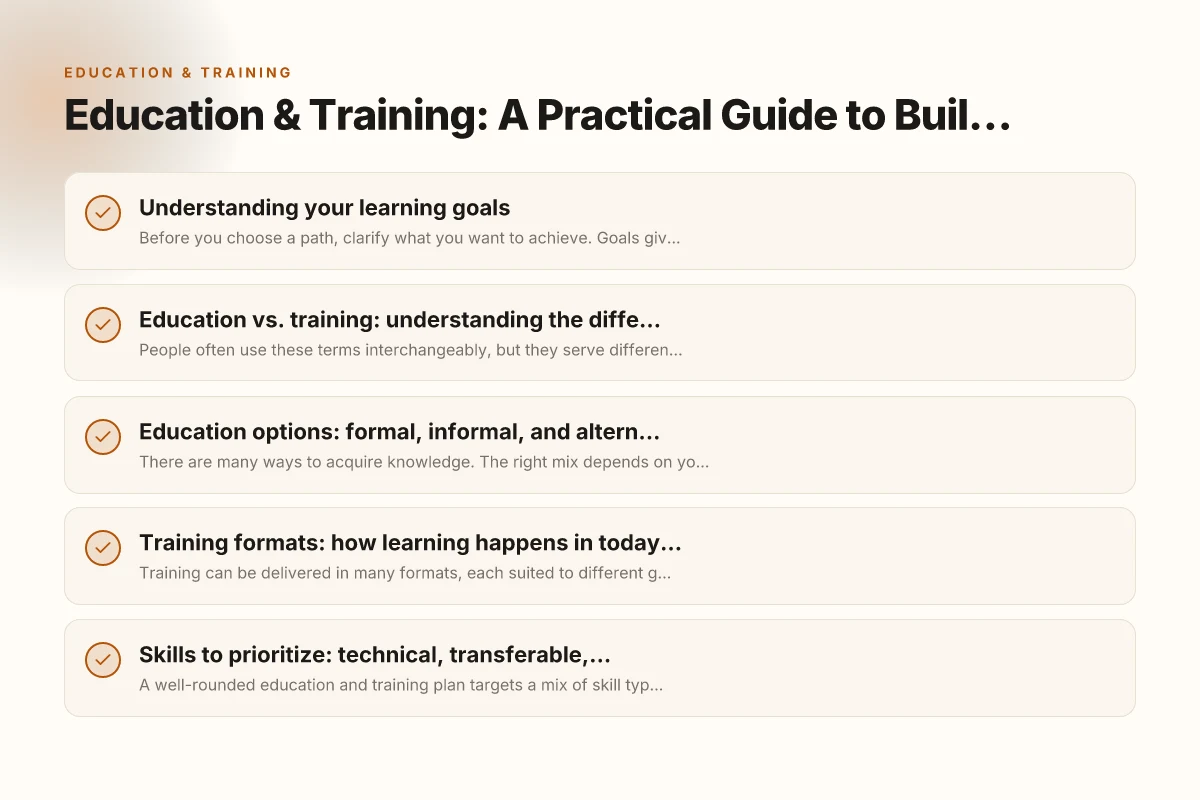
Education vs. training: understanding the difference
People often use these terms interchangeably, but they serve different purposes.
- Education
- Focuses on broad knowledge, critical thinking, and foundational concepts.
- Often delivered in schools, colleges, and universities.
- Provides transferable skills such as communication, analysis, and problem-solving.
- Training
- Concentrates on specific, practical skills needed for a job or task.
- Often delivered through workshops, bootcamps, online courses, or on-the-job programs.
- Emphasizes performance, efficiency, and applied knowledge.
A strong learning plan blends both: foundational education to understand context and theory, plus targeted training to apply skills promptly in work or life. Project Area: Understanding, Defining, and Managing Your Scope
Education options: formal, informal, and alternative pathways
There are many ways to acquire knowledge. The right mix depends on your goals, time, and resources.
- Formal education
- Degrees (Bachelor’s, Master’s, PhD)
- Diplomas and certificates from accredited institutions
- Pros: recognized credentials, structured learning, access to networks
- Cons: time-intensive and potentially expensive
- Informal education
- Self-directed study, reading, podcasts, and lectures
- Community courses, public library programs, and MOOCs
- Pros: flexible, low-cost, wide variety
- Cons: may lack formal recognition. Requires self-discipline
- Alternative pathways
- Apprenticeships, internships, and co-op programs
- Vocational training and industry certificates
- Micro-credentials, badges, and stackable certificates
- Pros: hands-on experience, rapid skill development, industry relevance
- Cons: may require networking and proactive job-seeking
- Choosing a path
- Start with core skills that are in demand in your field.
- Consider accreditation and the value of credentials in your target industry.
- Weigh time to completion, cost, and potential return on investment.
Education vs. training: understanding the difference
| Dimension | Education | Training | Key distinction | Typical outcome | Caveat |
|---|---|---|---|---|---|
| Purpose | Broad base knowledge | Practical skill-building | Education = theory + context; Training = hands-on | Foundational competence | Overlap exists |
| Pace | Slower, cumulative | Faster, task-based | Education deep, training focused | Versatile readiness | Both useful |
| Assessment | Exams, essays | Projects, simulations | Assessment type differs | Credentialed proof | Context matters |
| Setting | Institutions, classrooms | Workshops, on-the-job | Environment varies | Transferable or specialty | Hybrid models common |
| Duration | Months to years | Hours to months | Duration varies | Fit to goals | Plan accordingly |
Compiled November 2026; check the provider's site for current details.
Training formats: how learning happens in today’s world
Training can be delivered in many formats, each suited to different goals and constraints. Vision & Values: Aligning Strategy, Culture, and Impact
- Online courses
- Self-paced platforms, guided cohorts, live webinars
- Benefits: flexibility, scalability, access to global instructors
- In-person programs
- Workshops, bootcamps, and classroom-based training
- Benefits: social learning, immediate feedback, hands-on practice
- Blended learning
- Combines online modules with in-person sessions
- Benefits: balance of flexibility and accountability
- Microlearning
- Short, focused lessons, often 5–15 minutes each
- Benefits: easy to fit into a busy schedule, reinforces memory
- On-the-job training
- Real work tasks with coaching, shadowing, and mentoring
- Benefits: direct relevance, immediate application, builds workplace relationships
Skills to prioritize: technical, transferable, and adaptive
A well-rounded education and training plan targets a mix of skill types.
- Technical skills
- Industry-specific competencies: programming languages, data analysis, lab techniques, design tools
- Stay current with updates and best practices through continual learning
- Transferable skills
- Communication, collaboration, critical thinking, problem-solving, project management
- High value across roles and industries
- Adaptive and lifelong learning skills
- Ability to learn quickly, adapt to new tools, and stay curious
- Include time for reflection, evaluating outcomes, and adjusting plans
- Digital literacy and remote work readiness
- Proficiency with collaboration tools, cybersecurity awareness, and online etiquette
- Increasingly essential in many workplaces
Budgeting and planning your education journey
Financial and time planning reduces frustration and helps you sustain momentum.
- Create a learning budget
- Include tuition, materials, software, and potential travel.
- Consider free or low-cost options first. Invest in high-impact credentials only.
- Build a learning calendar
- Schedule regular study blocks. Set realistic milestones.
- Include buffers for life events and burnout prevention.
- Track return on investment (ROI)
- Estimate how a course or credential could lead to higher pay, a promotion, or new opportunities.
- Review outcomes after 3–6 months to adjust your plan.
A practical comparison: credential paths for common goals
| Goal | Path option | Typical duration | Typical cost | Pros | Cons |
|---|---|---|---|---|---|
| Get basic professional skills quickly | Short online certificates, micro-credentials | Weeks to a few months | Low to moderate | Fast entry, focused scope | May have limited recognition |
| Shift to a new field with credibility | Associate degree or professional diploma | 1–2 years | Moderate | Structured learning, recognized credentials | Time and cost investment |
| Advance to senior roles or academia | Master’s degree or PhD | 1–5+ years | High | Deep knowledge, research opportunities | Lengthy commitment, cost, uncertain ROI |
| Build hands-on trade skill | Apprenticeship or vocational certificate | 1–3 years | Moderate | Paid work while learning, job-ready | Regional availability varies |
| Develop broad leadership skills | MBA or leadership program | 1–2 years (full-time) or flexible | High | Strategic insight, networking | Not always specialized; cost/ROI varies |
This table helps you map goals to practical credential options. Remember that credentials are most effective when they align with clear career outcomes, rather than being pursued as an end in themselves.
Maximizing learning effectiveness: strategies that work
Learning happens best when it’s active, reflective, and supported by feedback. Social Auditing: What It Is, Why It Matters, and How to Do It Effectively
- Set SMART goals
- Specific, Measurable, Achievable, Relevant, Time-bound
- Break large goals into weekly or monthly milestones
- Practice deliberately
- Focus on core skills, with progressively challenging tasks
- Seek targeted feedback and adjust strategies accordingly
- Build a learning routine
- Regular, shorter sessions beat sporadic cram sessions
- Pair learning with accountability partners or study groups
- Apply learning in real tasks
- Create side projects, volunteer work, or simulations that use new skills
- Translate knowledge into tangible outputs and demonstrate value
- Seek mentorship and communities
- Mentors provide guidance, feedback, and opportunities
- Communities offer support, accountability, and shared resources
- Assess and reflect
- Regularly review what’s working, what isn’t, and why
- Adjust objectives and methods based on outcomes and interests
Education options: formal, informal, and alternative pathways
| Pathway | Structure | Credentialing | Access | Cost signal | Suitability |
|---|---|---|---|---|---|
| Formal degree | Structured program | Degree awarded | Broad admission | High | Traditional careers |
| Formal diploma | Accredited program | Diploma | Moderate access | Moderate | Trade and applied fields |
| Informal learning | Self-directed | None | High | Low | Quick upskilling |
| Bootcamps | Intensive programs | Certificates | Limited spots | Moderate | Tech and coding |
| Apprenticeships | Work+training | Certification | Employer-led | Shared cost | Skilled trades |
| Micro-credentials | Short courses | Certificates | Flexible | Low to moderate | Targeted skills |
| Alternative learning | Non-traditional | Varies | Open access | Varies | Creative paths |
Compiled November 2026; check the provider's site for current details.
The final recommendation: design your education & training plan with flexibility
Education and training should be a scaffold you can adapt over time, not a rigid ladder that might break if you stumble. Start with a clear goal and a realistic plan, then mix formal foundations with practical, on-the-job learning. Use a blend of online and offline formats that suit your life stage, budget, and learning style. Build in accountability mechanisms, mentors, peers, progress dashboards, and schedule regular reviews to adjust your path as needs evolve.
If you’re early in your journey, consider a entry-level certificate or micro-credential that unlocks opportunities while you continue exploring long-term goals. If you’re mid-career, map a credential path that aligns with your target role and provides measurable ROI within 18–36 months. If you’re pursuing personal growth, prioritize breadth and curiosity: diverse topics, broad literacy, and skills that improve adaptability. Programme Outcomes
In short, Education & Training are tools for unlocking your potential. With a thoughtful plan, diverse formats, and a steady practice routine, you can acquire meaningful skills, advance your goals, and enjoy the ongoing process of learning throughout your life.