Host Families: A Complete Guide to Welcoming Students, Travelers, and Exchange Guests
Learn how host families work, benefits, tips for a successful match, and how to navigate expectations and safety.
Host families offer a warm, hands-on way to experience a new culture. Whether hosting students for an exchange program, travelers on long or short stays, or guests visiting for work or study, the family environment can enrich learning, language practice, and personal growth. This guide explains what host families are, how they work, how to find a good match, and how to manage expectations for a positive experience on both sides.
Comparison of Hosting Models: Host Family vs. Other Accommodation Models
| Model | Typical Guest Pool | Interaction Level | Responsibilities | Typical Duration | Ideal For |
|---|---|---|---|---|---|
| Host Family (traditional) | Students, travelers, or guests | High | Full household etiquette, meals, chores | Short-term to long-term | Families hosting regardless of age |
| Homestay with Private Room | Students, travelers | Moderate | Shared spaces minimal; meals optional | Short-term | Guests seeking immersion with less hosting burden |
| Co-Living / Roommate-style | Travelers, digital nomads | Moderate to high | Shared chores; lease/agreements | Medium to long-term | Those seeking social living and flexibility |
| Traditional B&B / Guesthouse | Tourists, business travelers | Low to moderate | Cleaning, breakfast service | Short-term | Guests seeking hospitality-driven stay |
| Rental/Apartment via Platform | Any traveler | Low | Minimal interaction; host not involved | Short-term | Guests preferring privacy and autonomy |
Compiled November 2026; check the provider's site for current details.
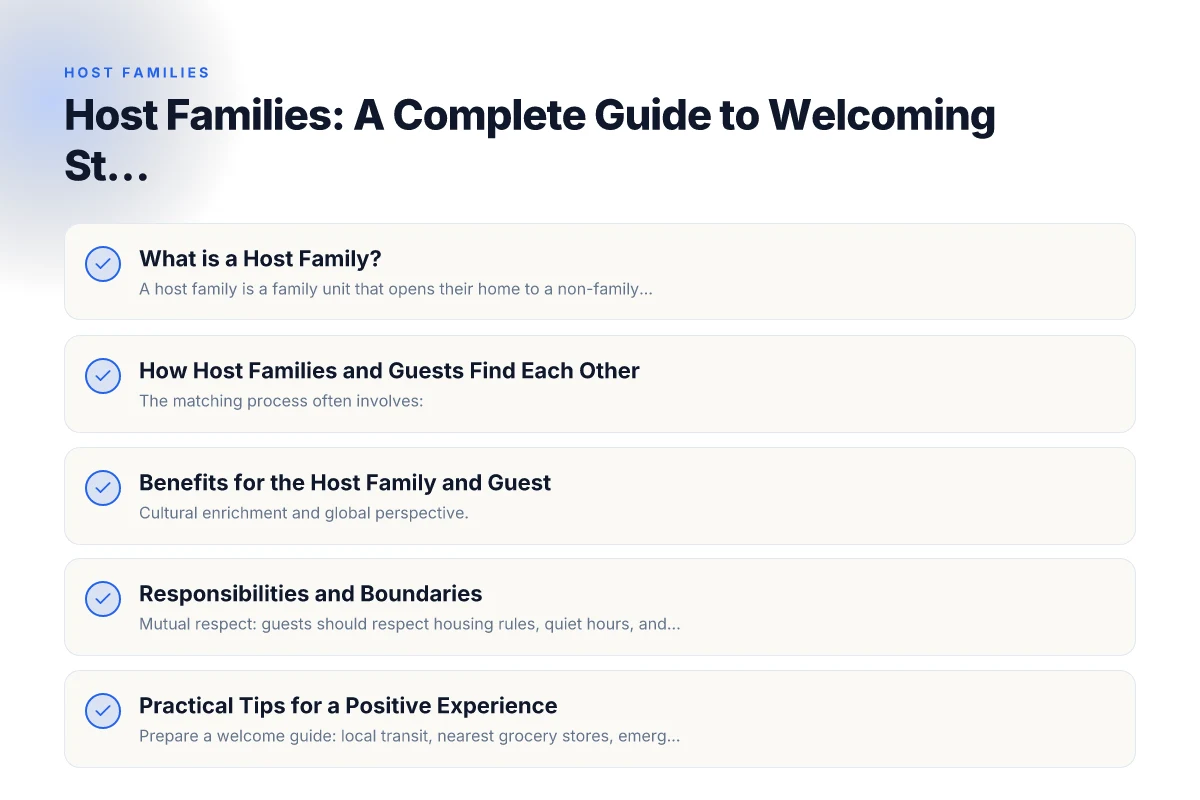
What is a Host Family?
Defining the concept
A host family is a family unit that opens their home to a non-family member for a defined period. The guest may be a student, exchange participant, traveler, or someone in need of temporary accommodation. The arrangement typically includes shared meals, household duties, and social interaction that fosters cultural exchange.
Common formats
- Homestay with students: language learning, immersion, and guided routines.
- Short-term homestays: for travelers or interns needing a place to live for weeks.
- Culture exchange families: focuses on learning about customs, celebrations, and daily life.
- Work or study accommodations: sometimes includes a workspace and local guidance.
How Host Families and Guests Find Each Other
Matching platforms and processes
The matching process often involves:
- Application submissions from both sides.
- Background checks and safety screenings.
- Interviews or trial introductions, either in person or virtual.
- Reference checks and home visits (where applicable).
- Agreements outlining house rules, duties, and expectations.
What to look for in a match
- Language goals and preferences (e.g., practice, formal study, or daily conversation).
- Dietary restrictions, accessibility needs, and cultural or religious considerations.
- Schedule compatibility and guest’s responsibilities.
- Desired level of independence versus guidance and supervision.
- House rules about guests, guests’ guests, and overnight visitors.
Benefits for the Host Family and Guest
For hosts
- Cultural enrichment and global perspective.
- Language practice and enhanced communication skills.
- Personal growth and a sense of giving back to the community.
- Opportunities for supplemental income or reciprocal hosting.
For guests
- Safe, affordable accommodation with local support.
- Real-world language immersion and cultural understanding.
- A sense of belonging and community during the stay.
- Access to local tips, transportation advice, and social networks.
Benefits for Host Family vs. Guest: Quick Snapshot
| Benefit | For Host Family | For Guest | Notes |
|---|---|---|---|
| Personal connection | Yes | Yes | Builds cultural exchange |
| Meals provided | Yes/optional | Yes/optional | Depends on arrangement |
| Local tips and safety | Yes | Yes | Host guidance enhances safety |
| Cost savings | Yes | Yes | Compared to hotels/local options |
| Privacy level | Moderate | Moderate to high | Depends on space and rules |
| Flexibility of stay | Yes | Yes | Varies by model |
Compiled November 2026; check the provider's site for current details. History: Understanding Its Scope, Types, and How It Shapes Our World
Responsibilities and Boundaries
Household roles and etiquette
- Mutual respect: guests should respect housing rules, quiet hours, and shared spaces.
- Privacy: hosts provide a private space and reasonable privacy expectations. Guests respect guest rooms.
- Meals and routines: if meals are shared, clarify who cooks, grocery shopping, and dietary needs.
- Safety and conduct: establish emergency plans, contact information, and acceptable activities.
Timeframes and contracts
- Start and end dates, check-in/out times, and extensions.
- Clear rules about guests’ guests, overnight stays, and curfews if applicable.
- Termination clauses or mediation steps if conflicts arise.
Practical Tips for a Positive Experience
Before the stay
- Prepare a welcome guide: local transit, nearest grocery stores, emergency contacts, and cultural norms.
- Set clear expectations: daily routines, meals, chores, internet use, and house rules.
- Discuss language goals: how much practice is desired and in what contexts.
During the stay
- Host check-ins: regular, gentle conversations to address concerns early.
- Guest involvement: invite guests to family meals or outings to build rapport.
- Respect boundaries: maintain a balance between inclusivity and guest privacy.
After the stay
- Feedback and debrief: discuss what worked well and what could be improved.
- References and future opportunities: offer mutual references or future hosting possibilities.
A Quick Comparison: Host Family vs. Other Accommodation Models
| Model | Pros | Cons | Ideal For |
|---|---|---|---|
| Host family | Rich cultural immersion, language practice, support system | Less privacy, living with a family schedule | Learners, travelers seeking immersion |
| Private rental | More privacy, flexibility, independence | Lacks cultural integration, higher cost | Solos, business travelers, longer stays |
| Dorm or campus housing | Easy access to peers, structured environment | Less personalized guidance, uniform setups | Students, group travelers |
| Guesthouse or apartment-sitter | Convenience, straightforward contracts | Variable quality, fewer cultural experiences | Short stays, travelers seeking reliability |
Safety, Compliance, and Best Practices
Staying safe as a host or guest
- Verify programs and references: use established organizations with clear safety policies.
- Personal information: share only necessary details with program coordinators and hosts.
- In-home safety: smoke detectors, emergency contacts, and secure locks on entry points.
- Insurance: ensure coverage for both host and guest in case of damage or accidents.
Navigating misunderstandings
- Document everything: agreements, dates, and agreed-upon rules in writing.
- Use formal channels: contact program coordinators or housing coordinators when issues arise.
- Mediation: involve a neutral mediator if conflicts persist.
Legal and cultural considerations
- Local housing laws: understand occupancy limits, tenant rights, and short-term rental rules.
- Cultural sensitivity: acknowledge different customs and etiquette to minimize friction.
- Dietary and accessibility needs: plan with inclusivity in mind.
How to Get Started: Step-by-Step
- Define your hosting goals: purpose, duration, and level of involvement.
- Gather essential information: living arrangements, house rules, and available spaces.
- Choose a program or platform: research organizations with solid safety records and transparent processes.
- Complete the screening: background checks, interviews, and reference checks.
- Prepare your home and welcome plan: safety checks, welcome guide, and first-week check-ins.
- Match and onboard: meet in person or virtually, set expectations, sign agreements.
- Ongoing support: maintain open communication, address concerns promptly, and celebrate milestones.
Responsibilities and Boundaries in Hosting
| Area | Host Responsibilities | Guest Expectations | Boundaries / Rules | Provisions (yes/no) |
|---|---|---|---|---|
| House rules | Provide and explain | Follow | Clear in advance | Yes |
| Meals | Coordinate or provide | Receive or self-serve | Dietary needs respected | Yes |
| Cleaning | Shared or assigned tasks | Keep common areas tidy | Defined chores | Yes/No as arranged |
| Privacy | Provide private spaces | Respect others’ space | Quiet hours | Yes |
| Guests/visitors | Permit or monitor | Inform | Overnight guest limits | Yes/No as arranged |
Compiled November 2026; check the provider's site for current details.
The Recommendation: Is Hosting Right for You?
If you value cultural exchange, language learning, and helping someone feel at home in a new place, hosting can be deeply rewarding. It’s not just about providing a bed. It’s about offering a supportive environment that fosters growth for both sides. The best host families are those that plan thoughtfully, communicate clearly, and remain flexible as needs evolve. If you’re willing to invest time to build trust, set boundaries, and stay engaged, hosting can be a meaningful and sustainable experience for years to come.