job type finance officer(2026)
A comprehensive guide to the Finance Officer job type, covering responsibilities, skills, and career progression.
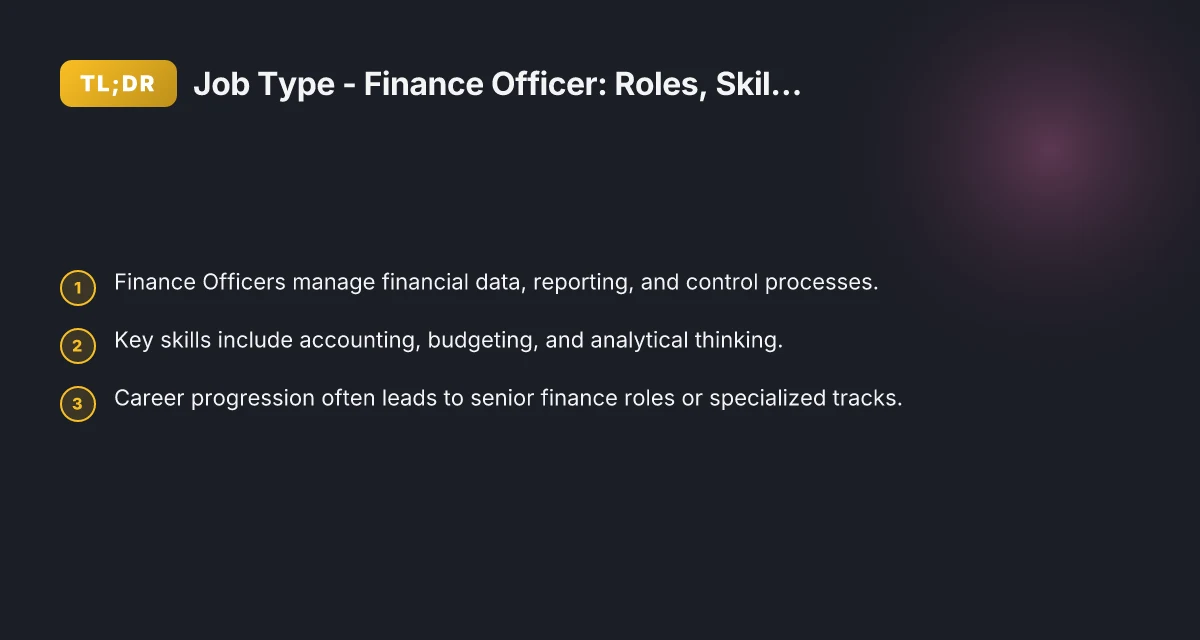
Finance Officer is a pivotal job type in many organizations, bridging day-to-day financial operations with strategic fiscal oversight. Whether you’re exploring this role for the first time or mapping a career path, understanding what Finance Officers do, the skills they need, and how the role evolves will help you make informed decisions. This article breaks down the core responsibilities, required competencies, typical work settings, and growth opportunities associated with the Finance Officer job type.
Comparison of Core Responsibilities across Finance Officer roles
| Role Focus | Primary Duties | Decision Impact | Typical Timeframe | Examples (contexts) |
|---|---|---|---|---|
| General Finance Officer | Financial reporting, budgeting, cash flow monitoring | Moderate | Monthly/quarterly | SMEs, nonprofits, corporate finance teams |
| Senior Finance Officer | Policy compliance, risk management, audit coordination | High | Quarterly/annually | Large enterprises, regulated industries |
| Treasury-Focused Officer | Cash management, forecasting, liquidity planning | High | Daily/weekly | Banks, manufacturing, retail |
| Controller-leaning Officer | GAAP adherence, internal controls, close process | High | Monthly | Public companies, shared services |
| Compliance/Regulatory Officer | regulatory filings, tax compliance, due diligence | Moderate | Annually | Multinational firms, NGOs |
Compiled November 2026; check the provider's site for current details.
What a Finance Officer does
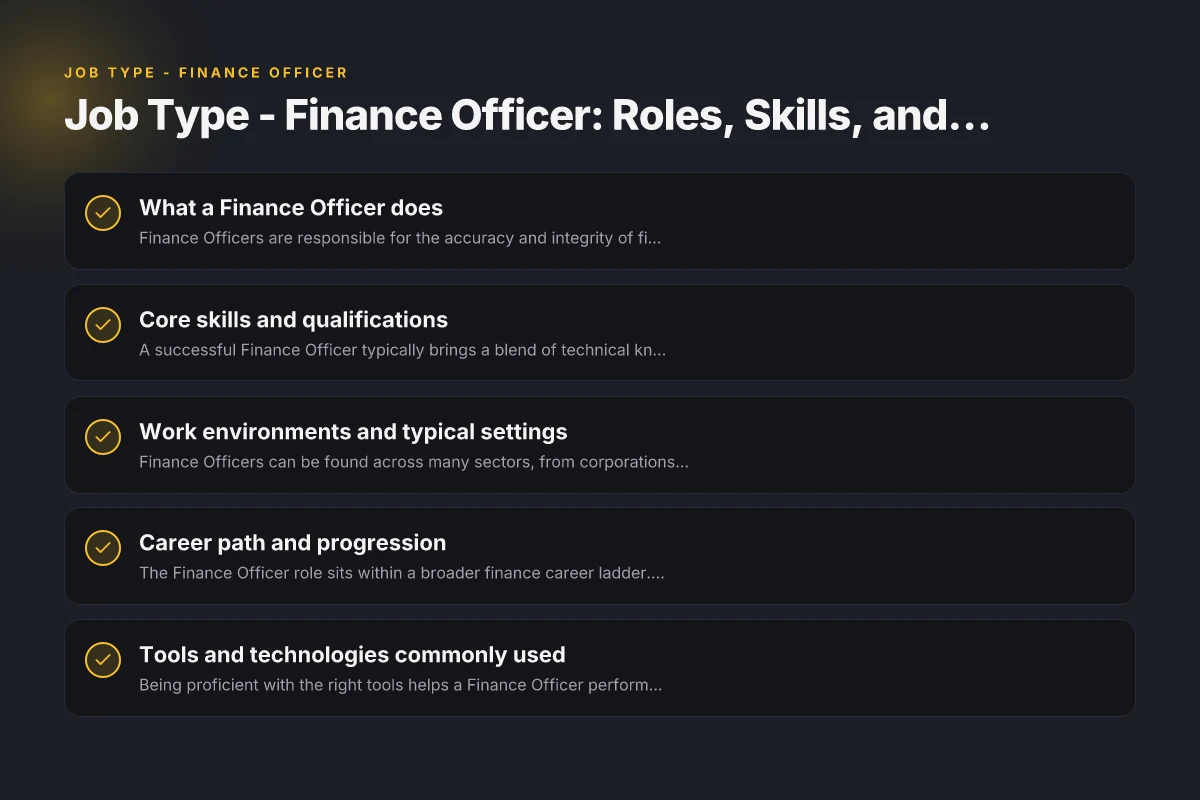
Finance Officers are responsible for the accuracy and integrity of financial information, ensuring that records reflect the true state of the organization’s finances. Their work supports decision-making, compliance, and financial control.
Typical responsibilities include:
- Recording transactions in ledgers and financial software
- Preparing periodic financial statements and reports
- Monitoring cash flow, accounts receivable, and accounts payable
- Assisting with budgeting and forecasting processes
- Reconciling bank statements and intercompany accounts
- Supporting audits and ensuring regulatory compliance
- Implementing internal controls to prevent errors and fraud
- Collaborating with other departments to interpret financial data
The exact mix of duties can vary by organization size, industry, and whether the role is more junior or senior. In smaller teams, a Finance Officer may handle a broader range of tasks, while in larger organizations, the role might be more specialized or supervisory.
Core skills and qualifications
A successful Finance Officer typically brings a blend of technical know-how and professional judgment. The following areas are most important: fold housing(2026)
Technical accounting and finance
- Proficiency with accounting software (e.g., SAP, Oracle, NetSuite, QuickBooks)
- Strong understanding of double-entry bookkeeping, GL management, and chart of accounts
- Knowledge of financial statements (income statement, balance sheet, cash flow)
- Familiarity with internal controls, reconciliations, and journal entries
- Basic tax and regulatory awareness relevant to the organization’s location
Financial analysis and reporting
- Ability to interpret financial data and provide actionable insights
- Experience with budgeting, variance analysis, and forecasting
- Competence in generating management reports and dashboards
- Attention to detail and accuracy in numerical work
Compliance and governance
- Understanding of applicable laws, standards (e.g., IFRS or local GAAP), and auditing practices
- Awareness of risk management, anti-fraud controls, and data privacy considerations
Soft skills
- Communication: translating financial information into clear messages for non-finance colleagues
- Collaboration: working with departments across the organization
- Problem-solving: identifying issues and proposing practical solutions
- Time management: meeting reporting deadlines and processing timelines
- Adaptability: adjusting to changing regulations, systems, or processes
Educational and certification steps
- A bachelor’s degree in finance, accounting, or business administration is common
- Some roles prefer or require professional qualifications (e.g., CPA, ACCA, CIMA)
- Continuous professional development (CPD) is valued to stay current
Work environments and typical settings
Finance Officers can be found across many sectors, from corporations and government agencies to nonprofits and education institutions. The day-to-day environment varies by sector:
- Corporate finance in medium-to-large firms often emphasizes controls, reporting cycles, and cross-functional collaboration
- Nonprofits may focus on grant accounting, fund tracking, and donor reporting
- Public sector roles may involve compliance with government accounting standards and tighter procurement rules
- Startups or small businesses may require broader responsibilities and faster turnaround on cash management
Work hours can be regular with peak periods around month-end, quarter-end, or fiscal-year close. Some roles involve ad-hoc financial projects, audits, or system upgrades.
Core Skills and Qualifications by Competency Type
| Competency Type | Specific Skill | Certification / Qualification | Proficiency Level (general) | Career impact | Typical roles |
|---|---|---|---|---|---|
| Technical | Financial accounting, budgeting | CPA, ACCA, CIMA | Proficient | Medium | Accountant, Financial Analyst, Officer |
| Analytical | Variance analysis, forecasting | CMA, CFA | Proficient | High | Analyst, Controller |
| Tools | ERP (SAP/Oracle), Excel modeling | ERP user, Excel expert | Proficient | Medium | Financial Officer, Controller |
| Compliance | Tax rules, regulatory reporting | CPA, Tax qualification | Basic to Proficient | Medium | Compliance Officer, Finance Officer |
| Communication | Stakeholder reporting, negotiation | MBA optional | Proficient | Medium | FP&A, Finance Officer, CFO support |
Compiled November 2026; check the provider's site for current details. fold(2026)
Career path and progression
The Finance Officer role sits within a broader finance career ladder. Typical progression might look like this:
- Entry-level: Junior Finance Officer, Accounts Assistant, or Finance Administrator
- Mid-level: Finance Officer, Senior Finance Officer, or Financial Analyst
- Senior-level: Finance Manager, Controller, or Head of Finance
- Specialist tracks: Tax Specialist, Treasury Manager, Internal Controls Specialist, or Audit Lead
advancement often depends on a combination of demonstrated technical skill, reliability in reporting, and the ability to contribute to strategic decisions. Gaining certifications, expanding system experience, and taking on cross-functional projects can accelerate progression.
Table: Typical responsibilities by level
| Level | Core responsibilities | Focus areas |
|---|---|---|
| Entry (Junior) | Data entry, reconciliations, basic reporting | Accuracy, process adherence |
| Mid (Officer/Analyst) | Budgeting support, variance analysis, financial reports | Analysis, communication across teams |
| Senior (Manager/Lead) | Consolidated reporting, team oversight, process improvement | Strategy alignment, controls, mentorship |
| Executive (Head) | Financial strategy, risk management, stakeholder communication | Vision, governance, external relations |
Tools and technologies commonly used
Being proficient with the right tools helps a Finance Officer perform more effectively. Common software and platforms include:
- Enterprise Resource Planning (ERP) systems: SAP, Oracle NetSuite, Microsoft Dynamics
- Accounting software: QuickBooks, Xero, SAGE
- Spreadsheet mastery: advanced Excel/Google Sheets (pivot tables, vlookups, macros)
- Business intelligence: Power BI, Tableau, or similar dashboards
- Document and workflow tools: OCR capture, document management systems, approval workflows
- Compliance and tax software depending on region
Automation and data integrity tools are increasingly part of the role, reducing manual entry and improving reporting speed. job type finance clerk(2026)
Common challenges and how to overcome them
Finance Officers face a mix of routine tasks and evolving requirements. Here are some common challenges and practical approaches:
- Challenge: Tight reporting deadlines
- Strategy: Build standardized templates, automate recurring tasks, and maintain a calendar of close processes.
- Challenge: Data quality issues
- Strategy: Enforce validation checks, establish a clean-reconciliation routine, and collaborate with IT for data governance.
- Challenge: Regulatory changes
- Strategy: Subscribe to regulatory updates, participate in CPD, and implement changes through controlled processes.
- Challenge: Cross-functional communication gaps
- Strategy: Develop concise management reports, hold regular liaison meetings, and translate financial concepts into business terms.
- Challenge: Capacity constraints in small teams
- Strategy: Prioritize tasks, document processes, and seek opportunities to streamline workflows with automation.
The value a Finance Officer brings to an organization
A Finance Officer plays a critical role in safeguarding financial health and enabling informed decision-making. Their value stems from:
- Accurate financial data: Reliable numbers inform budgeting, forecasting, and strategy.
- Strong controls: Prevents errors and fraud, preserving assets and compliance.
- Timely reporting: Supports management oversight and external stakeholder confidence.
- Collaboration: Bridges finance with operations, sales, and leadership to improve efficiency.
- Adaptability: Responds to regulatory changes, system upgrades, and business pivots.
Is the Finance Officer job type right for you?
Consider these self-assessment questions:
- Do you enjoy meticulous, numbers-driven work with a focus on accuracy?
- Are you comfortable working with financial software and data analysis tools?
- Do you like working with multiple departments and explaining financial concepts clearly?
- Are you motivated by processes, controls, and governance, as well as opportunities to learn and grow?
- Can you handle deadlines and adapt to changing regulatory or business needs?
If you answered yes to these questions, the Finance Officer job type could be a strong fit. It offers a solid foundation in accounting and financial management, with clear pathways to leadership roles and specialized tracks. job type finance assistant(2026)
Practical tips for landing a Finance Officer role
- Build a strong resume that highlights: software proficiency, reconciliation experience, budgeting support, and reporting capabilities.
- Prepare for interviews by articulating how you improved a process, reduced errors, or contributed to a successful audit.
- Demonstrate your ability to work with non-finance colleagues by giving examples of cross-functional collaboration.
- Highlight certifications and CPD activities, even if they are self-study or short courses.
- Gather references from supervisors who can speak to your reliability, accuracy, and teamwork.
Work Environments and Settings Comparison
| Setting | Typical Environment | Remote/In-office Balance | Collaboration Focus | Pace | Example Settings |
|---|---|---|---|---|---|
| Corporate Finance | Office, finance dept | Mixed | Cross-functional | Moderate to fast | Global companies |
| Nonprofit | Office, finance team | Mixed | Donor and grant reporting | Moderate | NGOs, foundations |
| Public Sector | Government offices | In-person | Compliance-heavy | Steady | Municipal agencies |
| Private Practice / Consulting | Client sites, office | Flexible | Diverse client teams | Fast | Accounting firms, consultancies |
| Manufacturing | Site + office | Hybrid | Operations + finance | Moderate | Industrial firms |
Compiled November 2026; check the provider's site for current details.
Final recommendation
If you’re aiming for a role that blends precision, analysis, and business impact, the Finance Officer job type is an excellent choice. It provides hands-on experience with the core mechanics of finance while offering a clear ladder toward strategic leadership. Focus on strengthening your technical base, expanding your reporting and forecasting skills, and building your communication and collaboration abilities. With dedication and ongoing learning, you can progress from a solid Finance Officer to influential finance leadership positions.