Job Type - Youth Worker
A practical guide to what a youth worker is, typical duties, skills, and career pathways.
Youth work is a people-centered career focused on helping young people navigate the challenges of adolescence and early adulthood. A youth worker builds trusting relationships, plans engaging activities, and connects youths with resources and opportunities. This article outlines what a youth worker does, the typical job types within the field, essential skills, required qualifications, and practical steps to start or advance a career in youth work.
Compare Youth Worker Roles at a Glance
| Role | Typical Setting | Primary Focus | Required Experience | Notes |
|---|---|---|---|---|
| Youth Support Worker | Community centers, NGOs | Casework, mentoring | Moderate (1-3 yrs) | May require driving; background checks common |
| School Youth Worker | Schools, colleges | Student wellbeing, referrals | Moderate to extensive | Often with teaching or counseling focus |
| Outreach / Field Youth Worker | Outreach programs, camps | Fieldwork, engagement | Moderate | Travel often; flexible hours |
| Residential Care Worker | Youth homes, shelters | Daily living support | Moderate to high | 24/7 shifts possible; safety training needed |
Compiled November 2026; check the provider's site for current details.
What is a Youth Worker?
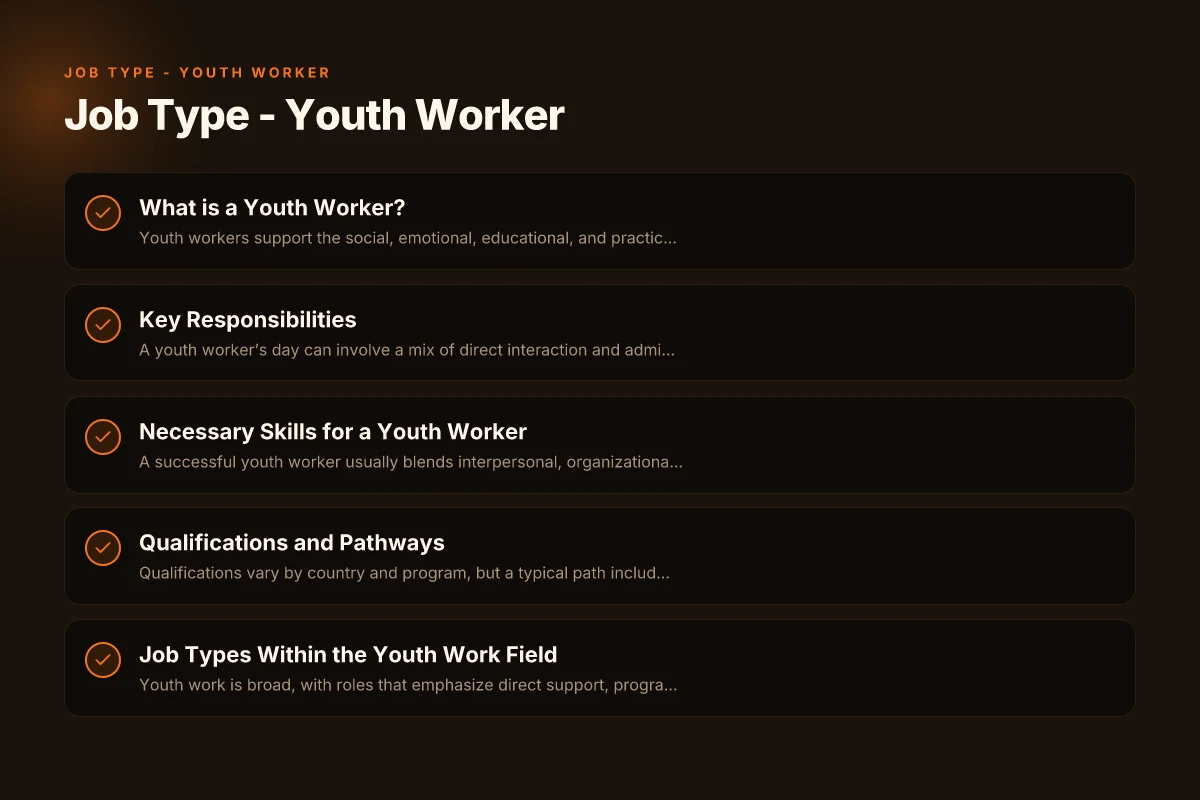
Youth workers support the social, emotional, educational, and practical needs of young people, usually aged 12 to 25, depending on the program and country. They often work in community centers, schools, charities, government agencies, or faith organizations. The core aim is to empower youth to make healthy choices, develop resilience, and participate actively in their communities.
Common settings
- Community centers and youth clubs
- Schools and after-school programs
- Child protection and welfare services
- Nonprofit organizations focused on youth development
- Residential facilities and youth employment programs
- Mentoring and support services, including LGBTQ+ or faith-based programs
Typical roles within the field
- Detached youth worker: engages with young people in their own neighborhoods and on the streets.
- Outreach worker: connects with hard-to-reach youths, delivering programs and resources.
- School-based youth worker: supports students within the school environment.
- Program coordinator or facilitator: leads workshops, activities, and group sessions.
- Caseworker or social care support: helps with safeguarding, referrals, and welfare concerns.
- Project worker: develops and runs specific initiatives (e.g., substance abuse prevention, employability programs).
Key Responsibilities
A youth worker’s day can involve a mix of direct interaction and administrative tasks. Responsibilities often include:
- Building trusting relationships with young people through listening, empathy, and non-judgmental support.
- Planning and delivering engaging activities, workshops, and group sessions.
- Providing information, guidance, and advocacy to access education, employment, housing, or health services.
- Monitoring safety and safeguarding, including risk assessment and reporting concerns.
- Maintaining records, writing reports, and coordinating with schools, families, and partner organizations.
- Facilitating peer mentoring and leadership opportunities to develop young people’s skills.
- Running outreach sessions in the community or online to reach diverse youth populations.
Necessary Skills for a Youth Worker
A successful youth worker usually blends interpersonal, organizational, and practical skills. Core competencies include:
- Communication: clear speaking and active listening, ability to adapt to different youths and contexts.
- Empathy and non-judgmental attitude: making young people feel valued and heard.
- Safeguarding and risk assessment: understanding how to protect young people and respond to concerns.
- Facilitation and group management: planning activities, guiding discussions, and managing dynamics.
- Cultural competence and inclusivity: respecting diverse backgrounds and identities. -Problem-solving and decision-making: handling crises, offering options, and supporting choices.
- Administrative skills: record-keeping, reporting, and coordinating services.
- Collaboration: working with families, schools, and community services.
- Patience and resilience: persevering through challenging behaviors or slow progress.
Qualifications and Pathways
Qualifications vary by country and program, but a typical path includes a combination of education, training, and practical experience. Victim Support NI: Help, rights, and services in Northern Ireland
Common entry routes
- Certificate or diploma in youth work, community development, or a related field.
- Bachelor’s degree in youth work, social work, psychology, education, or community development.
- Apprenticeships or supervised practice programs that combine work and study.
Certifications that help
- Safeguarding and child protection training
- First aid and emergency response
- Mental health awareness and crisis intervention
- Anti-bullying and peer mentoring programs
- Disability awareness and inclusive practice
- Substance misuse awareness (where relevant to your role)
Experience that counts
- Volunteering with youth groups, sports coaches, or mentoring programs
- Internships in schools, charities, or social services
- Participation in community outreach or after-school clubs
- Event planning or program facilitation experience
Credentials to research
- Local licensing or registration requirements for youth workers
- Sector-specific qualifications for child protection or safeguarding
- Employer prerequisites for roles in schools or government-funded programs
Skills vs. Roles Matrix
| Skill / Competency | Essential Across Roles | Strongly Valuable | Training Often Required | Typical Certification | Notes |
|---|---|---|---|---|---|
| Communication | Yes | Yes | Yes | Varies | Clear, empathetic tone |
| Boundaries & Ethics | Yes | Yes | Yes | Confidentiality important | |
| Crisis Intervention | Helpful | Yes | Sometimes | Varies | De-escalation skills key |
| Case Management | Helpful | Yes | Often | Documentation required | |
| Cultural Competence | Yes | Yes | Yes | Inclusive practice |
Compiled November 2026; check the provider's site for current details.
Job Types Within the Youth Work Field
Youth work is broad, with roles that emphasize direct support, program design, or policy influence. Here are several common job types:
Direct support and mentoring
- Youth Worker: engages with individuals and groups, runs activities, and provides guidance.
- Outreach Worker: meets youths where they are, often in public spaces or online platforms.
- Personal Development Coach: focuses on skill-building, confidence, and goal setting.
Program design and delivery
- Program Facilitator: designs and delivers workshops, training sessions, and group activities.
- Project Coordinator: oversees specific youth programs, monitors outcomes, and coordinates staff.
- Activity Coordinator: organizes events, trips, and experiential learning opportunities.
Education and school-based roles
- School Support Worker: assists students within the school setting, supports wellbeing initiatives.
- Attendance or Welfare Officer: focuses on engagement and safeguarding, often in collaboration with school staff.
- Transition Advisor: helps youths move from school to further education or work.
Policy, advocacy, and research
- Youth Policy Advisor: analyzes needs, develops recommendations, and liaises with government or NGOs.
- Research Assistant: collects data on youth issues to inform programs and funding decisions.
- Advocacy Coordinator: mobilizes youth voices and coordinates campaigns or campaigns to improve services.
Specialist areas
- Substance misuse prevention and intervention
- Mental health and wellbeing support
- LGBTQ+ youth programs and inclusive practice
- At-risk youth and safeguarding response
- Employment readiness and apprenticeships
Career Pathways and Progression
Starting as a youth worker can lead to broader roles in community development, education, or social services. Consider these progression avenues: Organisation - Voluntary Service Belfast
- Raise responsibilities within your organization: lead a team, design new programs, or manage budgets.
- Specialize in a field: mental health support, safeguarding, disability services, or employment readiness.
- Move into supervisory or management roles: program manager, team leader, or service coordinator.
- Transition to related professions: social work, counseling, education, or policy research.
- Pursue further study: bachelor’s or master’s degrees in social work, education, youth development, or public health.
Salary Expectations and Job Market
Salaries for youth workers vary by country, region, setting, and experience. Entry-level roles often pay modestly but increase with qualifications and responsibility. Some regions offer salary scales tied to public sector or non-profit funding, while others depend on grant-based programs. Benefits can include professional development opportunities, supervision, and a chance to contribute meaningfully to young people’s lives.
Job prospects tend to be strongest where there is a focus on youth wellbeing, education, and community development. In many places, demand grows as services adapt to youth mental health needs, safeguarding requirements, and transitions from education to work.
Pathways and Qualifications Table
| Pathway | Typical Education | Relevant Certifications | Entry Level Availability | Advancement Path | Notes |
|---|---|---|---|---|---|
| Certificate in Youth Work | Certificate or Diploma | First Aid, Safeguarding | High | Supervisor roles | Shortest route |
| Diploma in Youth Work | Diploma | Counseling, Mental Health | Moderate | Senior practitioner, Coordinator | Balanced depth |
| Bachelor’s in Social Work/Youth Work | Bachelor's | Social Work license | Moderate | Program manager, Lead youth worker | Widens scope |
| Master’s in Youth Work / Social Services | Master’s | Child & Adolescent Mental Health | Lower | Program director | highest qualification |
Compiled November 2026; check the provider's site for current details. Job Type - Volunteers
Key Challenges and Rewards
- Challenges: high caseloads, exposure to safeguarding risks, administrative burdens, irregular hours, and emotional strain.
- Rewards: seeing young people grow, building lasting relationships, contributing to community well-being, and developing a versatile skill set.
Practical Steps to Become a Youth Worker
If you’re considering a career as a youth worker, here’s a practical roadmap:
- Explore the field: read about different roles, talk to current youth workers, and attend local information sessions.
- Volunteer or intern: gain hands-on experience with youth groups, after-school clubs, or community programs.
- Choose a qualification path: decide whether a certificate, diploma, or degree aligns with your goals and the requirements in your area.
- Obtain essential training: safeguarding, first aid, and mental health awareness are highly valuable.
- Apply for entry roles: look for job titles like youth worker, outreach worker, or program facilitator.
- Seek supervision and mentorship: many roles include supervision to support your professional development.
- Build a portfolio: document activities, workshops you’ve run, and outcomes you’ve helped achieve.
- Continue learning: pursue specialized training (e.g., trauma-informed practice, youth mentoring, or digital youth work).
Salary, Demand & Job Market Snapshot
| Item | Entry | Mid | Senior | Demand Trend | Notes |
|---|---|---|---|---|---|
| Salary (USD) | 35k-40k | 40k-50k | 50k-65k | Growing | Region dependent |
| Job Outlook | Moderate | Steady | Positive | Increasing | Demand in schools & communities |
| Benefits | Often | Often | Yes | Stable | Pension, leave varies |
| Job Stability | Moderate | Good | High | Generally favorable | Union presence possible |
| Advancement Opportunities | Limited | Moderate | High | Strong | Leadership roles |
Compiled November 2026; check the provider's site for current details.
Table: Compare Common Youth Worker Roles
| Role | Primary Focus | Typical Setting | Key Skills Emphasized |
|---|---|---|---|
| Youth Worker | Direct support and relationship-building | Community centers, charities, schools | Communication, safeguarding, facilitation |
| Outreach Worker | Reaching hard-to-engage youths | On the street, online, community events | Outreach, adaptability, risk assessment |
| Program Facilitator | Designing and delivering workshops | Schools, youth clubs, nonprofits | Planning, presentation, group management |
| Project Coordinator | Managing a specific program from start to finish | NGOs, local government, education settings | Leadership, budgeting, reporting |
| School Support Worker | Supporting students’ wellbeing in school | Primary and secondary schools | Collaboration, casework, safeguarding |
Final section: Recommendation If you want a rewarding, impact-driven career that centers on helping young people develop, a youth worker role is a strong fit. Start by gaining hands-on experience through volunteering or internship, then pursue a qualification that matches your region’s requirements. Build a broad skill set, communication, safeguarding, and program facilitation, while seeking opportunities to specialize in an area you care about, such as mental health, employability, or inclusion. Stay curious, patient, and resilient, and continuously seek professional development to advance in the field. Organisation - Volunteer Development Agency