Management Structures: How to Choose and Implement Effective Organizational Frameworks

A practical guide to understanding management structures and how to choose and implement the right one for your organization.
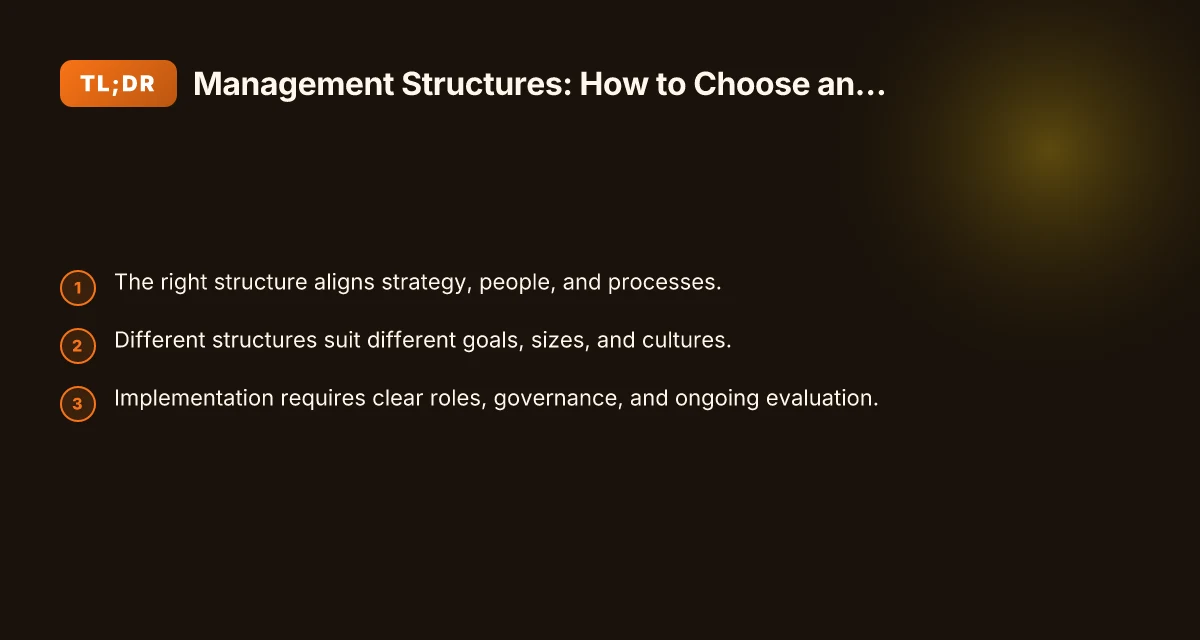
Management structures define how authority, information, and work flow through an organization. They shape decision speed, accountability, and collaboration. Choosing the right structure isn’t about following a trend. It’s about matching your strategic objectives, size, and culture to a framework that can scale and adapt. Below is a practical guide to understanding common structures, when to use them, and how to implement them effectively.
Comparison of common management structures by fit and characteristics
| Structure | Degree of centralization | Span of control (typical) | Flexibility for change | Pros | Cons |
|---|---|---|---|---|---|
| Functional | Centralized | Narrow to moderate | Low | Deep expertise; clear discipline | Silos; slow cross-functional work |
| Divisional (by product/region) | Decentralized | Moderate to wide | Moderate | Clear accountability; market focus | Duplication of functions; coordination cost |
| Matrix | Shared | Moderate to wide | Moderate to high | Cross-functional collaboration; agile | Role ambiguity; power struggles |
| Flat / horizontal | Low | Broad (team wide) | High | Fast decision making; empowerment | Limited depth; scaling challenges |
| Holacracy / self-management | Minimal hierarchy | N/A; team-based | High | Autonomy; rapid iteration | Governance overhead; clarity needed |
| Network / modular | Loose center; partner-led | Variable | High | Distributes work; scalable | Dependence on partners; alignment risk |
Compiled November 2026; check the provider's site for current details.
What is a management structure?
A management structure outlines how roles, responsibilities, and reporting relationships are arranged within an organization. It answers questions like:
- Who makes decisions on strategy, budgets, and operations?
- How does information move from front-line staff to leadership?
- How are teams grouped, and how do cross-functional efforts occur?
Common structures include functional, divisional, matrix, flat, and network structures. Each has trade-offs in speed, clarity, and collaboration.
Why structure matters
- Clarity: Clear roles reduce duplication and conflict.
- Accountability: Defined reporting lines make ownership visible.
- Agility: The right structure supports quick decisions and adaptation.
- Communication: Structured channels improve the flow of information.

Common management structures and when to use them
Functional structure
- What it is: Departments organized by specialized functions (e.g., Marketing, Finance, Operations).
- Best for: Stable environments with clear economies of scale, deep expertise, and strong functional leadership.
- Pros: Clear career paths within functions, deep technical excellence, strong efficiency.
- Cons: Siloes, slower cross-functional collaboration, potential misalignment with product or customer needs.
Divisional structure
- What it is: Semi-autonomous divisions centered around products, regions, or markets.
- Best for: Large, diverse portfolios or geographically dispersed operations.
- Pros: Faster decision-making at the division level, better customer focus, clearer P&L accountability.
- Cons: Duplication of resources, potential inconsistencies across divisions, higher overhead.
Matrix structure
- What it is: A blend of functional and project/product focus, with dual reporting lines.
- Best for: Organizations that require cross-functional collaboration on multiple projects.
- Pros: Resource flexibility, broad collaboration, balanced expertise.
- Cons: Reporting confusion, potential power struggles between managers, heavier governance needs.
Flat (or horizontal) structure
- What it is: Few levels of management, broader spans of control.
- Best for: Startups, small to medium teams, culture-driven environments.
- Pros: Fast decision-making, strong employee empowerment, high transparency.
- Cons: Overburdened managers, potential role ambiguity, scalability challenges.
Network/lean structures
- What it is: Core team coordinates a flexible set of external partners and contractors.
- Best for: Firms prioritizing speed and specialization, limited fixed headcount.
- Pros: Scalability, cost efficiency, focus on core capabilities.
- Cons: Dependency on partners, complex governance, IP/security considerations.
How to choose the right structure
- Define strategy and constraints
- Identify core priorities: speed, scale, product focus, customer intimacy.
- Assess culture: risk tolerance, collaboration style, decision-making norms.
- Consider size and growth trajectory: how quickly you plan to scale and add functions.
- Map work and decision rights
- List key decision domains: strategy, budgets, product, people, and risk.
- Decide who makes each decision and where approvals flow.
- Consider interdependencies and cross-functional needs.
- Evaluate governance needs
- How will you handle conflicts, escalations, and policy enforcement?
- What reporting cadence and metrics matter most?
- What systems are needed for visibility (OKRs, dashboards, project management)?
- Plan for evolution
- Most organizations evolve from one structure to another as they grow.
- Build in flexibility: allow for temporary project-based teams or hybrid models during transitions.
Decision criteria to match structures to organizational context
| Criterion | Very suited | Suited | Neutral | Unsuitable | Strong caveats |
|---|---|---|---|---|---|
| Company size (employees) | 100–500 | 50–1500 | Growth trajectory matters | ||
| Industry pace | Fast-moving | Moderate | Slow | Requires adaptability | |
| Geographic spread | Centralized HQ | Regional hubs | Global dispersed | Coordination needs | |
| Core product type | Single product | Portfolio | Custom solutions | Integration complexity | |
| Customer alignment | Product-driven | Market-driven | Function-driven | Requires cross-functional teams | |
| Change capacity | High | Moderate | Low | Change management capability | |
| Talent availability | Deep specialists | Generalists | Mixed | Hiring market effects |
Compiled November 2026; check the provider's site for current details. NORTHERN IRELAND POST QUALIFYING
A practical framework for choosing
| Context | Suggested structure | Key signals |
|---|---|---|
| Small, founder-led with a single product | Flat or lightweight functional | Need for fast decisions, strong founder involvement |
| Product-centric startup with multiple offerings | Matrix or product-focused divisional | Cross-functional speed, diverse product teams |
| Large company with clear product lines and regions | Divisional or hybrid (functional plus product) | Clear P&L ownership, regional autonomy |
| High coordination across functions and projects | Matrix with formal governance | Complex initiatives, frequent changes in scope |
| Core services with outsourcing or contractors | Network/lean structure | Scalability, cost control, tight partner governance |
Roles and governance in common structures
- Functional: CEO or general manager, function heads (CFO, CMO, COO), team leads.
- Divisional: Divisional heads, functional still present within divisions, centralized shared services.
- Matrix: Project/product managers and functional managers share oversight. A clear RACI helps delineate accountability.
- Flat: Leadership team or founders. Team leads for domains. Aim for consensus-based decisions.
- Network: Core executive team plus partner managers, vendor governance, and a centralized coordination function.
RACI helps here
RACI stands for Responsible, Accountable, Consulted, Informed. It’s a simple tool to map who does what in a structure, reducing confusion during transitions or ongoing operations.
Managing a transition to a new structure
- Communicate a clear why
- Explain the strategic reasons for change, expected benefits, and the timeline.
- Acknowledge concerns about role changes, reporting lines, and job security.
- Design with people in mind
- Map roles to outcomes, not just titles.
- Create new career pathways and development plans aligned with the new structure.
- Establish decision rights and governance early
- Draft organograms, decision matrices, and escalation paths.
- Set up governance rituals: quarterly reviews, cross-functional forums, and dashboards.
- Pilot and iterate
- Start with a pilot team or a single division to test the structure.
- Gather feedback, measure outcomes, and adjust before broader rollout.
- Invest in capability and culture
- Train leaders on new governance models and conflict resolution.
- Foster a culture that values collaboration across boundaries and roles.
Metrics to track the impact of a structure
- Decision speed: time from issue identification to approval.
- Cross-team collaboration: frequency and quality of cross-functional initiatives.
- Alignment with strategy: progress toward strategic OKRs and product outcomes.
- Resource efficiency: utilization of shared services and duplication reductions.
- Employee engagement: perceptions of clarity, autonomy, and growth opportunities.
A short comparison: selecting structure for a mid-sized company
- Current state: 200 employees, growing product lines, inconsistent cross-team work.
- Objective: improve speed without sacrificing quality, maintain customer focus.
- Recommended structure: hybrid model combining product-focused divisions with functional governance.
- Practical steps:
- Create product units with P&L oversight.
- Retain central finance, HR, and IT for consistency.
- Implement a cross-functional steering committee for major initiatives.
- Define RACI for core processes (strategy, budgeting, product development, and performance review).
Common pitfalls to avoid
- Over-engineering early: extra layers can stall decisions and frustrate teams.
- Siloed thinking: functional focus overshadowing product or customer needs.
- Inadequate role clarity: overlapping authority leads to conflict or neglect.
- Poor change management: neglecting communication, training, and support during transition.
- Ignoring culture: a structure without the right cultural alignment tends to fail.
A practical framework for choosing, with scoring and recommended action
| Step | Question | How to answer | Weight | Score | Recommendation |
|---|---|---|---|---|---|
| 1 | Is speed to decision priority? | Yes / No | 2 | ||
| 2 | Are product lines distinct? | Yes / No | 2 | ||
| 3 | Is cross-functional work frequent? | Yes / No | 1.5 | ||
| 4 | Is scaling across regions required? | Yes / No | 1.5 | ||
| 5 | Is managerial capacity limited? | Yes / No | 1 | ||
| 6 | Culture openness to self-management | Yes / No | 1 | ||
| Overall fit | Recommend structure or hybrid with notes |
Compiled November 2026; check the provider's site for current details.
Final recommendation
If your organization is approaching a pivotal size or portfolio complexity, a structured, yet flexible approach tends to yield the best results. Start by clarifying strategic priorities and the decision rights that support them. Map your current processes and identify where bottlenecks or misalignments occur. Consider a hybrid structure that preserves the strengths of your existing model while introducing clear, accountable cross-functional collaboration. Build governance routines, invest in leadership capability, and pilot the change with a small, representative group before scaling. With deliberate design and ongoing iteration, the right management structure becomes a powerful enabler of strategy, speed, and employee engagement. Links to Other Sites