news reviews(2026)
A practical guide to understanding News & Reviews, with tips, trends, and evaluation methods for dependable sources.
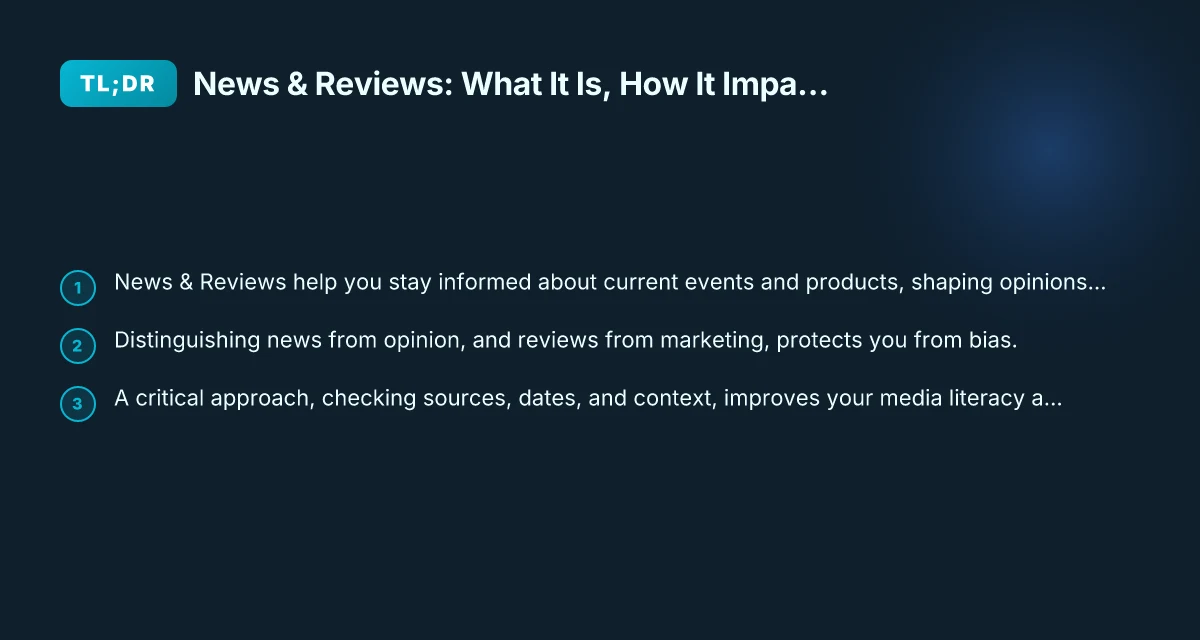
News & Reviews: What they are and why they matter News & Reviews sit at the intersection of information and evaluation. News aims to deliver factual updates about events, people, and ideas. Reviews analyze, critique, and rate products, services, or experiences. Together, they form a compass for navigating a fast-moving world, helping you understand what happened, why it matters, and whether it’s worth your time, money, or attention.
What counts as news
- Timeliness: Reports reflect recent events or discoveries.
- Verification: Facts are supported by multiple sources, documents, or firsthand accounts.
- Objectivity: Presenting information without unnecessary spin, while acknowledging uncertainty when it exists.
What counts as a review
- Criteria: Clear standards for evaluation (performance, value, design, durability, user experience).
- Evidence: Specific observations, data, or comparisons, not vague opinions.
- Transparency: Disclosure of methods, sample size, sponsorship, or potential conflicts of interest.
How to tell good news from bad news
- Check the date: Is the information current or outdated?
- Look for sources: Are quotes attributed? Are primary sources cited?
- Assess bias: Is there an angle or a persuasive goal beyond informing?
- Cross-check: Do other reputable outlets corroborate the key facts?
- Read beyond headlines: Are there details that explain context, limitations, or uncertainty?
How to tell good reviews from paid promotions
- Look for disclosure: Is there a sponsorship notice or affiliate link?
- Compare to other reviews: Do multiple independent sources reach similar conclusions?
- Seek raw data: Are there charts, benchmarks, or test protocols available?
- Be wary of hype: Extraordinary claims require extraordinary evidence.
Comparison of News vs. Reviews in Practice
| Aspect | News Story | Review | Practical takeaway | Example indicator |
|---|---|---|---|---|
| Purpose | Inform about events | Evaluate or rate quality | Use both for full picture | News = facts; Review = judgment |
| Source focus | Institutions, spokespeople | Product, author experience | Check credibility | Source named, author bio |
| Evidence strength | Concrete facts, quotes | Opinions, tested claims | Look for tests, data | Data or tests cited |
| Timeliness | Timely updates | Periodic assessment | Consider recency | Date present |
| Bias cues | Indirect through framing | Direct via rating | Watch for adjectives | Rankings, stars, scores |
| Verification | Cross-check with outlets | Look for reproducibility | Seek corroboration | References, methods |
| Language | Neutral, hedged | Persuasive, evaluative | Detect tone shifts | Qualifiers used |
Compiled November 2026; check the provider's site for current details.
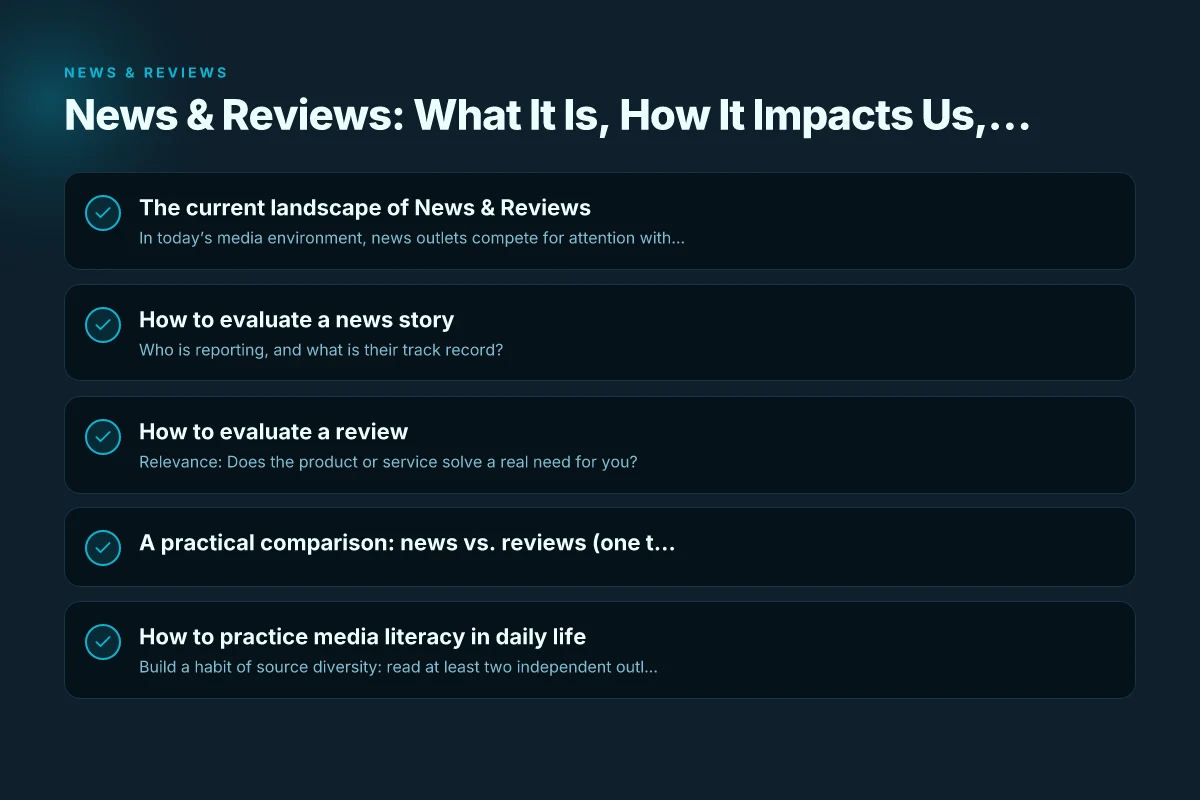
The current landscape of News & Reviews
In today’s media environment, news outlets compete for attention with rapid publishing, social amplification, and sometimes sensational framing. Reviews proliferate across commerce, entertainment, tech, and lifestyle, making it easier to find opinions that align with your tastes, but also easier to encounter biased or promotional content.
Key trends to watch
- Short-form news: Quick updates, often with catchy headlines, can sacrifice depth.
- Data-driven reporting: Visualizations, dashboards, and reproducible results are increasingly common.
- Niche specialization: Publications excel by focusing on specific communities or topics.
- Review transparency: More outlets label sponsorships and provide methodology details.
- User-generated signals: Comments, ratings, and community verdicts influence perception but aren’t always reliable.
How to evaluate a news story
Core questions to ask
- Who is reporting, and what is their track record?
- What is the primary source, and is it cited?
- Are numbers sourced, and are methods explained?
- What’s the counter-narrative, if any?
- Does the piece distinguish fact from analysis or opinion?
Practical checklist
- Verify the date and location.
- Confirm the event with at least two independent outlets.
- Note any language that signals bias (alarmist or euphemistic wording).
- Check for corrections or updates since publication.
How to evaluate a review
Criteria you should care about
- Relevance: Does the product or service solve a real need for you?
- Performance benchmarks: How does it perform under typical use?
- Pros and cons: Are trade-offs clearly stated?
- Comparisons: Is there a fair side-by-side with similar options?
- Sustained value: Is there evidence of long-term reliability or support?
What to do with a review
- Read multiple reviews to identify consensus and outliers.
- Seek out the reviewer’s methodology: testing environment, version numbers, and time frame.
- Watch or read the review in full, not only teasers or highlight reels.
A practical comparison: news vs. reviews (one table helps)
| Aspect | News | Reviews |
|---|---|---|
| Purpose | Inform about events and developments | Evaluate a product/service and offer a verdict |
| Evidence relied on | Facts, sources, documents, eyewitnesses | Tests, measurements, user experience, data |
| Tone | Factual with context where possible | Opinionated guidance with pros/cons |
| Update cadence | Frequent, often daily | Periodic, tied to product cycles or campaigns |
| Transparency | Sourcing and corrections expected | Methodology and sponsorship disclosure expected |
How to practice media literacy in daily life
- Build a habit of source diversity: read at least two independent outlets for the same topic.
- Check the “about” and “terms” pages: sponsorships, editorial standards, and corrections policies are clues to reliability.
- Save a moment for skepticism: pause before sharing surprising claims. Check the underlying data.
- Use fact-checking tools: reputable fact-checkers can help verify contentious statements.
- Create your own evaluation notes: a quick checklist you can apply to each piece helps you stay consistent.
Tools and habits to adopt
- News apps with calibrated sources and timestamped updates.
- Bookmarking key sources and creating a personal “watchlist” of topics.
- A simple notebook or digital doc for per-article notes: date, source, claims, evidence, and verdict.
Criteria to Evaluate a News Story
| Criterion | Definition | What to look for | Red flags | Yes / No / N/A |
|---|---|---|---|---|
| Attribution | Who said it | Named sources, quotes | Anonymous claims | yes / no |
| Evidence | Supporting data | Data, documents | Vague statements | yes / no |
| Update frequency | How current | Date, update notes | No dates | yes / no |
| Conflicts of interest | Beneficiary ties | Disclosures, funding | Hidden ties | yes / no |
| Verification | Corroboration | Cross-checks with others | Single-source | yes / no |
| Language | Tone | Neutral terms vs loaded words | Loaded language | yes / no |
Compiled November 2026; check the provider's site for current details. compassion concern(2026)
The ethics of News & Reviews
- Transparency: Outlets should reveal sponsorships, affiliations, and potential conflicts.
- Accountability: Corrections and updates demonstrate commitment to truth.
- Respect for privacy: Ethical reporting avoids harm to private individuals unless justified.
- Avoidance of manipulation: Beware of clickbait, sensationalism, and fabricated data.
When in doubt, rely on trusted anchors
Some outlets have built reputations for rigorous standards. No source is perfect. You can often count on institutions with open corrections policies, clear sourcing, and a track record of transparency. Supplements to your core sources should include independent fact-checkers, industry reports, and primary documents when possible.
Criteria to Evaluate a Review
| Criterion | Definition | What to look for | Red flags | Yes / No / N/A |
|---|---|---|---|---|
| Methodology | How tested | Steps, conditions, sample size | Vague methods | yes / no |
| Evidence quality | Strength of claims | Data, tests, videos | Ancedotal only | yes / no |
| Balance | Fairness | Pros and cons, caveats | One-sided | yes / no |
| Transparency | Sources disclosed | Experiments, dates | Hidden sources | yes / no |
| Reproducibility | Can others test | Clear procedures | Unrepeatable | yes / no |
| Conflicts of interest | Ties to product | Disclosures | Undisclosed ties | yes / no |
Compiled November 2026; check the provider's site for current details.
Final section: recommendation
If you want to stay well-informed without getting overwhelmed, use News & Reviews as two complementary inputs. Follow a core set of trusted news outlets for daily updates, and couple them with independent, in-depth reviews for decisions you’re about to make, whether you’re buying a gadget, choosing a service plan, or forming an opinion on a major policy issue. Practice active skepticism: read beyond headlines, verify numbers, and note any sponsorships. Over time, you’ll develop a robust instinct for distinguishing news from commentary and for weighing reviews with appropriate gravity. nazarene quotes(2026)