Post Qualifying Award
A clear guide to understanding the Post Qualifying Award, including eligibility, benefits, and how it fits into professional advancement.
Post Qualifying Award: What It Is, Who It's For, and How to Earn It
The Post Qualifying Award is a credential designed to acknowledge and formalize ongoing professional development after the initial qualification in a given field. It sits at the intersection of a professional’s early career milestones and lifelong learning, signaling to employers, clients, and peers that you are committed to expanding your expertise beyond the basics. The exact structure and name can vary by country. Discipline, and institution, the core idea remains: show evidence of sustained, relevant learning that enhances your practice.
Comparison of Post Qualifying Award vs Similar Credentials
| Credential | Focus Area | Typical Eligibility | Time to Complete | Credential Type | Notable Benefits |
|---|---|---|---|---|---|
| Post Qualifying Award | Post-qualification study for professional upgrade | Depends on program; often requires degree + experience | Short to several months | Certification / Award | Signals validated post-qualifying learning |
| Master's Degree (Professional) | Advanced theoretical and applied knowledge | Bachelor’s required | 1–2 years full-time | Degree | Deep specialization, broader credentials |
| Postgraduate Diploma | Targeted, shorter postgraduate study | Bachelor’s or equivalent | 6–12 months | Diploma | Quick upgrade, fewer credits than full degree |
| Certification in Specialized Practice | Specific skill set | Experience in field; sometimes exam | Weeks to months | Certification | Marketable, recognized by industry |
| Professional Fellowship | Prestige and advanced practice | Usually mid-career; sponsor recommendations | Several months to a year | Fellowship | Networking, leadership focus |
Compiled November 2026; check the provider's site for current details.
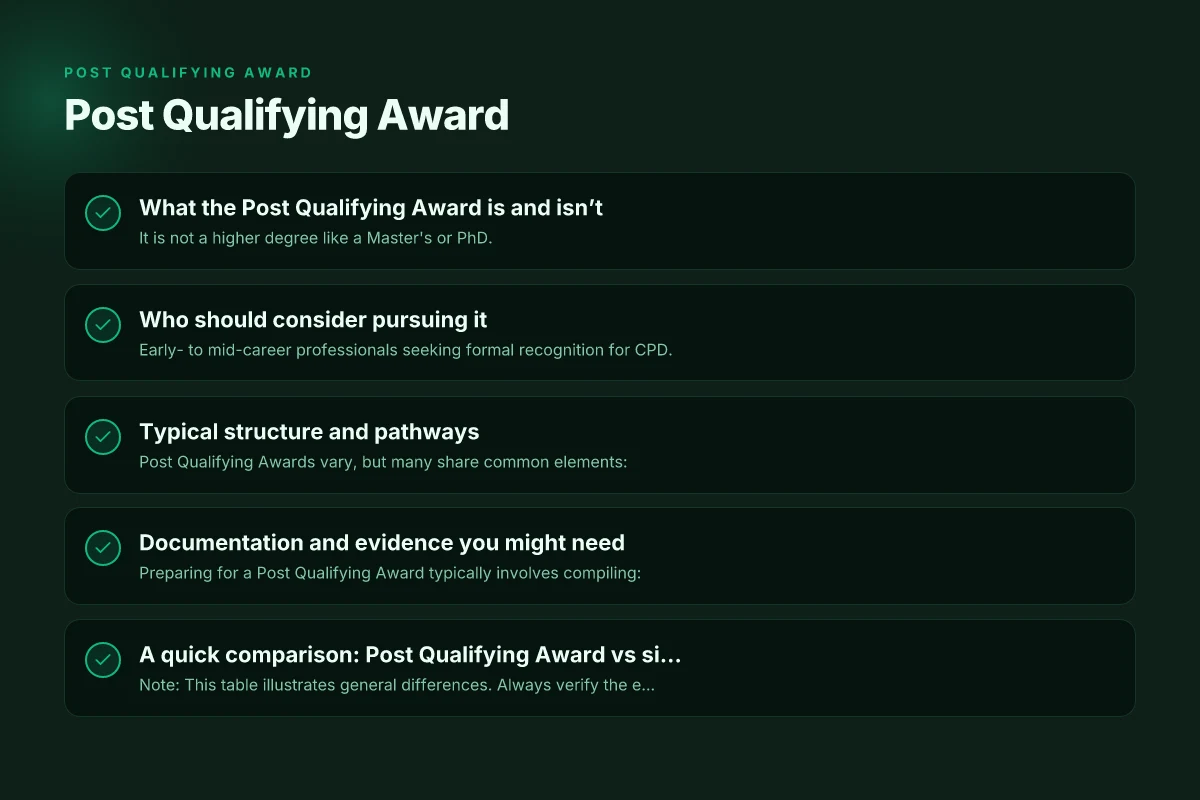
What the Post Qualifying Award is and isn’t
- It is not a higher degree like a Master's or PhD.
- It is not a license in most professions, though it can complement licensing by demonstrating ongoing competence.
- It is often a modular or portfolio-based credential, earned through a mix of coursework, reflective practice, and demonstrated outcomes.
- It may be offered by universities, professional bodies, or industry associations.
In practice, the Post Qualifying Award serves as a formal token of continued professional development (CPD). It recognizes that learning doesn’t stop at qualification. Substantial growth happens through targeted study, practical experience, and reflective practice in real-world settings.
Who should consider pursuing it
- Early- to mid-career professionals seeking formal recognition for CPD.
- Individuals preparing for formal roles that require evidence of ongoing development.
- Professionals moving into specializations or new practice areas.
- Those who want a tangible credential to accompany their resume, CV, or LinkedIn profile.
Eligibility often depends on:
- The minimum period since qualification (some programs require ongoing practice for a set time).
- Completion of specified CPD hours or units.
- Submission of a portfolio, reflective log, or reflective essay.
- Endorsement or supervisor verification of practical work.
Because requirements differ by field, it’s wise to check with the awarding body to understand whether your activities qualify and what documentation is needed.
Typical structure and pathways
Post Qualifying Awards vary, but many share common elements: Accredited Programs: What They Are, Why They Matter, and How to Choose
- CPD hours or units: A threshold of continuing education credits, often ranging from 20 to 120 hours across a cycle.
- Coursework or modules: Short courses, workshops, or online modules focused on current best practices, ethics, leadership, or specialized skills.
- Reflective practice: A portfolio, case study, or reflective log demonstrating how learning has been applied to real work.
- Assessment: A portfolio review, written assignment, or viva voce to verify learning and impact.
- Professional practice requirements: Sometimes a supervisor or mentor’s report is needed to confirm competencies.
Paths can include:
- Coursework-heavy route: Complete designated courses and pass assessments.
- Portfolio route: Gather evidence of practice changes, outcomes, and reflections.
- Hybrid route: A blend of coursework, CPD credits, and portfolio evidence.
Documentation and evidence you might need
Preparing for a Post Qualifying Award typically involves compiling:
- CPD log or transcript: A record of all relevant learning activities with dates and durations.
- Portfolio: Case studies, project reports, quality improvement initiatives, or evidence of skill development.
- Reflective statements: Essays or narratives explaining what you learned and how you applied it.
- Supervisor or peer endorsements: Letters or online verifications confirming professional growth.
- Proof of course completion: Certificates, transcripts, or digital badges from recognized providers.
- A completed application form: Usually including a personal statement and a summary of impact.
Organizational tips:
- Start early: Build your CPD log as you go, rather than scrambling at the end.
- Keep it discipline-specific: Align entries with the competencies the award emphasizes.
- Version control: Maintain a single, organized folder (digital or physical) with clearly labeled sections.
A quick comparison: Post Qualifying Award vs similar credentials
| Credential type | Focus | Typical requirements | Recognition | Time to complete |
|---|---|---|---|---|
| Post Qualifying Award | Ongoing professional development after initial qualification | CPD hours, portfolio, reflective work, assessment | Regional or field-specific recognition; complements licensing | Varies (months to a couple of years) |
| Certification (specialized, non-degree) | Specific skill or technology | Exam, practical assessment, or portfolio | Industry-recognized for particular roles | Weeks to months |
| Master’s degree (non-professional track) | Advanced academic study | Coursework, thesis, exams | Broad academic recognition | 1–2 years full-time; longer part-time |
| Professional license with CPD requirements | Entry to regulated practice + ongoing CPD | Licensing exam + post-licensing CPD | Legally required in many fields | Varies by jurisdiction |
Note: This table illustrates general differences. Always verify the exact criteria with the awarding organization in your field. InstaBase Web Engine: A Comprehensive Guide to the All-in-One Web Platform
Pathways and Pathway Fit for Career Goals
| Goal | Post Qualifying Award | Master's Degree | Certificate/ Diploma | Certification | Fellowship |
|---|---|---|---|---|---|
| Fast career upgrade | Yes / yes possible | No if time-limited | Yes | Yes | No |
| Broadening skills | Yes | Limited by program | Yes | Yes | Yes |
| Deep expertise in niche | Yes | No | Yes | Yes (niche certs) | Yes (research/leadership) |
| Management/ leadership track | Yes (focus varies) | Yes (if MBA/related) | No | Optional | Yes |
| Industry recognition | Yes | Yes (depending on program) | Yes | Yes | Yes |
Compiled November 2026; check the provider's site for current details.
How it fits into your career development plan
The Post Qualifying Award can complement several career objectives:
- Enhancing credibility: A formal credential that evidences commitment to ongoing learning.
- Narrowing the gap between practice and evidence: Demonstrates that your work is informed by current knowledge and methods.
- Supporting career progression: Some employers value CPD-focused credentials for promotions or specialization tracks.
- Preparing for changing landscapes: In fast-evolving fields, continuing education helps you stay current.
Tips to integrate it into your plan: PQ News: Your Essential Guide to Understanding and Following PQ News Coverage
- Map competencies: Identify the core skills and knowledge areas the award emphasizes and align your CPD activities accordingly.
- Schedule strategically: Block time for courses, reflective writing, and portfolio development within your annual plan.
- Seek alignment with goals: Choose CPD activities that advance your specific career milestones, such as leadership, ethics, or a sub-specialty.
- Engage mentors: Get feedback on your reflective statements and portfolio entries to strengthen your application.
How to apply: a step-by-step outline
- Research options: Identify the awarding bodies or institutions that offer a Post Qualifying Award in your field. Compare eligibility, costs, and timelines.
- Gather prerequisites: Compile your qualification details, CPD records, and any required endorsements.
- Plan your evidence: Decide which activities will form your CPD hours and how you will construct your portfolio or reflective statements.
- Complete required activities: Attend courses, fulfill CPD hours, and complete any assessments.
- Compile and submit: Assemble your portfolio, CPD log, statements, and proof of completion as required by the award.
- Prepare for assessment: If an oral or portfolio review is part of the process, rehearse your examples of impact and outcomes.
- Receive the award: Upon successful assessment, you’ll be awarded the Post Qualifying Award and can add it to your professional profile.
Documentation and Evidence Checklist
| Item Type | Post Qualifying Award | Master's Degree | Certification | Fellowship |
|---|---|---|---|---|
| Application form | Required | Required | Required | Required |
| Transcripts | Required | Required | Not always | Not always |
| Degree certificate | Not always | Required | Not always | Not always |
| Resume / CV | Required | Required | Required | Required |
| Letters of recommendation | Yes | Yes | Yes | Yes |
| Statement of purpose | Yes | Yes | Yes | Yes |
| Proof of work experience | Sometimes | Sometimes | Sometimes | Yes |
| Exam results (if any) | Yes / as applicable | No | Yes | No |
| Portfolio / examples of work | Optional | Optional | Optional | Yes (projects) |
| Language proficiency | If applicable | If applicable | If applicable | If applicable |
Compiled November 2026; check the provider's site for current details.
Common challenges and how to overcome them
- Time management: Balancing work, life, and CPD can be tough. Proactively schedule learning blocks and opt for flexible or online options where possible.
- Documentation fatigue: It’s easy to let records slip. Use a simple digital system (folders, tags, and reminders) to capture evidence in real time.
- Aligning with practice: Ensure your chosen CPD activities have direct relevance to your current or desired role. Avoid activities that are interesting but tangential.
- Varying requirements: Different awarding bodies may demand different formats. Maintain a master checklist for each program to avoid missing elements.
Final recommendation
If you are serious about professional growth and your field emphasizes lifelong learning, pursuing a Post Qualifying Award can be a strategic move. It provides formal recognition for your ongoing development, helps you articulate your learning impact to employers and clients, and can position you for advanced roles or specialty tracks. Before you commit, map out your career goals, review the specific requirements for your field, and build a practical plan that you can sustain over time. The most successful candidates approach the process as an integrated part of their professional life, not as a one-off project.