Using existing Internet resources - Intermediate level
A practical guide for intermediate users to locate, evaluate, and reuse online resources effectively.
Using existing Internet resources can save time and expand your work, but only if you search and evaluate wisely. This guide helps intermediate users harness the wealth of online materials while staying organized and critical.
Criteria for identifying good sources
| Source type | Authority | Currency | Relevance | Accuracy | Bias |
|---|---|---|---|---|---|
| Scholarly article | High | Often current | High relevance to topic | Peer-reviewed; cited | Low bias in content |
| News outlet | Moderate | Daily/recurring | Medium relevance | Fact-checked; some errors | Possible editorial slant |
| Official government site | High | Very current | High relevance | Official data | Minimal bias |
| Blog post | Low to moderate | Varies | Low to medium relevance | Often Anecdotal | Potential bias |
| Expert interview | Moderate | Varies | Medium relevance | Credible quotes; limited checks | Potential bias |
| NGO report | Moderate to high | Varies | Medium to high relevance | Data cited; methods stated | Some advocacy bias |
Compiled November 2026; check the provider's site for current details.
What "using existing Internet resources" means at an intermediate level
- It means finding information, data, tools, and media online that already exist, rather than creating everything from scratch.
- It includes primary and secondary sources, open data, tutorials, forums, and digital libraries.
- The goal is to augment your project with reliable, relevant material you didn’t produce yourself.
Why this matters
- Time efficiency: reuse credible sources instead of reinventing the wheel.
- Quality and credibility: reputable online resources can raise the overall trustworthiness of your work.
- Compliance: proper attribution and licensing protect you legally and ethically.
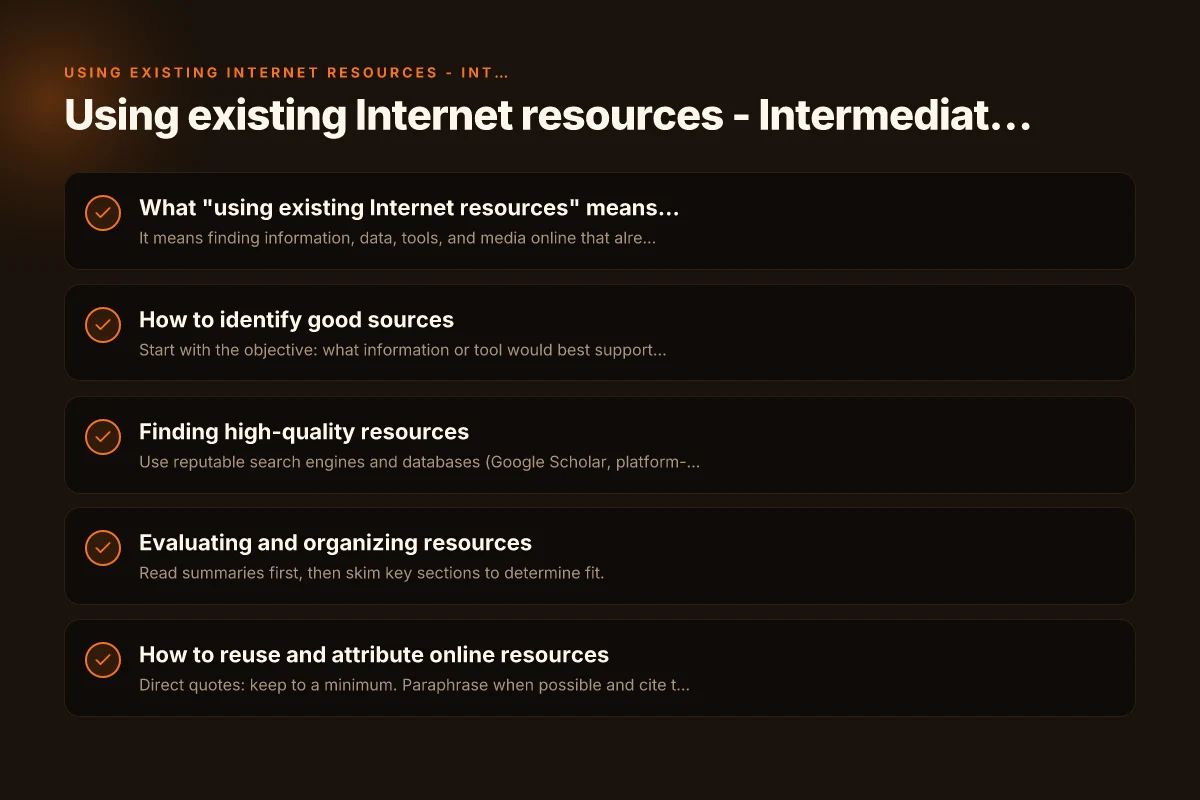
How to identify good sources
- Start with the objective: what information or tool would best support your goal?
- Check authority: who is the author or institution? Are they reputable?
- Look for accuracy: is the data or claim supported by evidence?
- Assess recency: when was it published or last updated?
- Review relevance: does it match your topic, audience, and depth?
Quick source-quality checklist
- Author or organization: clear authorship, expertise, and contact information.
- Publication date: up-to-date enough for your topic.
- Citations and evidence: data, references, or links to support claims.
- Peer review or editorial standards: indicates more rigorous vetting.
- Licensing: allowed uses (reusable, modifiable, attribution required).
- Bias and balance: is there a fair representation of viewpoints?
Finding high-quality resources
- Use reputable search engines and databases (Google Scholar, platform-specific catalogs, institutional repositories).
- Search with precise queries: quotes for exact phrases, minus signs to exclude, site: domain filters.
- Explore open data portals and digital libraries for free, reusable materials.
- Check citations in credible sources to discover additional resources.
- Save and organize links with notes to remember why each item is relevant.
Practical search tips
- Start broad, then narrow: “environmental impact data” → “environmental impact data 2023 government open data portal.”
- Use domain filters: site:.gov, site:.edu, site:.org for authoritative domains.
- Combine keywords with Boolean operators: “urban planning” AND “transportation data” NOT “fiction.”
- Look for metadata: authors, publish date, licensing terms, and data formats.
Evaluating and organizing resources
- Read summaries first, then skim key sections to determine fit.
- Check accessibility and format: PDFs, datasets, code, or HTML pages, choose what’s usable for your project.
- Record essential metadata: title, author/organization, date, URL, license, and notes on relevance.
- Decide on reuse rights: whether you can reuse as-is, adapt, or must provide attribution.
- Create a citation plan: how you will attribute sources in your final work.
Example evaluation table
| Resource | Authority | Currency | Relevance | License | Notes |
|---|---|---|---|---|---|
| Government open data portal on urban transit | High (government agency) | 2024 | Very relevant | CC-BY | Useful for datasets and maps |
| Research article on traffic models | Medium (university author) | 2022 | Moderately relevant | paywalled | Good for theory, needs access |
| Industry blog about city planning | Low to medium | 2023 | Somewhat relevant | Attributed, no reuse restriction | Helpful for case studies, verify |
Steps in evaluating and organizing resources
| Step | Action | Output | Tools |
|---|---|---|---|
| 1 | Define topic and questions | Topic scope | Outline, keywords list |
| 2 | Gather candidates | List of sources | Search engines, databases |
| 3 | Quick appraisal | Yes / no / short phrase | Skim headlines, abstracts |
| 4 | Full evaluation | Detailed notes | Evaluation rubric |
| 5 | Organize by themes | Thematic folders | Tags, folders |
| 6 | Record provenance | Citation info | Reference manager |
| 7 | Synthesize findings | Summary notes | Annotated bibliography |
| 8 | Attribute properly | Attribution statements | Style guide |
| 9 | Archive resources | Snapshot or copy | Cloud drive, backups |
Compiled November 2026; check the provider's site for current details.
How to reuse and attribute online resources
- Direct quotes: keep to a minimum. Paraphrase when possible and cite the source.
- Data reuse: check licenses (CC, PD, or specific terms). Most open datasets require attribution.
- Media: images, charts, and code often have licenses and attribution requirements. Respect them.
- Tools and code: many resources come with permissive licenses but follow instructions for use and modification.
Attribution best practices
- Include author, title, source, date, and URL.
- Note the license and what is permitted (reuse, modification, commercial use).
- Use a consistent citation style if your project requires it (APA, MLA, Chicago, or a project-specific format).
Handling reliability and bias
- Cross-check facts with multiple credible sources.
- Be cautious of outdated information or sources with obvious conflicts of interest.
- Distinguish between data (facts, figures) and interpretation (opinion, commentary).
- When in doubt, prefer primary sources and official publications over secondary summaries.
Common pitfalls to avoid
- Relying on a single source for critical claims.
- Ignoring licensing terms that affect reuse.
- Ignoring contextual differences (e.g., data collected in a different country or time period).
- Using low-credibility domains (personal blogs without credentials) for important facts.
Practical workflow from search to final resource set
| Phase | Activity | Deliverable | Time cue |
|---|---|---|---|
| Search | Use multi-source queries | Seed list | 15–30 min |
| Screen | Quick skims | Short judgments | 20–60 min |
| Evaluate | Depth checks | Evaluation records | 1–2 hours |
| Organize | Tag and group | Themed collections | 30–60 min |
| Attribute | Generate citations | Bibliography | 20–40 min |
| Compile | Create final set | Resource dossier | 1–2 hours |
Compiled November 2026; check the provider's site for current details. Changes to CINNI
Practical workflow: from search to final resource set
- Define the problem and what you’re looking for (data, references, tools, media).
- Gather a preliminary set of sources using targeted searches.
- Evaluate each source with the quality checklist.
- Filter to a manageable set and organize with notes and tags.
- Create a reusable archive: saved copies, metadata, and licenses.
- Integrate sources into your project with proper attribution and, if needed, adapted content.
- Review the final set for balance, coverage, and accessibility.
A small planning checklist
- What is the objective or question you’re solving?
- What kinds of resources will best help (data, literature, tools, media)?
- Which licenses and rights will you accept for reuse?
- Do you have enough diverse sources to avoid bias?
- Is there a clear, repeatable process to update these resources later?
When to go beyond “using” to “curating”
- If your project requires ongoing accuracy, consider building a curated resource library.
- Include summaries, key takeaways, and decisions tied to each source.
- Maintain versioning and update logs to reflect new data or revised analyses.
- Share your curated set with collaborators, including how to access, cite, and update it.
A lightweight curation template
- Resource name and URL
- Authority and credibility notes
- Date last updated
- Key data or insight you’ll cite
- License and reuse notes
- Personal annotations on relevance and quality
The recommendation: apply a disciplined, repeatable approach
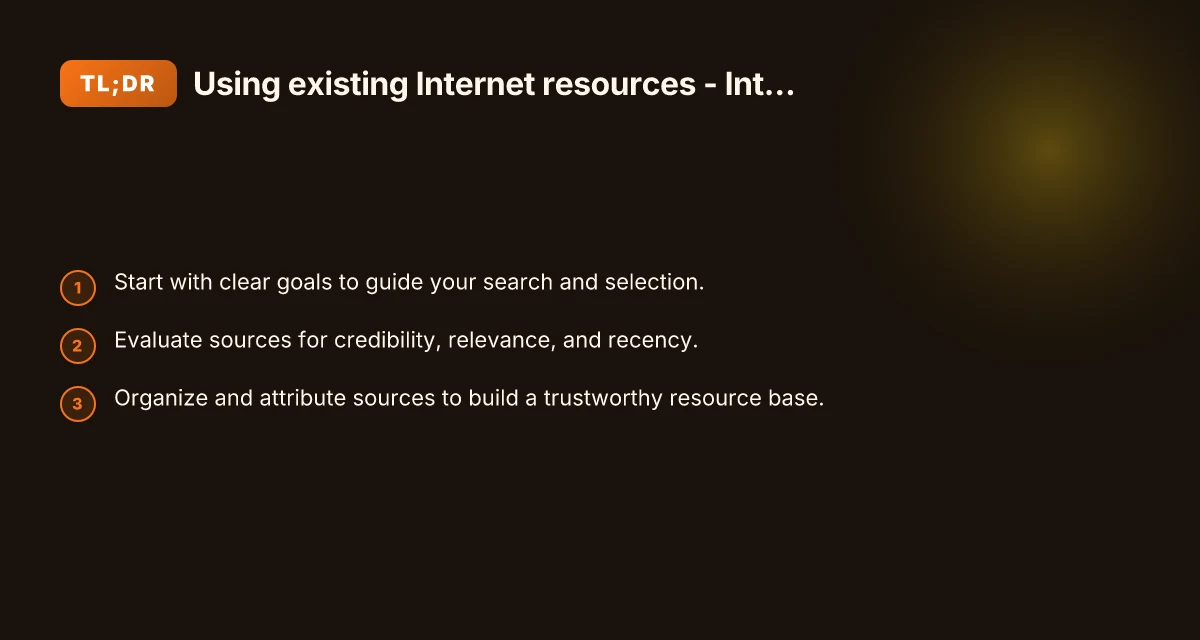
If you want to leverage existing Internet resources effectively at an intermediate level, establish a repeatable process: define, search smartly, evaluate critically, organize methodically, and reuse with proper attribution. This discipline saves time, reduces risk, and improves the quality of your work.
- Start with a clear objective and a plan for what kinds of resources you need.
- Use precise search strategies and reputable sources to build a credible base.
- Always evaluate for authority, currency, relevance, and licensing.
- Keep a well-organized archive with notes and attribution to make future work faster.
- Consider curating a small, reusable library if your projects reuse similar topics.
By following these steps, you can confidently use existing Internet resources at an intermediate level, turning abundant online information into reliable, well-supported outcomes.