working for peace(2026)
A practical guide to pursuing peace through careers, volunteering, and everyday actions that foster nonviolence and dialogue.
The idea of working for peace is not limited to high-profile diplomacy or international treaties. It spans a spectrum of careers, volunteer opportunities, and personal habits that collectively reduce violence, improve understanding, and build resilient communities. This article outlines practical paths to engage with peace in daily life and professional settings, offering concrete steps, skills to cultivate, and examples of how your work can contribute to a more peaceful world.
Comparison of peace work terminology and focus
| Term / Focus | Definition / Scope | Typical Roles | Outcome Target | Time Horizon |
|---|---|---|---|---|
| Peace work (general) | Activities aiming to reduce conflict and promote harmony | Mediator, facilitator, researcher | Reduced violence, increased collaboration | Medium to long term |
| Traditional security | Emphasis on deterrence and force | Defense analyst, policy maker, strategist | Stability, power balance | Long term |
| Peacebuilding | Rebuilding structures after conflict | Administrator, program manager, NGO lead | Reconciliation, governance | Long term |
| Conflict prevention | Stopping conflicts before they erupt | Policy advisor, analyst, early warning | Fewer crises | Long term |
| Peace education | Teaching values and skills for harmony | Trainer, curriculum developer | Awareness, empathy | Short to long term |
Compiled November 2026; check the provider's site for current details.
What it means to "work for peace"
Peace work is about creating conditions where people can thrive without fear of violence. It includes:
- Conflict prevention: addressing root causes before conflicts flare.
- Peacebuilding: rebuilding trust and institutions after violence.
- Justice and human rights: ensuring fair treatment and accountability.
- Dialogue and mediation: helping opposing sides communicate productively.
- Community resilience: strengthening social ties that deter crime and escalation.
Peace is not passive. It requires intentional action, whether you are drafting policy, teaching, volunteering, or advocating for marginalized communities. The key is to align your skills with opportunities that reduce harm, amplify voices, and create durable structures for cooperation.
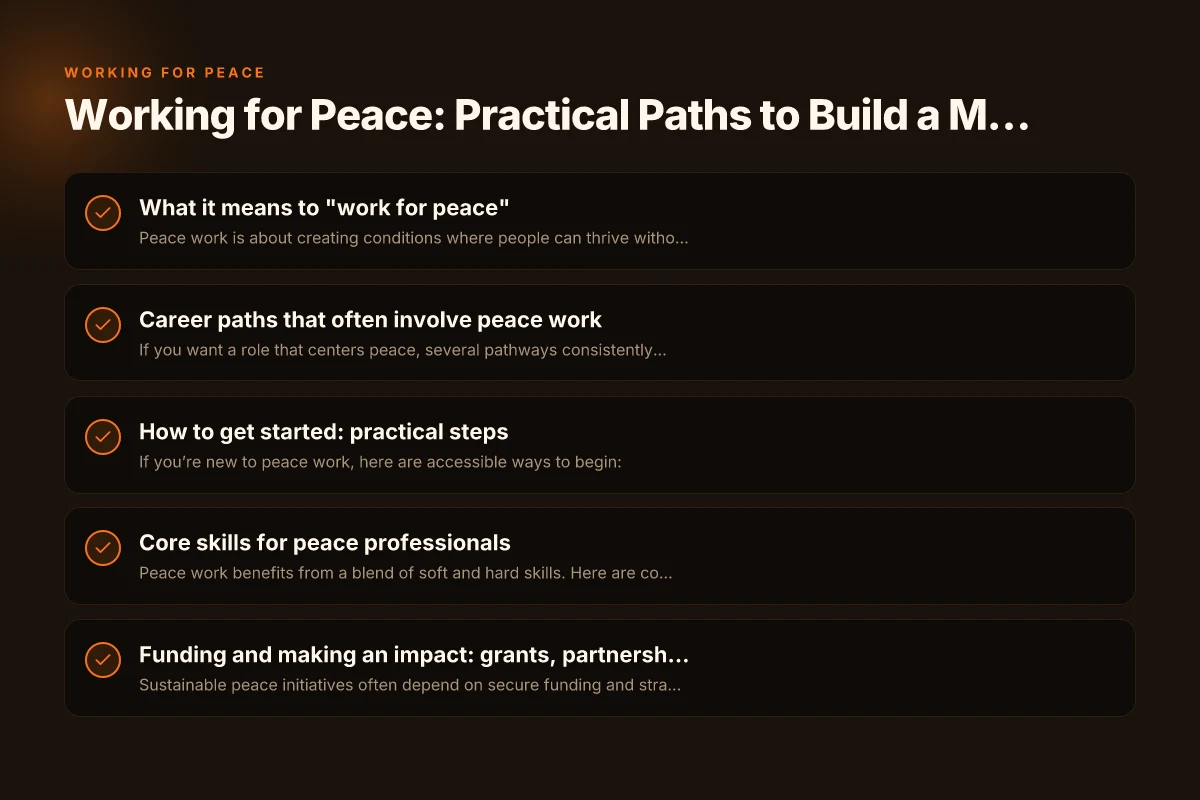
Career paths that often involve peace work
If you want a role that centers peace, several pathways consistently offer opportunities:
- Public policy and government: designing laws and programs that address conflict drivers such as poverty, inequality, and discrimination.
- International organizations and NGOs: facilitating diplomacy, humanitarian aid, and development projects.
- Law and human rights: protecting civilians, conducting investigations, and supporting accountability mechanisms.
- Education and youth programs: teaching critical thinking, media literacy, and nonviolent communication.
- Mediation and conflict resolution: formal or informal processes that help parties reach agreements.
- Journalism and advocacy: reporting on conflicts responsibly and informing the public.
- Community development and social work: addressing local tensions and building inclusive neighborhoods.
Skills that help across these paths include active listening, cultural competency, research and data analysis, project management, grant writing, and cross-cultural negotiation. Many roles value field experience, language abilities, and a track record of ethical leadership. response to the criminal justice review(2026)
How to get started: practical steps
If you’re new to peace work, here are accessible ways to begin:
- Volunteer with local organizations: shelters, immigrant support groups, or youth programs often need coordinators, tutors, or outreach volunteers.
- Seek micro-credentials: courses in mediation, human rights, or nonviolent communication can be completed in weeks and bolster your resume.
- Attend local forums and join coalitions: learn about current peace initiatives in your area and offer your time.
- Start a small project: a neighborhood dialogue circle, a fundraiser for peacebuilding groups, or an awareness campaign around a local issue.
- Build a portfolio of impact: document outcomes from your volunteering, such as reduced conflict incidents, increased collaboration, or improved access to services.
If you’re pursuing a paid career, consider internships or fellowships with think tanks, NGOs, or government agencies. Networking with mentors who work in peace-related fields can open doors and provide guidance tailored to your interests and location.
Core skills for peace professionals
Peace work benefits from a blend of soft and hard skills. Here are core capabilities to cultivate:
- Communication and active listening: translating complex issues into understandable terms and validating diverse perspectives.
- Mediation and negotiation: guiding conversations toward nonviolent, win-win outcomes.
- Cultural humility and bias awareness: recognizing your own assumptions and engaging respectfully with others.
- Research and data literacy: gathering evidence to inform policy and practice.
- Project and coalition management: coordinating stakeholders, timelines, and resources.
- Ethical judgment and accountability: maintaining integrity in sensitive contexts.
Develop these through real-world practice, reflective learning, and feedback from peers or mentors. Some roles may require language skills, security-awareness training, or certifications in mediation techniques. defining victims of violence(2026)
Funding and making an impact: grants, partnerships, and sustainability
Sustainable peace initiatives often depend on secure funding and strategic partnerships. Consider these approaches:
- Grant writing and fundraising: many peace organizations rely on grants from foundations, government, and donors.
- Public-private partnerships: collaborating with businesses to fund social programs that reduce violence.
- Community-driven fundraising: local campaigns that engage residents and demonstrate local demand for peace initiatives.
- Measurement and reporting: tracking outcomes to show impact and justify continued support.
A useful way to think about funding is as a mechanism for amplifying impact rather than a hurdle. Build a clear theory of change, set measurable goals, and communicate progress transparently to supporters.
Career paths and sectors in peace work
| Sector / Pathway | Typical roles | Required background | Entry opportunities | Advancement indicators | Funding stability |
|---|---|---|---|---|---|
| International NGOs | Field officer, program manager | Development, IR, social science | Internships, fellowships | Promotions, leadership roles | Moderate to high |
| Government / diplomacy | Peace envoy, policy advisor | IR, public policy, law | Fellowships, civil service | Senior advisor, director | Medium |
| Academia / think tanks | Researcher, analyst, lecturer | Political science, methods | PhD, publications | Tenure, senior fellow | Variable |
| Community peacebuilding | Facilitator, coordinator | Training, mediation | Volunteer, local orgs | Project lead | Low to moderate |
| Private sector / CSR | CSR strategist, impact analyst | Business, sustainability | Corporate programs | Head of program | Moderate |
Compiled November 2026; check the provider's site for current details. a widows plea for restraint(2026)
A simple comparison: traditional security vs. peace-oriented approaches
| Aspect | Traditional Security Approach | Peace-Oriented Approach |
|---|---|---|
| Primary aim | Deterrence and force projection | Prevention, dialogue, and resilience |
| Tools | Military capacity, enforcement | Mediation, community organizing, development |
| Stakeholders | State actors, security apparatus | Civilians, NGOs, communities, local leaders |
| Metrics of success | Absence of aggression, risk reduction | Trust levels, access to services, cooperative projects |
| Risks | Escalation, civilian harm | Sustained engagement, slower visible gains |
This table highlights how peace work often shifts the focus from immediate force-based solutions to long-term prevention and inclusive processes. Both sets of tools can be essential, but peace-oriented strategies emphasize nonviolence, accountability, and social cohesion.
Stories of impact: real-world examples
- A city councilor partners with schools, faith groups, and youth organizations to implement a neighborhood dialogue program that reduces conflicts between teens and residents, resulting in fewer incidents and more collaborative projects.
- A mediation program trains returning citizens as community mediators, helping to resolve disputes in local housing developments and creating pathways to employment.
- An international NGO runs a rights-based education campaign in regions affected by violence, empowering young people to advocate for peaceful political participation and civic engagement.
These examples show how peace work can manifest at community, national, and international levels. The common thread is a focus on human dignity, inclusive processes, and shared safety.
Practical steps to get started in peace work
| Step | Activity | Tools / Resources | Timeframe | Success indicator | Notes |
|---|---|---|---|---|---|
| Self-assessment | Identify interests and values | Career maps, reflections | 1 week | Clear focus areas | Align with impact goals |
| Education / training | Short courses in mediation, IR | Online courses, certificates | 1–3 months | Certificate earned | Build credibility |
| Networking | Join peace-related groups | LinkedIn, conferences | Ongoing | 5 meaningful connections | Target local and global peers |
| Volunteer / internships | Hands-on experience | NGOs, schools, communities | 2–6 months | Verified projects | Build portfolio |
| Apply for roles | Targeted resumes | Job boards, referrals | 1–3 months | Interviews | Tailor per role |
| Start small project | Local peace initiative | Grants, partners | 3–6 months | Pilot outcomes | Learn by doing |
Compiled November 2026; check the provider's site for current details. profoundly disturbing(2026)
How to measure success in peace work
Measuring impact in peace-related fields can be challenging but is essential for funding and learning. Consider these indicators:
- Qualitative: changes in perceptions of safety, trust in institutions, and willingness to engage in dialogue.
- Quantitative: reductions in violence or crime rates, increased attendance at community meetings, improved access to essential services.
- Process measures: number of partnerships formed, mediations conducted, or trainings delivered.
- Sustainability signs: diverse funding streams, local leadership expansion, and ongoing community ownership of programs.
Regular monitoring, evaluation, and storytelling help demonstrate value to stakeholders and guide continuous improvement.
Personal and organizational recommendations
- Start small but think big: begin with a local project, then scale through networks and partnerships.
- Prioritize listening: create spaces where marginalized voices are truly heard and reflected in decisions.
- Build diverse coalitions: include voices across generations, cultures, and sectors to strengthen legitimacy and resilience.
- Invest in capacity building: provide training and resources to volunteers and staff to sustain quality work.
- Practice self-care and ethics: peace work can be emotionally demanding. Establish boundaries, supervision, and peer support.
Final recommendation
If you’re considering a path in peace work, map your strengths to concrete roles that fit your context. Choose a starting point, volunteering, a certificate program, or a local project, that aligns with your values and builds toward a longer-term plan. Gather mentors, document your impact, and stay connected to communities you aim to serve. Peace is not a single event but a lasting practice of listening, collaboration, and courageous action. By taking thoughtful steps today, you contribute to safer, more just, and more hopeful communities tomorrow.