Cancer Registration Scheme
A comprehensive overview of the Cancer Registration Scheme, including purpose, scope, how data is collected, uses, and how it affects patients and research.
Cancer Registration Schemes are centralized systems used to collect, store, and analyze information about cancer cases. They exist in many countries and jurisdictions, each tailored to local health systems, laws, and public health goals. At their core, these schemes aim to provide accurate, timely data that can inform prevention, screening, treatment, and policy. This article explains what a Cancer Registration Scheme is, how it works, who uses it, and why it matters for patients and society.
Comparison of Data Scope and Purpose
| Dimension | Cancer Registration Scheme | Hospital Records | Public Health Surveillance | Research Registry |
|---|---|---|---|---|
| Primary purpose | Population-level cancer incidence and outcomes | Individual patient care documentation | Tracking disease trends in population | Data collection for research projects |
| Population covered | All diagnosed cases in defined region | Patients treated at the facility | Population in jurisdiction | Cases eligible for research projects |
| Coverage completeness | High but varies by region | High for treated patients | Moderate to high for surveillance needs | Variable by study and consent |
| Data granularity | Summary events, anonymized identifiers | Detailed clinical notes, procedures | Aggregate trends, anonymized data | Rich data fields, often de-identified |
| Data linkage | Yes, with identifiers for follow-up | Limited to internal systems | Yes, across agencies | Possible with consent and approvals |
| Privacy safeguards | Strong, regulatory controls | Patient confidentiality preserved | Privacy-focused, de-identification | Data access controls for researchers |
| Public availability | Some aggregated stats published | Not publicly accessible | Public dashboards and reports | Access via approvals or collaborations |
Compiled November 2026; check the provider's site for current details.
What is a Cancer Registration Scheme?
A Cancer Registration Scheme is an organized process for capturing details about new cancer diagnoses and, in some cases, updates to existing cases. Key elements include:
- Patient demographics (age, sex, location)
- Cancer type, site, and stage
- Date of diagnosis and method of verification
- Treatments received (surgery, chemotherapy, radiotherapy, targeted therapy)
- Outcomes (remission, progression, survival, cause of death)
Data may come from hospitals, pathology labs, discharge summaries, death certificates, and other health records. The exact fields and coding systems (for example, ICD-10 for cancer types, TNM staging) can vary by country but share common objectives: to enable reliable counts, trend analysis, and research.
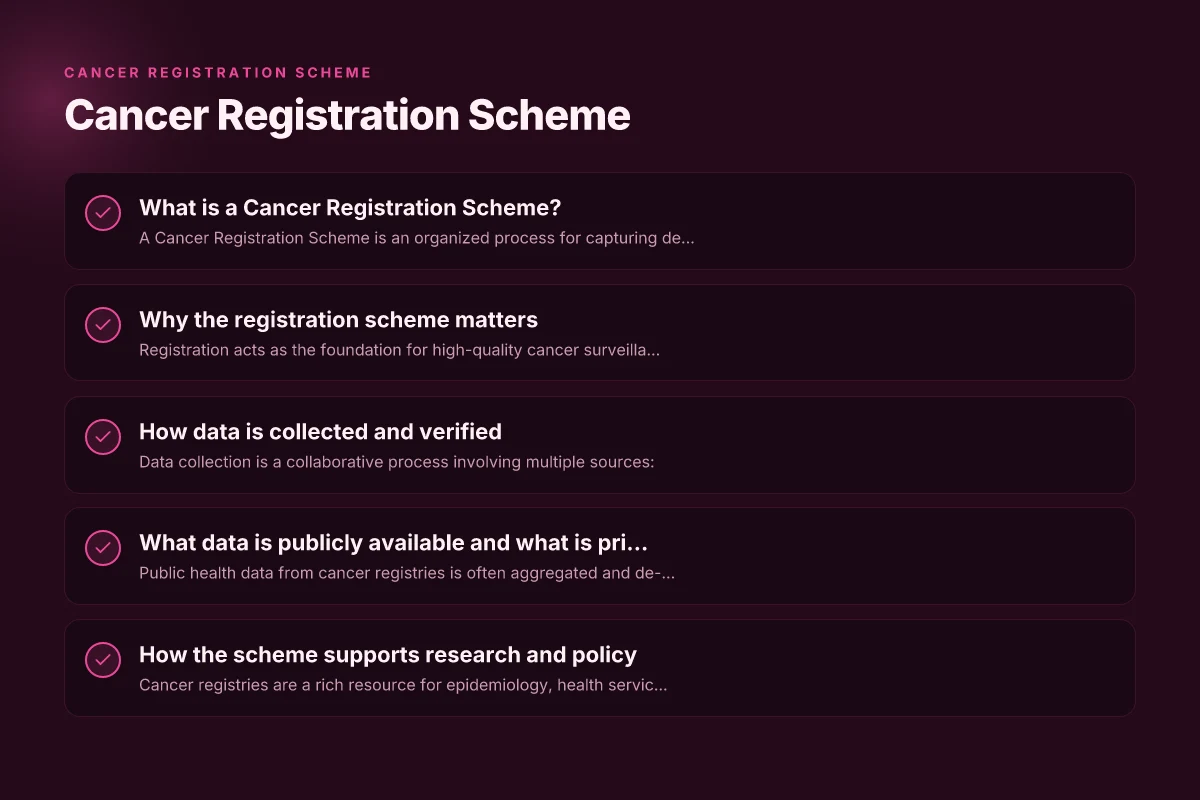
Why the registration scheme matters
Registration acts as the foundation for high-quality cancer surveillance. It helps public health officials:
- Monitor incidence and mortality trends over time and across regions
- Identify high-risk populations and geographic disparities
- Track the effectiveness of screening programs and early detection efforts
- Support planning for healthcare services, including staffing, bed capacity, and treatment resources
- Enable research into risk factors, treatment outcomes, and survival
For clinicians and patients, registration supports better care coordination and access to up-to-date, population-level insights about treatment effectiveness and gaps in care. Publications: A Practical Guide to Understanding and Using Them
How data is collected and verified
Data collection is a collaborative process involving multiple sources:
- Hospitals and oncology clinics: primary for diagnostic and treatment information
- Laboratories and pathology reports: confirm histology and cancer type
- Death registries: may provide cause of death and survival data
- Cancer registries can link with other health data (e.g., screening programs, comorbidity records) to enrich analyses
Quality assurance steps typically include:
- Standardized data collection forms and coding guidelines
- Regular data validation checks and discrepancy resolution
- Case-finding algorithms to ensure completeness
- Audits and feedback to reporting sites to improve accuracy
Patients’ privacy is a central concern. Registries follow legal and ethical standards, including data de-identification for research and secure data handling protocols. Access to identifiable information is restricted to authorized personnel and governing bodies.
What data is publicly available and what is private
Public health data from cancer registries is often aggregated and de-identified to protect privacy. Typical publicly shared outputs include: Posters: A Practical Guide to Choosing, Designing, and Displaying Stunning Posters
- Incidence and mortality rates by age, sex, cancer type, and region
- Survival statistics and trends
- Geographic heatmaps showing cancer burden
- Research-ready datasets that have been stripped of personal identifiers
More granular or longitudinal data may be accessible to researchers under strict governance, data-sharing agreements, and ethics approvals. Individual patient data remains protected, with access limited to authorized researchers and institutions.
How the scheme supports research and policy
Cancer registries are a rich resource for epidemiology, health services research, and policy development. They enable:
- Population-based studies on cancer risk factors and screening impact
- Evaluation of treatment patterns and adherence to clinical guidelines
- Prognostic analyses and survival benchmarks across subgroups
- Resource planning for new therapies, diagnostic tools, and supportive care
- International comparisons to inform best practices and learn from global experience
Researchers often use registry data in combination with other data sources, such as clinical registries, biobanks, and NHS or national health databases, to gain deeper insights.
A practical guide to using registry data
For clinicians, researchers, and policymakers, here’s how to approach registry data effectively: Nurses: Roles, Training, and Impact in Modern Healthcare
- Define the question: What outcome, population, and timeframe do you want to study?
- Check data availability: Identify variables such as cancer site, stage, treatment, and outcomes.
- Assess quality: Consider completeness, validation status, and potential biases.
- Use appropriate methods: Standardized incidence rates, survival analyses (e.g., Kaplan-Meier), and multivariable models to adjust for confounders.
- Ensure ethics and governance: Obtain approvals and follow data-use agreements.
- Interpret with context: Recognize limitations like missing data or coding changes over time.
Below is a simple comparison to help decide when registry data is most useful for your project.
How Data Is Collected, Verified, and Accessed
| Aspect | Cancer Registration Scheme | Hospital Records | Public Health Surveillance | Research Registry |
|---|---|---|---|---|
| Data collection method | Mandatory reporting, clinician input | EHRs, coding, forms | Provider reporting, labs | Study-specific data pulls |
| Verification process | Case verification, standard formats | Chart review, coding audits | Data quality checks | Data cleaning per protocol |
| Data fields | Core tumor site, stage, diagnosis date, outcome | Demographics, visit notes, treatments | Case counts, rates, trends | Demographics, interventions, outcomes |
| Access controls | Restricted to authorized registrars | Inside hospital, role-based | Public health staff, partners | Researchers with approvals |
| Data update frequency | Regular updates (often quarterly) | Real-time to days/weeks | Ongoing | Per study timeline |
| Data sharing | Controlled with governance agreements | Limited to internal use | Public reports, aggregated data | Data sharing agreements required |
Compiled November 2026; check the provider's site for current details.
Quick comparison: Registry data vs. hospital records
| Aspect | Cancer Registry Data | Hospital Records |
|---|---|---|
| Scope | Population-wide or region-wide | Individual hospital patients or units |
| Completeness | Designed for comprehensive case-finding; higher population coverage | Varies by hospital and unit; may miss cases treated elsewhere |
| Consistency | Standardized coding and definitions across sites | Local practices; coding can vary between departments |
| Longevity | Longitudinal follow-up common; survival analyses possible | Limited to patient stay or care episode; follow-up may be fragmented |
| Privacy protections | Strong governance; de-identified datasets for research | Requires patient consent or robust governance for data use |
What patients should know about Cancer Registration Schemes
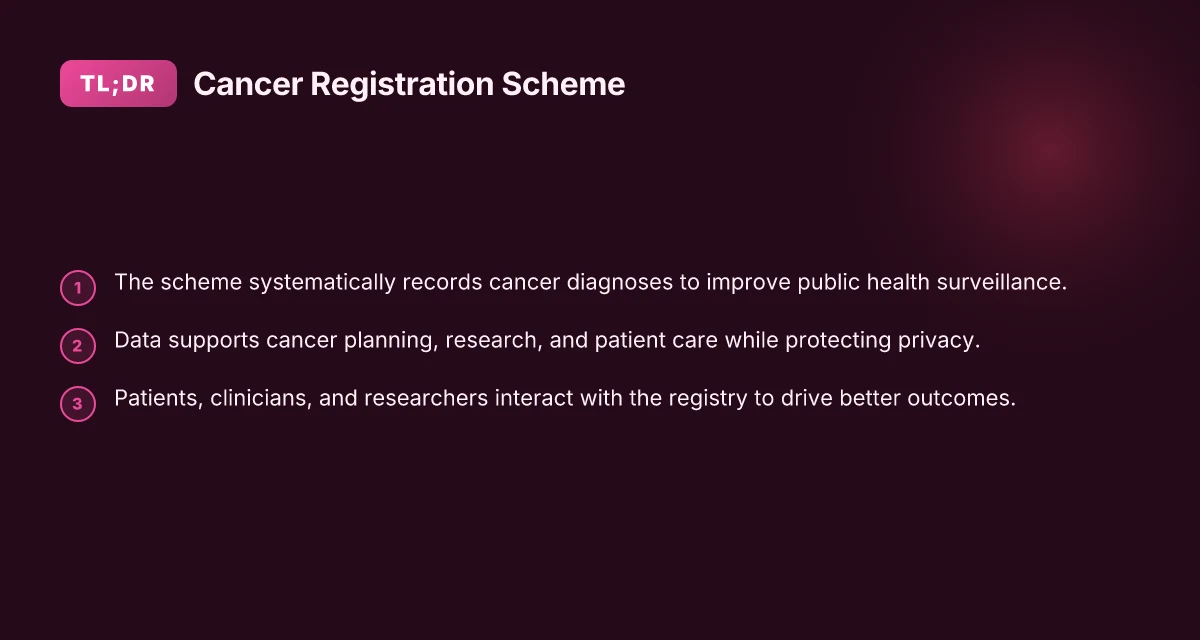
- Participation is typically passive: patients don’t need to do anything, and diagnoses are captured from routine clinical care.
- Data privacy protections are in place. In most cases, information used for research is de-identified.
- Registries help improve public health outcomes by guiding screening programs, resource allocation, and clinical guidelines.
- If you have questions about how your data is used, you can contact the healthcare provider or the national registry’s privacy office. In some places, you may have the right to opt out of certain data uses, depending on local law.
How to engage with the system as a clinician or administrator
- Ensure timely and accurate reporting: Encourage clinicians to complete all required fields and verify diagnoses against pathology reports.
- Adopt coding standards: Use consistent cancer site classifications and staging codes to facilitate reliable analyses.
- Invest in data quality: Implement regular data quality checks, staff training, and feedback loops to reporting sites.
- Collaborate across institutions: Linkages between hospitals, laboratories, and death registries improve data completeness.
- Communicate impact: Share findings with clinicians and administrators to drive improvements in care pathways and resource planning.
Public vs. Private Data and Patient Transparency Help Smokers: Practical Support and Strategies to Quit or Reduce Harm
| Topic | Cancer Registration Scheme | Hospital Records | Public Health Surveillance | Research Registry |
|---|---|---|---|---|
| Publicly available data | Aggregated statistics; no identifiable data | No patient-level data shared publicly | Public dashboards, summarized findings | Access via approved projects |
| Identifiable data | De-identified or coded; rare re-identification risk | Contains identifiers | No direct identifiers in public outputs | Re-identification risk mitigated; access controls |
| Patient notification | Often explained during enrollment; opt-out where allowed | Informed consent for data use varies | General privacy notices | Consent or ethics approval required |
| Data use transparency | Governance policies; annual reports | Internal use; audit trails | Public health reports | Research proposals, governance review |
| Rights for patients | Opt-out where permitted; data minimization | Data subject rights per policy | Opt-out where applicable | Consent and ethics compliance |
Compiled November 2026; check the provider's site for current details.
International and national variations
Cancer Registration Schemes differ by country in terms of:
- Legal framework and consent requirements
- Data privacy rules and access policies
- The granularity of data collected (e.g., genetic or molecular data)
- The cadence of data releases and public reporting
- The extent of linkage with screening programs, biobanks, or national health databases
Despite these differences, the underlying purpose remains the same: to provide a reliable, timely picture of cancer burden and outcomes to guide action.
The future of Cancer Registration Schemes
Advances in health data science are shaping how registries operate: Adolescent Smoking: Understanding, Risks, and Ways to Help Youth Quit
- Real-time or near-real-time reporting improves responsiveness to outbreaks or treatment innovations.
- Expanded data elements, including molecular subtypes and treatment regimens, support precision medicine research.
- Interoperability standards enable seamless data sharing across systems and borders.
- Data linkage with genomic, environmental, and social determinants data enriches risk modeling and equity analyses.
- Patient-facing tools and dashboards may offer individuals insights into local cancer trends and screening opportunities.
However, these advancements bring challenges:
- Managing data quality as data sources multiply
- Ensuring privacy with more detailed data
- Addressing disparities in data collection and access across regions
Careful governance, transparent methodologies, and ongoing stakeholder engagement will be essential.
Final takeaway and recommendation
A Cancer Registration Scheme is a cornerstone of modern cancer control. It aggregates high-quality, population-level data that informs prevention, early detection, clinical guidelines, and health system planning. For patients, clinicians, and researchers, understanding how the registry works helps maximize its benefits while safeguarding privacy. If you are involved in cancer care or health policy, engage with your national or regional registry: learn the data you can access, participate in data quality initiatives, and use the insights to drive improvements in care and outcomes. Continuous collaboration among hospitals, laboratories, researchers, and public health authorities will strengthen cancer surveillance and, ultimately, the fight against cancer.