Co-op research: what it is, why it matters, and how to do it well
A practical guide to cooperative research, its benefits, methods, and best practices for teams and organizations.
Co-op research is a collaborative research approach where multiple parties work together toward common goals, sharing resources, data, and insights. It emphasizes cooperation over competition, openness over opacity, and impact over prestige. In practice, co-op research can involve universities, industry partners, non-profits, government agencies, communities, and even individuals. The aim is to produce knowledge that is more robust, applicable, and scalable by drawing on diverse expertise and perspectives.
Comparison of Co-op Research Approaches (Differentiating factors)
| Factor | Co-op with Academia | Industry-led Co-op | Community-based Co-op |
|---|---|---|---|
| Primary goal | Knowledge generation | Product/solution impact | Community benefit |
| Stakeholders | Researchers, university partners | Company teams, sponsors | Community members, local orgs |
| Funding source | Grants, grants + match | Corporate funding | Grants, donations, in-kind |
| Intellectual property | Shared, often open | Company-owned | Shared/community-owned |
| Speed to results | Moderate | Fast | Variable |
| Risk level | Moderate | Medium to high | Medium to low |
| Governance model | Formal partnership agreement | Steering committee | Community council |
Compiled November 2026; check the provider's site for current details.
What makes co-op research different
- Shared purpose: All partners agree on the research question and expected outcomes.
- Resource pooling: Teams contribute time, funding, data, or facilities to a common pool.
- Joint governance: Decisions are made through inclusive processes, not unilateral mandates.
- Mutual benefit: Each partner gains value, whether through knowledge, tools, or practical applications.
Co-op research often contrasts with traditional, single-institution studies where a single entity drives the agenda and owns the data. In co-op models, data stewardship, authorship, and benefit sharing are negotiated upfront to prevent disputes and encourage ongoing collaboration.
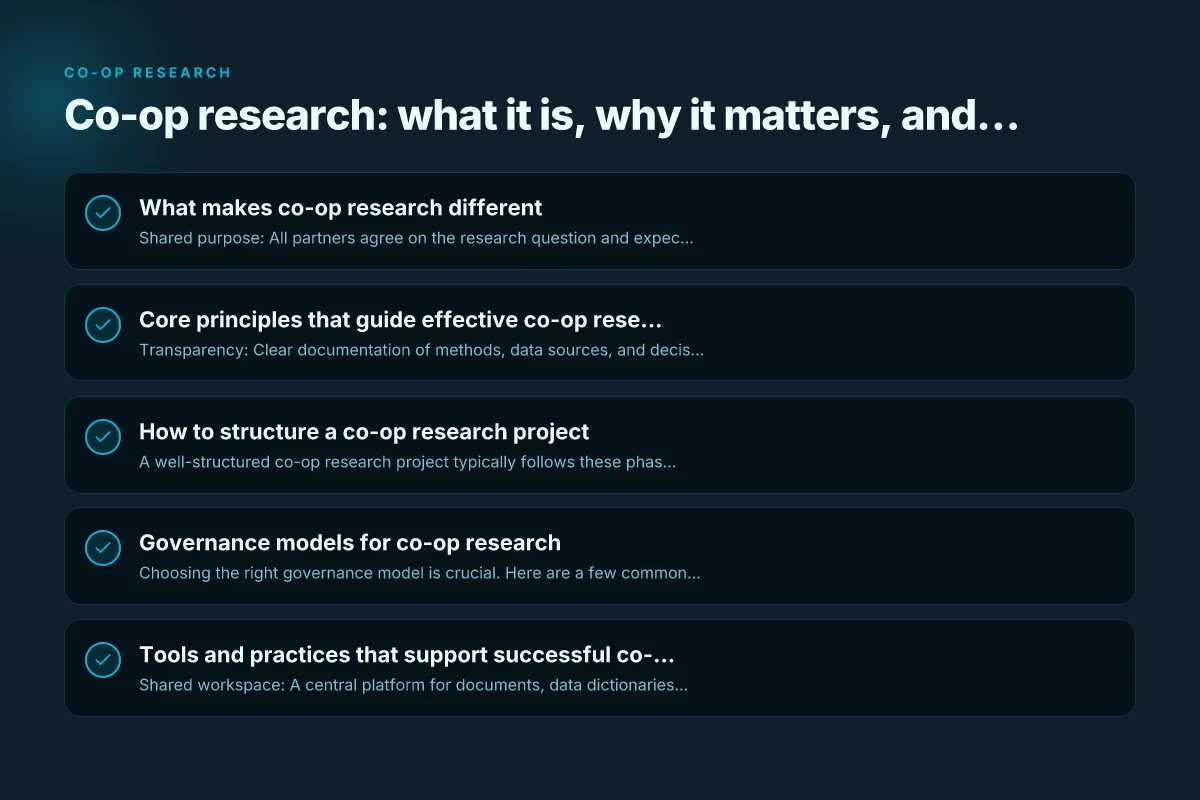
Core principles that guide effective co-op research
- Transparency: Clear documentation of methods, data sources, and decision-making processes.
- Reproducibility: Open or shareable methods and, where possible, data (with privacy safeguards).
- Inclusivity: Involve diverse stakeholders, including underrepresented groups who are affected by the research.
- Accountability: Define roles, responsibilities, and expected contributions. Monitor progress.
- Sustainability: Plan for long-term impact beyond a single project or grant cycle.
- Ethics and data governance: Align with legal and ethical standards, including data privacy and ownership.
If you’re designing a co-op research program, articulate these principles in a formal charter or memorandum of understanding at the outset. This helps prevent scope drift and keeps all partners aligned.
How to structure a co-op research project
A well-structured co-op research project typically follows these phases:
- Initiation and scoping
- Define the shared problem, scope, and success criteria.
- Identify partners, roles, and governance mechanisms.
- Establish data rights, licensing, and governance policies.
- Design and planning
- Develop a research plan with milestones, deliverables, and risk management.
- Agree on data collection methods, analytics tools, and standards.
- Create a collaboration calendar and communication norms.
- Data collection and analysis
- Coordinate data collection across partners while respecting privacy and consent.
- Use interoperable data formats and documented workflows.
- Conduct joint analyses, with cross-checks and validation from multiple perspectives.
- Synthesis and dissemination
- Synthesize findings into actionable insights, policy recommendations, or products.
- Co-author reports or papers to reflect the collaborative effort.
- Share results with stakeholders, practitioners, and the broader community.
- Evaluation and iteration
- Assess impact against the original success criteria.
- Reflect on process learning and areas for improvement.
- Plan for scalability, replication, or follow-up research.
Governance models for co-op research
Choosing the right governance model is crucial. Here are a few common approaches: Untitled Document: Understanding What It Is and How to Fix It
- Consortium model: A formal alliance of organizations with a steering committee, shared budget, and agreed milestones.
- Network model: Fluid participation where partners join for specific tasks. Governance is lighter-weight.
- Embedded co-PI model: A primary institution coordinates while co-PIs from partner organizations contribute leadership on sub-projects.
- Community-driven model: Stakeholders and community members co-create research questions and interpret results.
Whichever model you choose, codify governance in a written agreement that covers:
- Decision-making processes
- Intellectual property and data ownership
- Authorship and credit
- Resource commitments and accountability
- Conflict resolution and exit clauses
Tools and practices that support successful co-op research
- Shared workspace: A central platform for documents, data dictionaries, and project calendars.
- Open data and code practices: Where permissible, publish datasets and code to enable reproducibility.
- Standardized data schemas: Use common ontologies or schemas to facilitate integration.
- Versioned documentation: Track changes to methods, data, and analyses over time.
- Regular check-ins: Stand-up-style updates or cadence meetings to maintain alignment.
- Stakeholder mapping: Identify who is affected by the research and who should be involved in decisions.
Table: A quick comparison of collaboration approaches
| Approach | Strengths | Challenges | Best Use Case |
|---|---|---|---|
| Consortium | Strong funding and governance | Complex coordination | Large-scale, multi-year studies with shared impact goals |
| Network | Flexible participation | Variable commitment | Exploratory projects with diverse expertise |
| Embedded co-PI | Deep integration with partners | Dependency on partner leadership | Industry-academic research with practical, near-term outcomes |
| Community-driven | High relevance and legitimacy | Risk of scope drift | Research that directly informs community needs |
Core principles and how they map to practice
| Principle | User-centric design | Transparency | Reciprocity | Evidence-based iteration | Inclusivity | Documentation |
|---|---|---|---|---|---|---|
| What it means | End-user voice guides work | Open communication of progress | Mutual benefits and credit | Data-driven decisions | Diverse voices included | Records of decisions and learnings |
| How to implement | Co-design sessions | Publish findings, logs | Fair credit, shared outcomes | Pilot tests, metrics | Accessible participation | Living project repo |
| Indicators | User stories, feedback | Public updates | Benefit statements | Metrics dashboards | Demographic reach | Versioned docs |
Compiled November 2026; check the provider's site for current details. Murals: A Creative Guide to Transforming Spaces with Wall Art
Common pitfalls in co-op research and how to avoid them
- Ambiguity about goals: Create a concise charter and success metrics at the start.
- Unequal power dynamics: Ensure equitable participation, transparent decision rights, and fair credit.
- Data stovepipes: Build interoperable data standards and cross-team data sharing agreements.
- Scope creep: Use a formal change-control process and maintain a living project dashboard.
- Funding misalignment: Align the funding model with governance and deliverables from day one.
Mitigation strategies include:
- Kickoff workshops to align on values and expectations.
- An explicit data governance plan with owners for each data asset.
- Rotating leadership roles to prevent dominance by a single partner.
- Independent facilitation for critical decision points.
Ethical and legal considerations
Co-op research often intersects with sensitive data, community impact, and regulatory frameworks. Consider:
- Informed consent and participant rights for any data involving people or communities.
- Anonymization and privacy-preserving techniques for data sharing.
- Compliance with data protection laws (e.g., GDPR, HIPAA) and sector-specific regulations.
- Intellectual property arrangements that respect contributors’ rights while enabling broad use.
- Benefit sharing: Ensure that outcomes reasonably benefit all partners, including communities involved.
Measuring impact and success
Impact in co-op research can be both tangible and intangible. Useful metrics include:
- Knowledge outputs: publications, datasets, tools, protocols.
- Practical outcomes: prototypes, policy briefs, or implementation pilots.
- Stakeholder benefits: capacity building, skill development, or improved processes.
- Collaboration health: partner satisfaction, retention, and governance effectiveness.
- Sustainable impact: downstream adoption, scaling potential, or policy changes.
A practical approach is to establish a logic model at the outset, linking inputs to activities, outputs, outcomes, and long-term impact. Revisit and revise the model as the project evolves. Gallery: A Complete Guide to Understanding, Building, and Curating Your Visual Space
Quick-start structure for a co-op research project
| Phase | Activities | Outputs | Responsible roles | Timeframe | Success signals |
|---|---|---|---|---|---|
| Initiation | Define problem, stakeholders | Project charter | Project lead, sponsor | 1–2 weeks | Charter approved |
| Design | Co-create plan, ethics | Research plan, consent | Researchers, community reps | 2–4 weeks | Plan signed off |
| Execution | Collect data, iterate | Datasets, findings | Researchers, partners | 4–12 weeks | Data quality, insights |
| Evaluation | Analyze impact, report | Impact report | Analysts, evaluators | 2–4 weeks | Clear conclusions |
| Sustainment | Share learnings, scale | Playbook, guidelines | All partners | Ongoing | Adoption/rapport built |
Compiled November 2026; check the provider's site for current details.
When and why to choose co-op research
- You work on problems that span multiple domains and require diverse expertise.
- Your aim is to create solutions with higher real-world relevance and uptake.
- You want to share risk and resources to address complex challenges.
- Open science, transparency, and community engagement align with organizational values.
Co-op research is especially powerful in areas like public health, climate and environmental studies, urban planning, education, and technology development where collaboration accelerates impact and builds trust across sectors.
Practical steps to begin a co-op research initiative
- Define a compelling shared problem and measurable aims.
- Identify potential partners with complementary strengths and a track record of collaboration.
- Draft a lightweight governance charter covering roles, data, and IP.
- Agree on data standards and a secure, accessible data workspace.
- Establish a transparent communication plan, including regular milestones.
- Launch a pilot phase to test collaboration dynamics and refine processes.
- Scale up with broader participation, additional funding, and broader dissemination.
If you’re new to co-op research, start small: a one-year pilot with 2–4 partners, a clearly scoped question, and a published plan. Use the pilot to learn what works in your context before expanding. Sharing: Why Collaboration Wins and How to Do It Well
Final recommendation
Co-op research is not a one-size-fits-all method. Its strength lies in deliberate, principled collaboration. Begin with a strong governance framework, invest in open, interoperable data practices, and prioritize inclusive participation. By aligning on shared goals, ensuring transparent decision-making, and focusing on measurable impact, co-op research can yield robust knowledge and real-world benefits that individual actors could not achieve alone. If you’re contemplating a collaborative research effort, commit early to ethics, equity, and open communication, and design your project for both rigor and applicability.