Sharing: Why Collaboration Wins and How to Do It Well

A practical guide to sharing effectively, concepts, benefits, and actionable tips for individuals and teams.
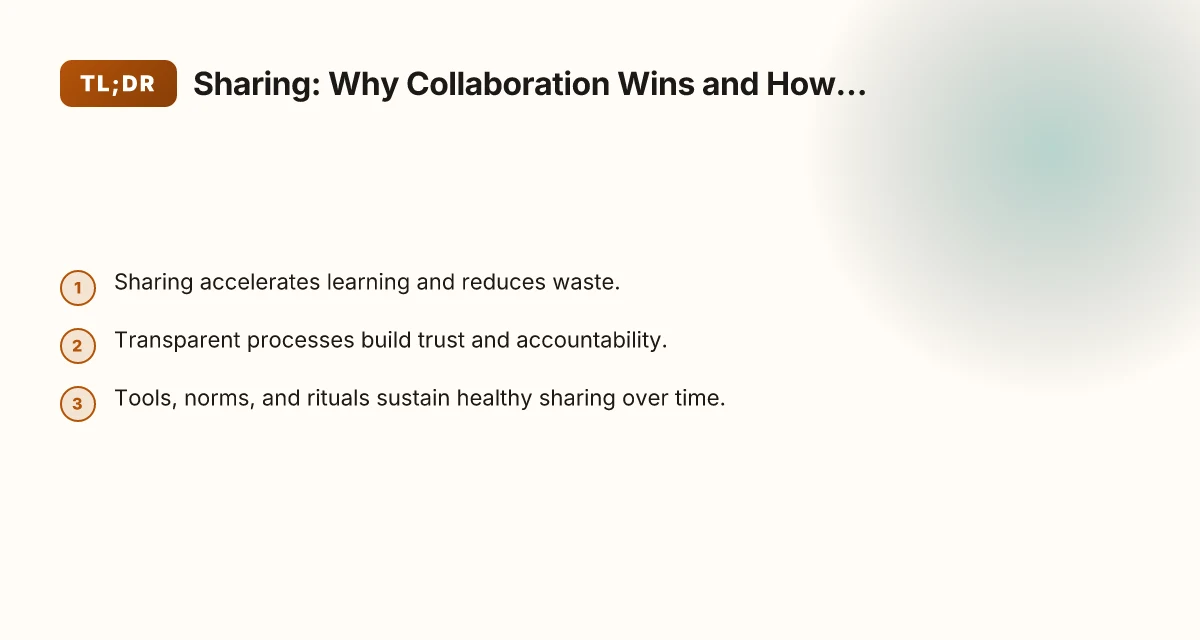
The act of sharing is a powerful driver of progress. When people openly exchange ideas, resources, and feedback, organizations move faster, learning compounds, and outcomes improve. Yet sharing isn’t just about moving information from one person to another. It’s about shaping a culture where collaboration is the default, where boundaries are clear but not rigid, and where every participant contributes to a larger purpose. This guide dives into what sharing means in practice, why it matters, and how you can cultivate it in work and life.
Compare flavors of sharing
| Flavor | Core idea | Good for | Potential risk | Example | How to start |
|---|---|---|---|---|---|
| Open sharing | Broad access | Communities | Overexposure | Open-source docs | Start with a public draft |
| Controlled sharing | Limited access | Teams with privacy needs | Coordination burden | Internal project repo | Define access levels |
| Reciprocal sharing | Give-and-take • mutual aid | Peer networks | Dependency on others | Skill swap circle | Set reciprocity rules |
| Sequential sharing | Step-by-step handoffs | Projects with stages | Bottlenecks if stalled | Handover checklists | Map handoff points |
| Resource-sharing | Shared assets | Resource-constrained contexts | Version conflicts | Shared library | Agree on versioning |
Compiled November 2026; check the provider's site for current details.
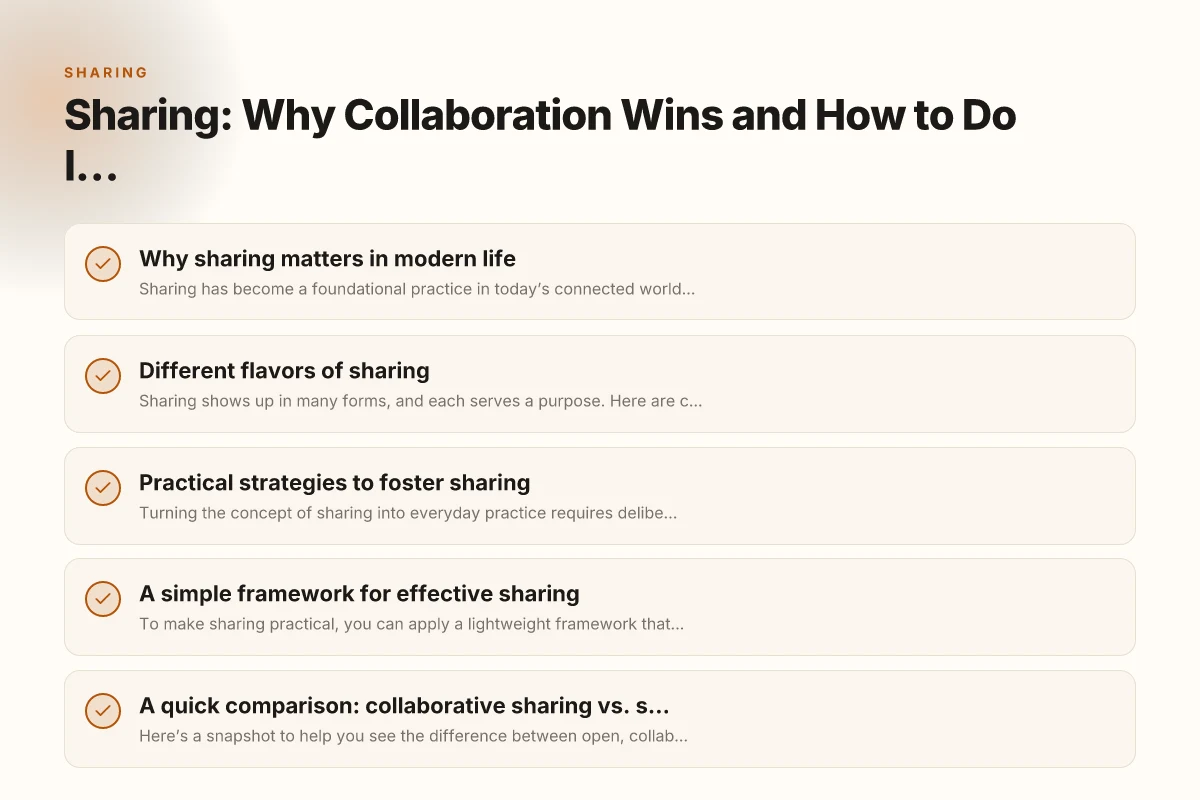
Why sharing matters in modern life
Sharing has become a foundational practice in today’s connected world. A few core reasons:
- Speed and efficiency: Ideas and resources spread faster when people don’t reinvent the wheel.
- Innovation through diversity: Different perspectives spark new approaches and solutions.
- Accountability and trust: Open sharing creates visibility into work and progress.
- Learning loops: Feedback from others shortens learning cycles and reduces errors.
In teams and organizations, successful sharing translates into better decision-making, higher quality work, and a more resilient culture. Individuals who share knowledge frequently often build stronger networks, gain credibility, and uncover opportunities they wouldn’t have found in isolation.
Different flavors of sharing
Sharing shows up in many forms, and each serves a purpose. Here are common flavors you’re likely to encounter:
Knowledge sharing
- Documenting processes, notes, and lessons learned.
- Creating playbooks, FAQs, and onboarding guides.
- Writing briefs, standups, and retrospectives to capture insights.
Resource sharing
- Releasing tools, templates, and code libraries.
- Lending equipment, spaces, or access to networks.
- Sharing data sets, research results, or design assets.
Social sharing
- Publicly communicating wins, challenges, and milestones.
- Cross-team collaboration and informal mentoring.
- Open channels for questions, feedback, and ideas.
Decision-sharing
- Making rationale visible for key choices.
- Providing clear ownership and timelines.
- Listing trade-offs and assumptions to align stakeholders.
Feedback sharing
- Constructive critique that’s specific and actionable.
- Regular performance conversations and reviews.
- Public recognition of contributions and lessons learned.
Practical strategies to foster sharing
Turning the concept of sharing into everyday practice requires deliberate habits, norms, and tools. Here are actionable strategies you can adopt. Donegall Pass: A Storied Belfast Street and Its Modern Relevance
Establish clear expectations
- Define what to share, when, and with whom.
- Set minimum sharing standards (for example, meeting notes within 24 hours, code comments with rationale, data sources cited).
- Create lightweight guidelines that fit your culture and avoid bureaucratic overhead.
Normalize documentation
- Capture decisions, priorities, and outcomes in living documents.
- Use templates for consistency (briefs, retrospectives, handoffs).
- Make documentation easy to find with a searchable repository or knowledge base.
Create safe sharing spaces
- Build channels that are respectful and inclusive.
- Establish norms for feedback: specific, timely, and kind.
- Encourage questions and curiosity, not judgment.
Use rituals and cadences
- Regular knowledge-sharing moments (weekly demos, monthly knowledge hours).
- Rotating “sharing captain” roles to distribute responsibility.
- Quick post-mortems after projects to capture what worked and what didn’t.
Invest in the right tools
- Knowledge bases, internal wikis, or document repositories.
- Collaboration platforms for real-time and asynchronous sharing.
- Versioned artifacts (code, design files) with clear ownership.
A simple framework for effective sharing
To make sharing practical, you can apply a lightweight framework that covers what to share, how to share, and how to follow up.
- What to share: outcomes, decisions, rationale, sources, and next steps.
- How to share: concise summaries, structured formats, and links to originals.
- How to follow up: assign owners, set due dates, and schedule check-ins.
A practical approach is the SHARE framework:
- S: Source material (where it came from).
- H: Highlights (key takeaways).
- A: Analysis (why it matters).
- R: Recommendations (what should happen next).
- E: Evidence (data, references, links).
Compare practical strategies to foster sharing
| Strategy | Description | When to use | Required effort | Benefit | Quick start |
|---|---|---|---|---|---|
| Documentation norms | Standard templates | New teams | Medium | Consistency | Create a template cheat sheet |
| Pair collaboration | Two people on tasks | Complex tasks | Medium | Shared understanding | Pair for the first sprint |
| Knowledge bases | Central repository | Growing info | Medium | Reusability | Add key docs weekly |
| Regular check-ins | Scheduled syncs | Ongoing projects | Low | Alignment | 15-min daily stand-up |
| Incentive alignment | Rewards for sharing | Flat hierarchies | Medium | Motivation | Recognize sharing acts |
Compiled November 2026; check the provider's site for current details. Community Training Co-operative: Empowering Skills, Shared Learning, and Local Impact
A quick comparison: collaborative sharing vs. siloed sharing
Here’s a snapshot to help you see the difference between open, collaborative sharing and restricted, siloed sharing.
| Dimension | Collaborative sharing | Siloed sharing |
|---|---|---|
| Access | Broad, with appropriate permissions | Narrow, often restricted to a few |
| Transparency | High: decisions, data, and learnings are visible | Low: information is hard to find or hidden |
| Feedback | Continuous and constructive | Limited and delayed |
| Speed | Fast: faster iteration and learning | Slow: bottlenecks and duplicated effort |
| Trust | Builds through consistent openness | Erodes when information is hoarded |
Notes:
- The right balance matters. Not all information should be public, but raising visibility where feasible accelerates progress.
- Practices like versioning, attribution, and data governance help maintain trust in open sharing.
Common pitfalls and how to avoid them
Sharing is powerful, but it can backfire if done poorly. Watch for these missteps and use the fixes suggested.
- Over-sharing without intent: Share with purpose and a clear audience. Avoid dumping everything without context.
- Under-sharing in moments of risk: When decisions are sensitive, share the rationale and non-sensitive details to maintain trust.
- Sharing for show rather than substance: Focus on real value, not ego. Share lessons learned and actionable next steps.
- Information overload: Curate and summarize. Provide digests and executive summaries so people can act, not just read.
Tips to mitigate: The Community Drum Circle
- Use short, structured updates with clear takeaways.
- Tag relevant stakeholders and set expectations for response times.
- Archive old updates to keep knowledge current and navigable.
Measuring the impact of sharing
If you’re trying to build a culture of sharing, you’ll want signals that it’s working. Consider these indicators:
- Lead time reduction: Faster decisions due to readily available information.
- Rework rate: Fewer repeated questions or duplicated efforts.
- Cross-functional collaborations: More projects involving multiple teams.
- Onboarding speed: New hires ramp up quickly thanks to accessible docs and playbooks.
- Feedback quality: More frequent, constructive feedback that leads to improvements.
Qualitative indicators also matter: perceived trust, psychological safety, and a sense of belonging in the team.
Compare impact measures for sharing
| Measure | What it tracks | Source data | Frequency | Target | Action if off target |
|---|---|---|---|---|---|
| Access breadth | Who can view/edit | Access logs | Monthly | Broader reach | Expand permissions |
| Collaboration depth | Degree of joint work | Project records | Monthly | More joint tasks | Encourage cross-team tasks |
| Time-to-value | Time from idea to output | Project timelines | Per project | Faster delivery | Remove blockers |
| Reuse rate | Reused assets/docs | Reuse metrics | Quarterly | Higher reuse | Centralize assets |
| Trust level | Perceived reliability | Surveys | Biannually | Increase trust | Improve transparency |
Compiled November 2026; check the provider's site for current details. Addresses: A Practical Guide to Understanding, Finding, and Using Addresses
Final recommendation: make sharing a living practice
Sharing isn’t a one-off gesture. It’s a living practice that evolves with your team, tools, and goals. Start small with a defined sharing habit, such as a weekly knowledge share or a simple decision log. Align on norms that elevate trust and clarity. Invest in lightweight templates that lower the friction of sharing. And always close the loop, follow up on what was shared with concrete actions, owners, and timelines.
Over time, you’ll notice a shift: faster learning, more cohesive teams, and clearer momentum toward your objectives.
If you’re just starting, here are three starter steps:
- Step 1: Introduce a 15-minute weekly knowledge share where one teammate presents a lesson, a tool, or a project outcome, with a short Q&A.
- Step 2: Create a simple decision log that records the decision, the rationale, the data used, and the next review date.
- Step 3: Build a shared repository with templates for onboarding, troubleshooting, and standard operating procedures.
By leaning into sharing as a core practice, you’ll unlock collaboration that compounds over time, enabling everyone to contribute more effectively and feel more connected to the work they do. The result is a healthier, more adaptive, and more innovative environment. Reports: A Complete Guide to Understanding, Creating, and Using Reports Effectively