Donations: How to Give Effectively, Tax-Smartly, and Ethically

A practical guide to giving: types, impact, tax considerations, and tips to maximize the good your donations do.
The act of donating is more than sending money. It is a choice about what you value, how you want to contribute, and the impact you hope to see in the world. Whether you are giving to a local charity, a global nonprofit, or a peer project, the fundamentals remain the same: clarity about intent, informed selection, and stewardship of resources. This guide walks you through the essentials of making donations that align with your goals, maximize impact, and fit your financial situation.
Comparison of donation types and when to use them
| Type | When to use | Pros | Cons |
|---|---|---|---|
| Cash gifts | Quick, flexible support | Easy to give; broad impact | Security risk; needs vetting |
| Donor-advised funds | Planned giving; multi-year impact | Tax planning; grants to multiple charities | Fees; processing time |
| Grants to nonprofits | Long-term programs | Accountability; sustainable | Selection process; limited control |
| In-kind gifts | Specific needs (goods/services) | Tangible help; may reduce costs | Shipping/logistics; valuation |
| Bequests | Estate planning | Legacy impact; potential tax benefits | Irrevocable; delayed results |
Compiled November 2026; check the provider's site for current details.
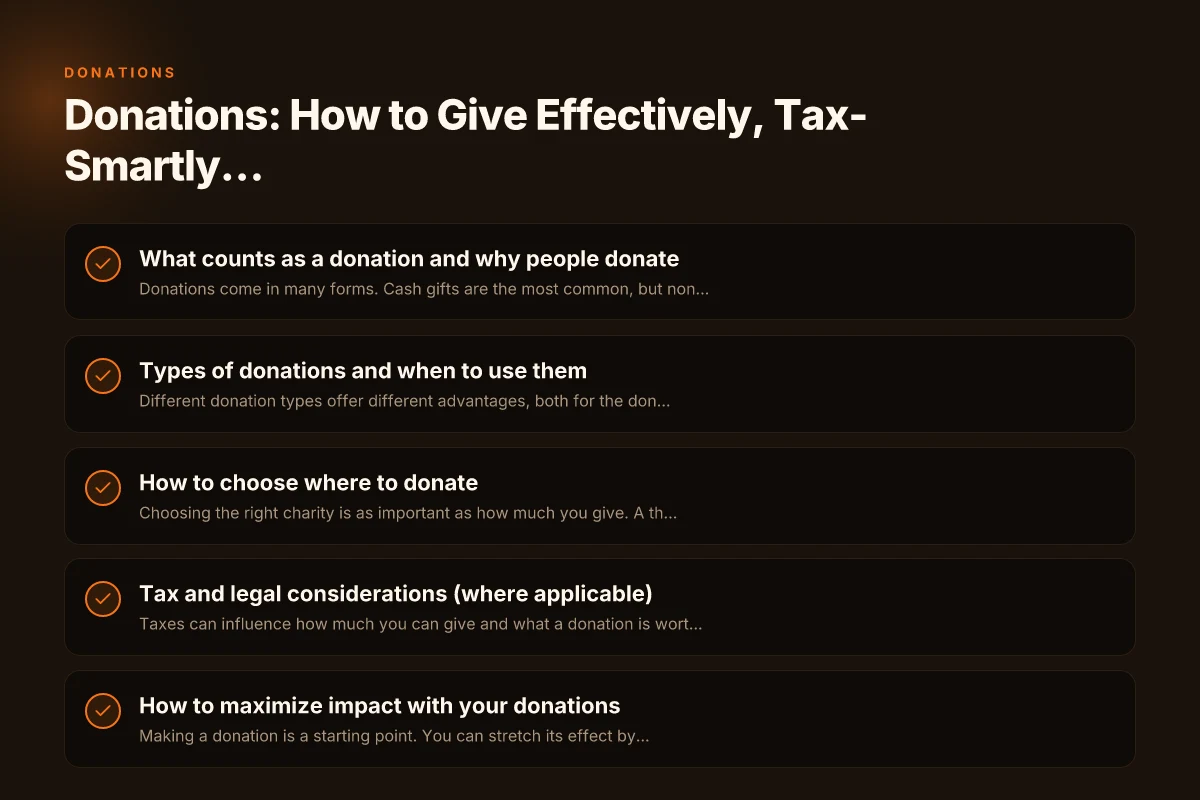
What counts as a donation and why people donate
Donations come in many forms. Cash gifts are the most common, but nonprofits also grate for in-kind gifts, goods, and services. Some people donate time as volunteers or offer professional expertise at no charge. Others donate appreciated securities or retirement assets to minimize taxes or to unlock greater giving power.
Why people donate varies. Sense of social responsibility, faith, community ties, and personal stories of impact motivate giving. For many, donating is about participating in solutions rather than merely consuming services. Understanding your motivation helps you choose causes that sustain your commitment over time.
Types of donations and when to use them
Different donation types offer different advantages, both for the donor and the recipient. Here is a quick overview to help you decide what fits your goals, finances, and convenience.
Cash donations
- Simple and flexible: write a check, use a donation portal, or set up recurring gifts.
- Immediate impact for operational needs like programs, staffing, or emergency relief.
In-kind donations
- Goods: clothing, food, equipment, or supplies that charities can use or distribute.
- Services: professional help (legal, marketing, IT), or skilled labor.
Stock and securities
- Donating appreciated securities can avoid capital gains taxes and provide a larger gift than cash.
- Often benefits both donor and charity, especially for high-net-worth individuals.
Donor-advised funds (DAFs)
- A charitable giving account you fund today, then recommend grants over time.
- Good for people who want to time their distributions or optimize taxes, while retaining control over recommendations.
Charitable gifts from retirement accounts
- Qualified Charitable Distributions (QCDs) from IRAs can be tax-efficient for donors aged 72 and older (where permitted).
- Reduces taxable income while supporting preferred charities.
Planned giving
- Bequests in wills or estate plans, life-income gifts, or charitable remainder trusts.
- Enables larger gifts over time and supports long-term planning.
Matching gifts and employer programs
- Some employers match charitable contributions, doubling the impact.
- Check HR or corporate philanthropy programs for specifics.
Tax and legal considerations by donation type Contacts: A Practical Guide to Managing Your Network and Communication
| Topic | Cash gifts | Donor-advised funds | Public charities grants | In-kind gifts | Bequests |
|---|---|---|---|---|---|
| Tax deduction eligibility | Yes; itemized/limited | Yes; occurrence via fund | Yes; to charity | Yes; value reputable | Yes; estate deduction |
| Required documentation | Receipt; date | Statement from fund | Receipt; grant report | Receipt; appraisal if needed | Will/estate paperwork |
| Limits / caps | Percent of AGI | Generally limited by fund rules | Program-specific | Valuation rules | Estate tax planning |
| Public vs private | Public charity recipient | Intermediary | Direct grantor | Charitable organization | Estate instrument |
| Addressing compliance | Donor privacy vs records | Fund governance | Charity status | Valuation standards | Probate compliance |
Compiled November 2026; check the provider's site for current details.
How to choose where to donate
Choosing the right charity is as important as how much you give. A thoughtful process enhances impact, reduces waste, and helps you stand by your values.
Define your giving goals
- What issue matters most to you (education, health, environment, vulnerable populations, etc.)?
- Do you want to address immediate crises or fund long-term solutions?
- Are you hoping to learn and engage more deeply with the cause?
Research and due diligence
- Review the charity’s mission, programs, geographic focus, and leadership.
- Look at impact data, annual reports, and independent ratings (e.g., charity evaluators).
- Verify tax-exempt status and financial transparency.
Evaluate impact and efficiency
- Assess program outcomes, scalability, and unintended consequences.
- Compare administrative costs to program costs, but remember that some overhead supports capacity and quality.
- Consider where your contribution can leverage partnerships or replication.
Align with your values
- Faith-based, secular, global or local impact, your alignment matters for ongoing engagement.
- Consider whether you prefer a direct service recipient approach or systemic, policy-oriented work.
Tax and legal considerations (where applicable)
Taxes can influence how much you can give and what a donation is worth to you. Rules vary by country, but several common themes apply broadly.
- Tax-deductible gifts: In many jurisdictions, donations to approved charities are deductible against income, reducing tax liability.
- Limits and expiration: Some regions cap annual deductions relative to income. Others allow unlimited deductions for certain types of gifts.
- Valuation of non-cash gifts: In-kind donations require appraisal or fair market value assessment.
- Documentation: Keep receipts, acknowledgment letters, and, for large gifts, formal appraisal records.
- Qualified opportunities: Donating through a donor-advised fund or certain vehicle accounts can optimize timing and tax outcomes.
If you’re unsure, consult a tax professional who understands charitable giving in your jurisdiction. They can help you model different gift types, cash, securities, DAFs, or estate gifts, and their tax implications. Belfast Together: Building Community, Culture, and Resilience
Table: Quick comparison of gift types by impact and administration effort | Gift type | Impact potential | Tax considerations | Administration ease | Ideal for | | Cash donations | Immediate program support | Usually deductible; varies by country | Easy (online portals) | Most donors seeking simplicity | | Appreciated securities | High potential tax efficiency | Capital gains avoided; possible value deduction | Moderate (transfer process) | Investors with long-term holdings | | Donor-advised funds | Flexible, scalable giving | Tax planning advantages; timing control | Moderate to high (account setup) | Donors with multi-year planning | | In-kind gifts | Tangible support for specific needs | Value-based deduction; may require appraisal | Moderate (logistics) | Donors with goods or specialized services | | Estate gifts | Long-term impact; legacy | Potential estate tax benefits | Requires planning | Donors seeking lasting influence |
How to maximize impact with your donations
Making a donation is a starting point. You can stretch its effect by thinking strategically about timing, stewardship, and collaboration.
- Start with a plan: Set annual targets, track outcomes, and adjust as needs evolve.
- Diversify your giving: Mix immediate, programmatic gifts with longer-term investments like endowments or DAFs.
- Build relationships: Engage with grantees, volunteer, or offer expertise to deepen impact and learn from results.
- Be transparent: Communicate your criteria and expectations. Solicit feedback and public impact reports.
- Consider matching and leverage: Use employer programs or joint campaigns to amplify a single contribution.
- Plan for sustainability: Favor organizations that build capacity and create resilient programs.
A simple framework to decide where to donate (impact vs ease)
| Decision axis | High impact, long-term | Moderate impact, mid-term | Quick relief, immediate | Local community focus | Global reach focus |
|---|---|---|---|---|---|
| Cash directly to charity | Yes | Yes | Yes | Yes | Yes |
| Intermediary fund usage | Yes | Yes | No | No | Yes |
| In-kind gifts | Yes | No | Yes | Yes | No |
| Community foundations | Yes | Yes | No | Yes | No |
| Disaster relief funds | No | No | Yes | No | No |
Compiled November 2026; check the provider's site for current details. Training course Introduction to ICT
A simple, practical approach to a first donation
If you’re new to giving or want to start small, here’s a straightforward method to get going:
- Identify a cause you care about and a local organization you can trust.
- Check their impact data and financials for the past 2–3 years.
- Decide on a gift type: cash for simplicity, or a small stock donation if you hold appreciated assets.
- Set a donation amount and a frequency (one-time, quarterly, annually).
- Request a simple acknowledgment and impact update from the charity.
- If you can, offer to volunteer or lend a skill to deepen the relationship.
The ethics of donations: avoid common pitfalls
Donating responsibly means avoiding a few common traps that can diminish value or cause harm.
- Donor dependency: Don’t become someone who creates program reliance without building local capacity.
- Mission drift: Don’t fund activities outside the charity’s core mission.
- Lack of accountability: Avoid organizations with opaque reporting or inconsistent outcomes.
- Greenwashing or hype: Look for evidence of impact beyond glossy campaigns.
- Cultural insensitivity: Ensure programs respect local contexts and communities.
Final thoughts and recommendations
Donations are a powerful tool for good when approached with clarity, diligence, and a long-term mindset. Start with a clear purpose, do your homework, and choose a donation type that aligns with your financial situation and values. Consider pairing gifts with engagement, volunteering time, sharing expertise, and communicating impact, to ensure your generosity resonates beyond the initial transaction. If you’re contemplating significant giving, seek professional guidance for tax-efficient strategies and estate planning to maximize both your impact and your peace of mind. In the end, thoughtful donations create ripples of change that extend far beyond the gift itself.