Education and Training: A Practical Guide to Lifelong Learning and Skill Development
A practical overview of education and training, why they matter, and how to choose effective pathways for lifelong learning.
Education and training are the core engines of personal and career development. They shape how we think, problem-solve, and adapt to a changing world. Whether you’re starting your first job, transitioning to a new field, or pursuing a personal passion, a structured approach to education and training helps you learn faster, retain more, and apply what you’ve gained with confidence. This guide offers a clear map of what education and training involve, how to choose the right path, and practical steps to maximize results.
Comparison of Education vs. Training
| Aspect | Education (formal) | Training (practical) | Key Considerations | Typical Duration |
|---|---|---|---|---|
| Primary goal | Knowledge, theory, credentials | Skills, proficiency, tasks | ||
| Delivery style | Lectures, coursework | Hands-on, practice-based | ||
| Typical providers | Universities, colleges | Vocational schools, on-the-job | ||
| Credential type | Degree / diploma | Certificate / badge | ||
| Cost range | Moderate to high | Moderate to low | ||
| Time to completion | Months to years | Days to months | ||
| Transferability | Broad, formal credits | Task-specific | ||
| Assessments | Exams, essays | Practical tests |
Compiled November 2026; check the provider's site for current details.
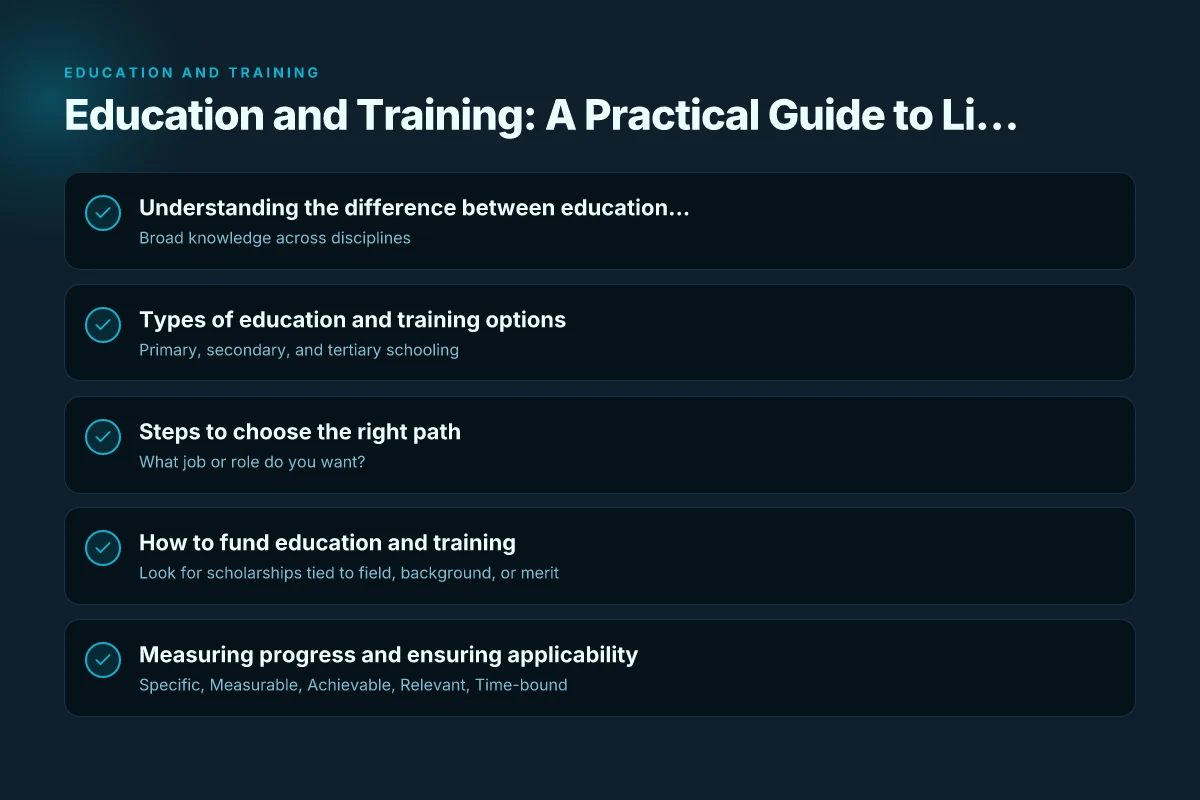
Understanding the difference between education and training
What education typically covers
- Broad knowledge across disciplines
- Critical thinking, theory, and conceptual frameworks
- Accreditation and recognized credentials
- Foundational skills used across many careers
What training typically covers
- Practical, job-specific skills
- Hands-on practice and performance standards
- Shorter timeframes and targeted outcomes
- Credentials that are often industry-recognized or competency-based
Education and training are complementary. Education provides the deep understanding that helps you adapt and innovate, while training translates that understanding into concrete abilities you can apply immediately on the job. When planning your path, consider both the breadth of education and the depth of training you need.
Types of education and training options
Formal education
- Primary, secondary, and tertiary schooling
- Degrees (associate, bachelor’s, master’s, doctoral)
- Accredited institutions and structured curricula
- Often longer time commitments and higher cost
Vocational and technical training
- Trade schools, apprenticeships, certificate programs
- Hands-on training focused on specific trades (electrician, plumber, HVAC, etc.)
- Strong industry connections and often high employability
Continuing education and professional development
- Short courses, workshops, and seminars
- Update knowledge on evolving topics (software, compliance, leadership)
- Applicable to current roles or to pivot to new ones
Online and hybrid learning
- Flexible schedules, self-paced courses, and remote collaboration
- Platforms range from MOOCs to university-backed programs
- Often a blend of video lectures, readings, assignments, and assessments
Informal and experiential learning
- On-the-job learning, mentoring, projects, and self-directed study
- Builds practical know-how and tacit skills
- Highly customizable and cost-effective
Credentialing and recognition
- Degrees, certificates, licenses, and badges
- Some fields require licensure (healthcare, teaching, engineering)
- Others rely on demonstrated competencies (badges, micro-credentials)
Types of Education and Training Options
| Option | Formal Education | Informal/Noncredit Learning | On-the-Job Training | Online/Flex Learning | Apprenticeships |
|---|---|---|---|---|---|
| Example | Bachelor’s degree | MOOCs, workshops | Mentored work shifts | Self-paced courses | Paid training with employer |
| Credential | Degree / certificate | Certificates not always issued | Certification often not required | Certificates / badges | Apprenticeship completion |
| Access | Structured programs | Open access | In-work setting | Global access | Employer-sponsored |
| Pace | Fixed schedule | Flexible | Part-time | Flexible | Structured with a mentor |
| Cost | Higher | Low to none | Low to moderate | Moderate | Often paid w/ wages |
| Duration | 9–48 months | Hours to months | Varies | Varies | 1–4 years |
Compiled November 2026; check the provider's site for current details.
Steps to choose the right path
Clarify your goal
- What job or role do you want?
- What level of mastery do you need (awareness, proficiency, expert)?
- Are you seeking a formal credential or practical skills?
Assess time, cost, and access
- How many hours per week can you commit?
- What is your budget, including tuition, materials, and fees?
- Do you need online access, or can you attend in person?
Consider your learning style
- Do you prefer structured syllabi or flexible, self-paced study?
- Are you motivated by deadlines, feedback, or hands-on practice?
- Do you value peer interaction and networking?
Research outcomes and quality
- Look at job placement rates, graduate outcomes, and industry recognition
- Verify accreditation, faculty credentials, and curriculum alignment with standards
- Seek reviews from current students or professionals in the field
Plan a blended approach
- Combine formal education with hands-on training and ongoing learning
- Use informal study to reinforce concepts and practice skills
- Build a portfolio of work, projects, or certifications to demonstrate capability
How to fund education and training
Scholarships, grants, and employer support
- Look for scholarships tied to field, background, or merit
- Many employers offer tuition reimbursement or professional development stipends
- Some industries provide funding for certifications that benefit the workforce
Savings and payment plans
- Budget for tuition and materials. Consider installment plans
- Some online programs offer lower total costs than traditional programs
Alternatives that maximize value
- Community colleges or vocational schools for cost-effective training
- Open educational resources (OER) and free online courses to test interest
- Micro-credentials and badges as stepping stones toward larger credentials
Measuring progress and ensuring applicability
Set SMART learning goals
- Specific, Measurable, Achievable, Relevant, Time-bound
- Break larger goals into smaller milestones and deadlines
Create a practice-rich routine
- Schedule hands-on practice, simulations, or real-world projects
- Use deliberate practice: chunk tasks, get feedback, adjust technique
Build a portfolio and demonstrate outcomes
- Collect projects, code repositories, case studies, or certifications
- Use tangible results to showcase abilities to potential employers
Seek feedback and reflect
- Regular feedback from mentors, instructors, or peers
- Reflect on what worked, what didn’t, and how to improve next time
Steps to Choose the Right Path Fundraising: A Practical Guide to Planning, Launching, and Growing Your Campaign
| Step | What to Decide | Key Questions | Evidence to Gather | Typical Decision Time |
|---|---|---|---|---|
| 1. Goal | Short-term vs. long-term | What skill will you need in 2–5 years? | Career plan | Quick to months |
| 2. Skills vs. theory | Hands-on vs. conceptual | Do you prefer doing or analyzing? | Preference notes | Days to weeks |
| 3. Time | Availability | How much time can you commit weekly? | Schedule | Immediate to weeks |
| 4. Budget | Cost tolerance | What can you invest now? | Finances | Immediate to weeks |
| 5. Credentials | Necessary validation | Do you need a degree or a certificate? | Market requirements | Weeks to months |
| 6. Access | Location & format | In-person, online, hybrid? | Availability | Immediate to weeks |
| 7. Outcomes | Measurable results | What job or advancement does it enable? | Job postings, alumni | Weeks to months |
Compiled November 2026; check the provider's site for current details.
A practical comparison: choosing between formal degree and certificate-based training
| Aspect | Formal Degree | Certificate/Micro-credential |
|---|---|---|
| Time to complete | Typically 2+ years (bachelor’s), 1–2 years (master’s) | Weeks to months for most programs |
| Cost | Higher upfront cost; long-term investment | Lower cost; paid per program |
| Depth of theory | Strong theoretical foundations | Practical, applied emphasis |
| Flexibility | Often fixed schedules, campus-based | High flexibility; online options common |
| Recognition | Broadly recognized for many professions | Industry-specific recognition; good for skills |
| Outcome focus | Broad educational outcomes, transferable skills | Specific competencies aligned to job requirements |
| Lifelong value | Broad career flexibility and adaptability | Quick upskilling; career pivot or advancement |
Practical tips for immediate impact
- Start with a skill you can practice today: pick an observable outcome you can measure in a week.
- Schedule learning blocks as you would appointments. Consistency beats intensity.
- Use a learning journal: note what you learned, questions, and how you’ll apply it.
- Build a small project: even a simple portfolio item demonstrates growing capability.
- Leverage communities: join study groups, mentor, or find an accountability buddy.
The role of lifelong learning in today’s economy
Education and training are not one-time events but ongoing processes. Technologies evolve, regulations shift, and industries converge. A mindset oriented toward continuous learning helps you stay employable, adaptable, and engaged. It also opens doors to new roles, leadership opportunities, and the chance to contribute more meaningfully to your organization and community.
A balanced approach often yields the best results: formal education to establish foundation and credibility, targeted training to gain practical skills, and ongoing informal learning to stay current and innovative. Your path should align with your goals, time, and preferred learning style, while keeping an eye on outcomes like job fit and career progression.
Final section: recommendation Ulster Cancer Foundation: Support, Research, and Hope for Northern Ireland
If you’re unsure where to start, begin with a clear goal and a minimal viable path. For many professionals, a blended approach works best: enroll in a short, credible online certificate relevant to your field to validate skills quickly, while continuing with informal, hands-on practice and selective formal study as needed. Build a small, tangible portfolio of work and seek feedback from mentors or peers. Reassess every 6 to 12 months to ensure your learning aligns with your evolving career goals. This strategy delivers momentum, tangible results, and the flexibility to adjust as your interests and the market change.