Fundraising: A Practical Guide to Planning, Launching, and Growing Your Campaign
A practical guide to fundraising strategies, tools, and best practices to maximize impact and support.
Fundraising is the lifeblood of many organizations, from startups and nonprofits to community groups and schools. Done well, it’s not just about collecting money. It’s about aligning supporters with a mission, building long-term relationships, and creating a sustainable pipeline of resources. This guide walks you through the essential steps, from planning and storytelling to choosing channels, engaging donors, and measuring success.
Start with a clear plan: goals, audience, and message
Before you launch any fundraising effort, clarify the what, who, and why.
- Define the goal: How much do you want to raise, and by when?
- Identify the audience: Current supporters, new donors, corporate partners, grantmakers.
- Craft the message: Why does this cause matter now? What impact will the funds have?
- Set milestones: Monthly targets, donor tiers, and interim achievements to track progress.
A written plan helps keep your team focused and makes it easier to communicate to potential supporters. Include a budget that shows how funds will be used, a timeline with key milestones, and a risk assessment that anticipates obstacles.
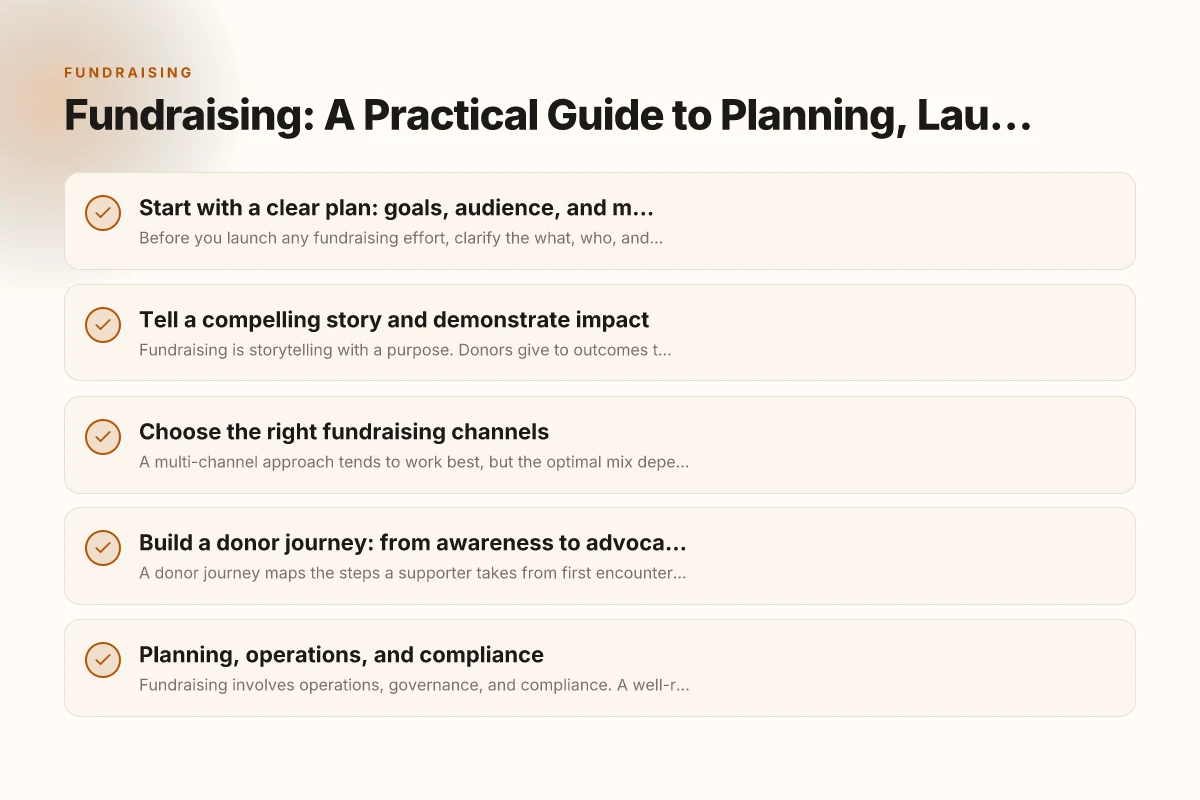
Tell a compelling story and demonstrate impact
Fundraising is storytelling with a purpose. Donors give to outcomes they can visualize and trust.
- Start with the problem: Frame it in human terms and connect it to your mission.
- Show the solution: Explain how funds translate into actions and results.
- Be specific about impact: Use numbers where appropriate, but also share qualitative stories.
- Include your “why now” factor: Why is this campaign urgent and relevant today?
Storytelling should be authentic and transparent. If possible, pair stories with data that backs up claims, such as outcomes achieved through prior funding or pilot results. Make it easy for readers to see the chain: donation leads to activity leads to impact. Ulster Cancer Foundation: Support, Research, and Hope for Northern Ireland
Choose the right fundraising channels
A multi-channel approach tends to work best, but the optimal mix depends on your audience and resources. Consider these common channels:
- Online campaigns: Crowdfunding pages, donation forms on your site, recurring giving programs.
- Email and social media: Personal appeals, progress updates, and testimonial content.
- Events: Virtual or in-person gatherings that combine education and giving opportunities.
- Grants and foundations: Research and apply to funders whose priorities align with your mission.
- Corporate partnerships: Sponsorships, employee matching, and cause-related marketing.
- Community fundraising: Local drives, school campaigns, and neighborhood partnerships.
Table: Channel comparison at a glance
| Channel | Pros | Cons | Best Use |
|---|---|---|---|
| Online campaigns | Low cost, scalable | Competition for attention | Small to mid-sized goals, broad reach |
| Email campaigns | Personal, trackable, repeatable | Can fatigue audiences quickly | Donor stewardship, recurring giving |
| Events | Relationship-building, visibility | Resource intensive, logistics | Major gifts, onboarding new supporters |
| Grants & foundations | Large gifts, credibility | Competitive, lengthy processes | Project-based funding, specific outcomes |
| Corporate partnerships | Strategic, long-term funding | Alignment and approval hurdles | Sustained support, employee engagement |
| Community drives | Local engagement, volunteers | Limited funds, regional focus | Neighborhood initiatives, early-stage campaigns |
Build a donor journey: from awareness to advocacy
A donor journey maps the steps a supporter takes from first encounter to ongoing partnership. A well-designed journey reduces friction and increases lifetime value.
- Awareness: Reach people who care about your mission through stories, testimonials, and clear value propositions.
- Consideration: Provide transparent details about how funds are used, plus a clear call to action.
- Conversion: Make giving easy with a simple, fast, secure process. Offer recurring options.
- Engagement: Share progress, impact reports, and opportunities to get involved beyond giving.
- Advocacy: Invite donors to advocate, volunteer, or refer others.
To strengthen the journey, segment your audience and tailor messages. Automations can help, welcome emails, donor anniversaries, and targeted appeals based on past giving. Troubleshooting the PC
Planning, operations, and compliance
Fundraising involves operations, governance, and compliance. A well-run process reduces risk and builds donor trust.
- Compliance: Understand nonprofit status, fundraising regulations, data privacy, and security requirements.
- Governance: Ensure leadership oversight of fundraising activities, conflicts of interest policies, and transparency in reporting.
- Financial controls: Separate fundraising from program budgets, track expenses, and maintain auditable records.
- Data management: Collect only what you need, protect donor data, and segment for personalized outreach.
- Reporting: Communicate results to stakeholders, including donors, board, and funders.
Tools and practices to consider:
- CRM/system for donor management to track interactions and gifts.
- Payment processors with secure transactions and easy refunds.
- Clear policies on matching gifts, tax receipts, and gift acknowledgement.
- Transparent impact dashboards that show where funds go and what is achieved.
The fundraising plan: components and a simple template
A robust fundraising plan acts as a blueprint for success. Here’s a simple template you can adapt.
- Executive summary: Mission, goals, and key strategies.
- Audience and personas: Donor types you’ll target with tailored messages.
- Case for support: Clear, concise reason to give and the impact expected.
- Channel strategy: The mix of channels, timelines, and roles.
- Tactics and calendar: Specific actions, dates, and owners.
- Budget and resources: Staffing, tools, and costs. Expected ROI.
- Metrics and evaluation: Leading indicators, lagging outcomes, and how you’ll optimize.
- Risk management: Potential challenges and contingency plans.
Practical tips: Searching shortcuts in Netscape
- Start with a pilot: Test a single channel or segment before scaling.
- Set SMART goals: Specific, Measurable, Achievable, Relevant, Time-bound.
- Build a content bank: Develop reusable assets, impact stories, infographics, donor spotlights.
- Prepare ready-to-send materials: Donation receipts, tax letters, thank-you notes, impact reports.
A comparison of fundraising models (when to use which)
If you’re choosing a model for your campaign, a quick comparison can help you decide what to prioritize.
Table: Fundraising models and when to use them
| Model | When to use | Typical fund size | Team requirements |
|---|---|---|---|
| Recurring giving | Build steady, predictable income | Small to mid-range | Moderate automation, stewardship focus |
| Major gifts | For high-impact projects or capital campaigns | Large | Strong donor relations, prospects research |
| Grant funding | Project-based or program expansion | Varies | Grant writing, reporting, compliance |
| Crowdfunding campaigns | Broad reach, community involvement | Moderate | Content, social media, campaign manager |
| Corporate partnerships | Strategic alignment and long-term support | Moderate to large | PR, sponsorship negotiation, stewardship |
| Events and galas | Relationship building with donors and partners | Varies | Event planning, volunteers, sponsorships |
Measuring success and learning from outcomes
Measurement turns fundraising activity into actionable insights. Focus on both money raised and the quality of relationships built.
Key metrics to track: Can I combine two different operators
- Total funds raised vs. goal
- Donor acquisition cost and lifetime value
- Recurring giving growth and donor retention rate
- Average gift size and appeal-to-donor conversion rates
- Campaign ROI: Revenue versus costs, including staff time and tools
- Donor engagement metrics: email open rates, click-throughs, event attendance
Regular reviews help you adjust tactics. Hold post-campaign debriefs to capture what worked, what didn’t, and why. Use surveys or one-on-one conversations to understand donor motivations and barriers to giving.
Risks, ethics, and transparency
Fundraising carries responsibilities. Donors expect trust, accountability, and clarity about impact.
- Ethics: Honesty in presenting needs, results, and constraints.
- Transparency: Open reporting on how funds are used and what is achieved.
- Privacy: Protect donor data and honor consent preferences.
- Accessibility: Make giving options accessible to diverse audiences, including people with disabilities.
If something goes wrong, communicate honestly, outline corrective steps, and demonstrate commitment to improvement. A reputation for integrity often strengthens donor relationships over the long term.
The final recommendation: start with a solid foundation and grow deliberately
Fundraising succeeds where planning meets people. Start with a clear goal, a compelling case for support, and a donor-centric plan. Build a multi-channel approach tailored to your audience, with a focus on authenticity, transparency, and impact. Invest in storytelling, stewardship, and governance as much as you invest in campaigns. Test, learn, and iterate, and treat every donor interaction as a chance to deepen trust. What is a “Meta” search engine
If you’re just starting out, consider these first steps:
- Draft a one-page case for support that explains the problem, the solution, and the impact.
- Create a simple donor journey map with 3–5 touchpoints and a calendar for outreach.
- Launch a small recurring-giving program to establish baseline revenue and relationships.
- Set up a basic measurement system: a monthly dashboard with key metrics.
- Plan a pilot campaign on a single channel to learn what resonates with your audience.
For organizations with more resources, a phased expansion works well:
- Phase 1: Stabilize. Build your donor base, refine your messaging, and implement essential tools.
- Phase 2: Grow. Expand channels, optimize the donor journey, and increase donor retention.
- Phase 3: Scale. Launch major gifts, grants, and strategic partnerships. Optimize operations and governance.
Remember, fundraising is not just about funds, it's about building a community that believes in your mission and is willing to invest in it. A thoughtful plan, compelling storytelling, disciplined operations, and a transparent culture will set you up for sustainable success.