Can I combine two different operators

A practical guide on mixing operators, when it works, and how to do it safely.
Can I combine two different operators
When people ask if they can combine two different operators, they’re usually thinking about logic, math, programming, or even tools in the real world. The short answer is: yes in many cases, but not always. The specifics depend on the domain, the exact operators, and the rules governing their interaction. Below you’ll find a practical guide that covers common scenarios, helps you spot pitfalls, and offers best practices for safe, predictable results.
Comparison of contexts for combining operators
| Context | Data types supported | Compatibility notes | Typical pitfalls | Example domains | Verdict |
|---|---|---|---|---|---|
| Arithmetic with numbers | integers, floats | compatible within same type family | precision loss, overflow | math, engineering | generally ok |
| Booleans and logic | booleans only | true/false results | short-circuiting behavior | logic gates, filtering | usually yes |
| Strings and concatenation | text, strings | works with + in some languages | unintended merges, encoding | text processing | yes with care |
| Collections and sets | lists, arrays, sets | element-wise vs. structural | order dependence | data processing | yes with rules |
| Pointers and references | references, handles | depends on language | aliasing, mutation | low-level programming | cautious |
| Custom objects | user-defined types | operator overloading varies | method side effects | OO design | sometimes supported |
Compiled November 2026; check the provider's site for current details.
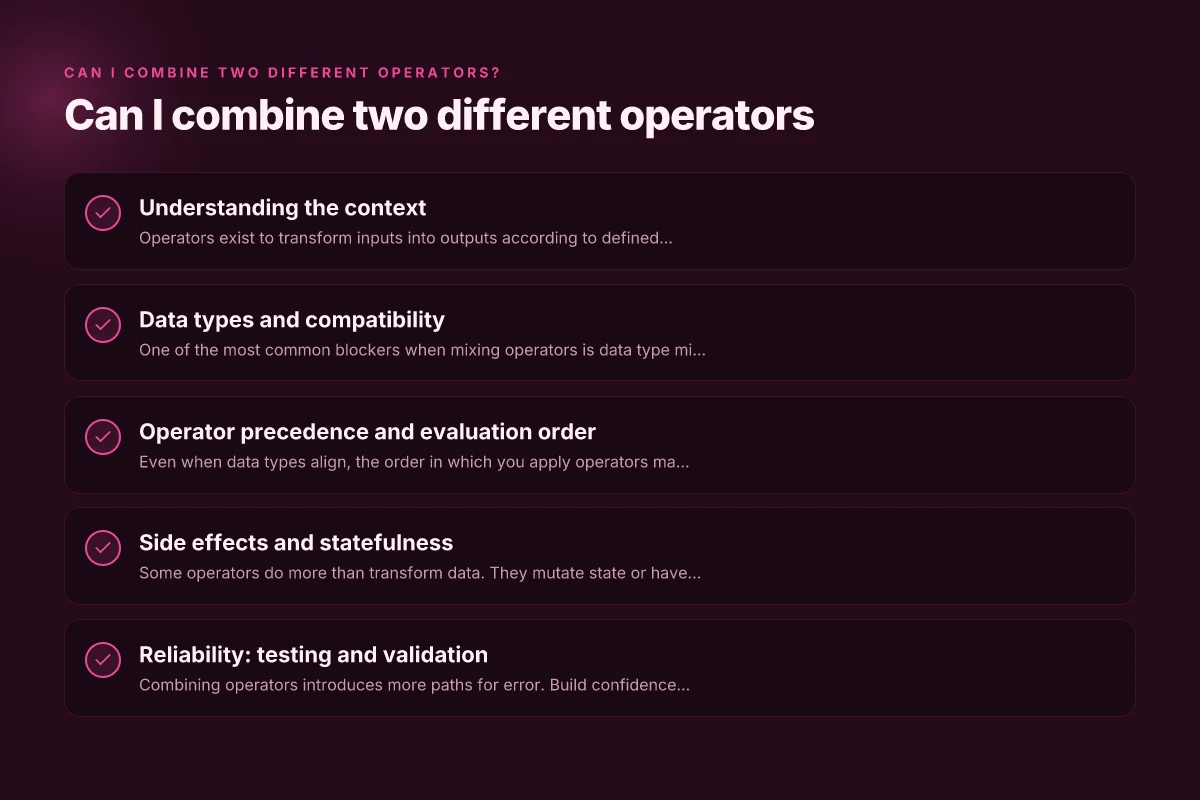
Understanding the context
Operators exist to transform inputs into outputs according to defined rules. When you mix them, you’re layering transformations. There are three broad contexts to consider:
- Mathematical or logical operators: typically governed by algebraic or boolean rules.
- Programming operators: subject to language syntax, operator precedence, and evaluation order.
- Real-world tools or processes: depend on device capabilities, safety constraints, and compatibility.
In each case, the key questions are:
- Do the operators operate on compatible data types or signals?
- Do they require a specific order of evaluation?
- Are there side effects or state changes to consider?
- Is there documentation or a standards reference that specifies interaction rules?
Answering these questions early saves time and avoids surprising results.
Data types and compatibility
One of the most common blockers when mixing operators is data type mismatch. For example: What is a “Meta” search engine
- In mathematics, you typically combine numeric operators on numbers, and mixing units requires conversion.
- In programming, you might combine arithmetic operators with logical operators, but only after normalizing to a consistent type or using explicit casting.
- In data processing pipelines, one operator may produce a boolean, another may require a numeric input.
Practical tips:
- Verify input and output types for each operator.
- Use explicit type conversion or casting when necessary.
- Maintain a clear data schema or contract for the pipeline.
If you’re unsure, create small, isolated tests with representative inputs to verify that the combined operation yields the expected type and value.
Operator precedence and evaluation order
Even when data types align, the order in which you apply operators matters. Most languages and systems define:
- Precedence: which operators bind tighter than others.
- Associativity: how operators of the same precedence are grouped.
- Short-circuit behavior: some logical operators stop evaluating once the result is known.
When combining operators: How do I broaden a search
- Check the rule set or documentation for precedence.
- Use parentheses to enforce the intended grouping.
- Consider writing a simple truth table or step-by-step evaluation to confirm behavior.
A common pitfall is assuming left-to-right evaluation in all contexts. Always verify the exact semantics for your environment.
Practical guidelines for choosing when to combine operators
| Criterion | Always | Often | Sometimes | Rarely | Never | Notes |
|---|---|---|---|---|---|---|
| Data compatibility | ✓ | ✓ | ✓ | Check types first | ||
| Side effects | ✓ | ✓ | Prefer pure expressions | |||
| Performance impact | ✓ | Measure bottlenecks | ||||
| Readability | ✓ | ✓ | ✓ | Clear precedence needed | ||
| Testing burden | ✓ | Include edge cases | ||||
| Domain suitability | ✓ | Some domains stigmatize mixing |
Compiled November 2026; check the provider's site for current details.
Side effects and statefulness
Some operators do more than transform data. They mutate state or have observable side effects. When you mix such operators, you must manage order and potential interference: How do I narrow a search
- In programming, a function with side effects executed inside an expression can lead to hard-to-debug behavior.
- In pipelines, a stage might modify global state, log information, or change configuration.
- In physical processes, one operation might alter a parameter critical to the next step.
Best practices:
- Keep side-effecting operations separate when possible.
- Make the sequence explicit with clear control flow.
- Document any state changes and why the order is important.
Reliability: testing and validation
Combining operators introduces more paths for error. Build confidence by:
- Creating a test suite that covers typical, boundary, and error cases.
- Validating outputs against independent references or golden results.
- Checking for performance regressions, especially if the combination is used in a high-throughput or real-time context.
- Observing edge cases, such as zero, null, or empty inputs, to ensure graceful handling.
A structured approach helps prevent surprises after deployment.
A practical comparison: combining operators in common domains
Here is a quick side-by-side when thinking about combining two operators in three typical domains. Use this as a mental model when you evaluate your specific case. How does a search engine work?
Domain: Mathematics
Example: Combining a square root operator with a negative sign
Rule: You can apply both if the expression is defined for the input. Beware of domain restrictions (e.g., sqrt of a negative in reals is not defined)
Tip: Use complex numbers if you must handle negatives inside roots PPT Slide: Mastering PowerPoint Slides for Effective Presentations
Domain: Programming (general-purpose language)
Example: Arithmetic (+, *) with a logical operator (&&)
Rule: Typically not meaningful without explicit casting or separate expressions
Tip: Split concerns into numeric computation and boolean logic What are some search engines
Domain: Data processing / pipelines
Example: A filter operator followed by a map or reduce
Rule: Often valid. Ensure the output type of the filter matches the input expectations of the next stage
Tip: Use a schema before and after each stage to prevent type drift Searching shortcuts in Netscape
Markdown table: quick decision guide
| Scenario | Are they typically compatible? | Key considerations | Safe practice |
|---|---|---|---|
| Arithmetic + Logical in code | Often not directly compatible | Types, side effects, evaluation order | Separate into distinct steps; use clear casting |
| Filter then Transform in a pipeline | Usually compatible | Output type of filter must feed transform | Test with representative data; document the pipeline |
| Two monetary operations (add, multiply) with units | Depends on units | Unit consistency; conversion required | Normalize units before combining; include unit checks |
| Stateful operation followed by stateless | Risk of interference | State changes can affect results | Isolate stateful parts; minimize shared state |
| Hardware signal processing | Sometimes complex | Timing, latency, and hardware constraints | Follow device documentation; simulate first |
Decision checklist for combining operators in a domain
| Domain | Data type concerns | Precedence complexity | Side effects risk | Validation needs | Recommendation |
|---|---|---|---|---|---|
| Data filtering | moderate | medium | low | medium | use short, readable expressions |
| Numerical modeling | high | high | medium | high | prefer explicit steps |
| Text processing | low | medium | low | medium | ok with clear rules |
| Database queries | medium | high | low | high | guard with tests |
| Reactive programs | medium | high | high | high | document evaluation order |
Compiled November 2026; check the provider's site for current details.
Practical guidelines if you’re unsure
- Start with the purpose: why are you combining these operators? What outcome do you want?
- Check official docs or standards for explicit rules about operator interaction.
- Use explicit parentheses to reflect your intended order of operations.
- Create small, repeatable tests that cover normal and edge cases.
- Document your approach clearly so future you (or teammates) can understand it.
If you’re designing a system or solving a problem, a good habit is to draft a small example that demonstrates the combined operation end-to-end. Then sanity-check every step: Troubleshooting the PC
- Are the inputs in the expected form?
- Do intermediate results make sense?
- Does the final output meet the requirements?
Final considerations and recommendations
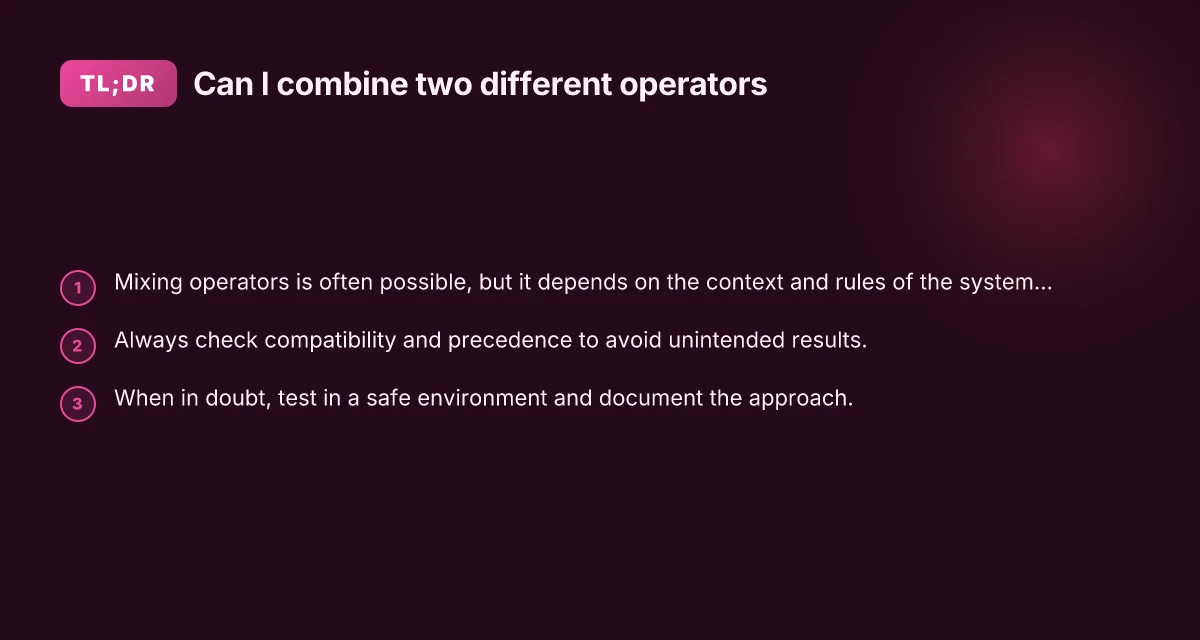
Can you combine two different operators? The answer is yes in many cases, but success hinges on understanding compatibility, order of operations, and potential side effects. The safest path is to:
- Verify input/output compatibility and perform any necessary type or unit conversions.
- Confirm the evaluation order and use parentheses to enforce your intended grouping.
- Separate or isolate operations with clear boundaries to minimize complexity and side effects.
- Test comprehensively, with both typical and edge-case inputs, and document your design choices.
If you want, share a concrete example of the two operators you’re considering. I can walk you through the exact steps to determine whether they can be combined, how to order them, and provide a tested template you can reuse.