what are some search engines(2026)

A clear guide to popular search engines, how they differ, and how to choose one.
Introduction When people think about searching the web, a handful of names come to mind. But what are search engines, exactly? In short, they’re tools that help you find information on the internet by indexing pages, interpreting your query, and returning a ranked list of results. Different search engines optimize for different goals, speed, privacy, business relevance, or specialized content. Below is a guide to some of the most commonly used options, plus tips on choosing the right one for your needs.
Quick feature snapshot of major general-purpose search engines
| Engine | Index size | Freshness | Privacy | Ad transparency | Special features |
|---|---|---|---|---|---|
| large | very fresh | no | partial | Rich results, knowledge graph | |
| Bing | large | fresh | no | partial | Image/video search, rewards |
| DuckDuckGo | moderate | good | yes | yes | Privacy-centric, bangs |
| Yahoo | large | moderate | no | partial | News, directory integration |
Compiled November 2026; check the provider's site for current details.
Major general-purpose search engines
What they are and what they’re best for
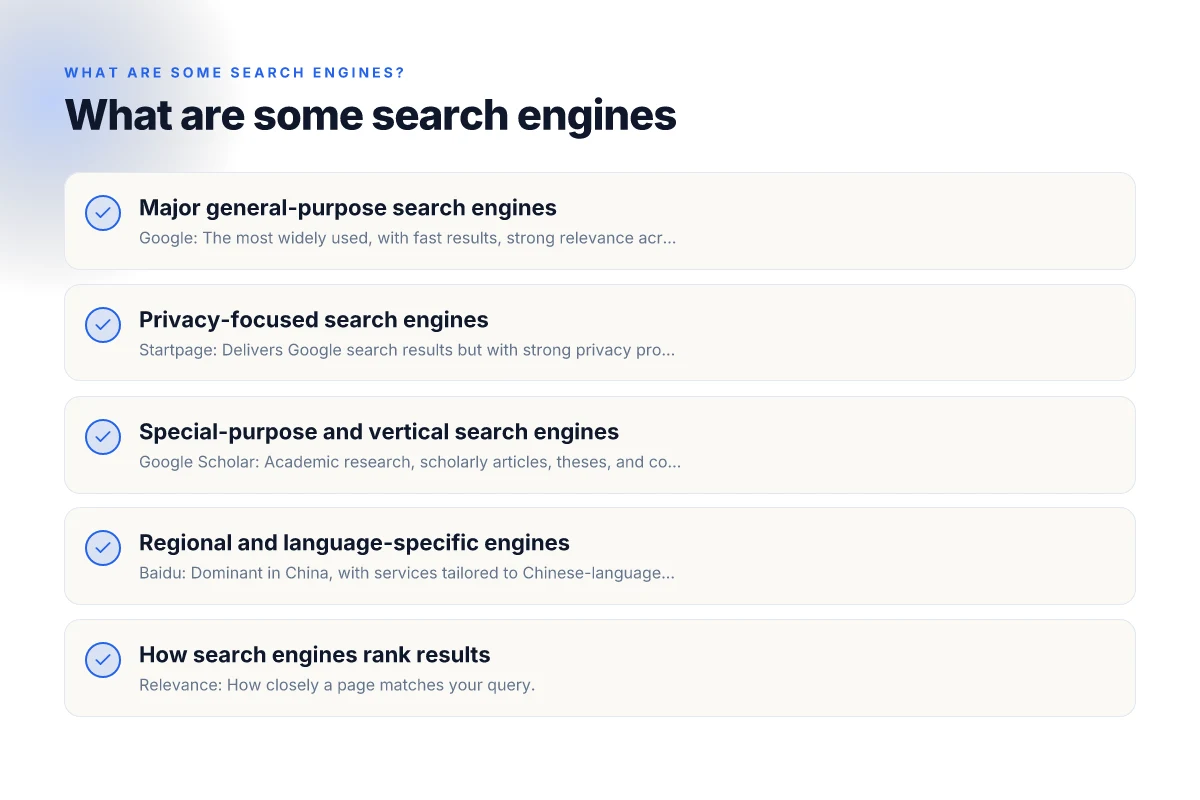
- Google: The most widely used, with fast results, strong relevance across a vast index, and numerous built-in tools like Google Images, maps, and news.
- Bing: Microsoft’s engine, known for strong image search, integration with Windows and Microsoft products, and a different ranking signals mix.
- DuckDuckGo: Privacy-first engine that doesn’t track you, with clean results and optional features like bangs to jump directly to other sites.
- Yahoo Search: Powered by Bing in many regions, offers a familiar portal experience and integrated news and mail.
- Ecosia: An eco-conscious search engine that uses ad revenue to fund tree-planting programs.
Privacy-focused search engines
Why privacy matters and what to expect
- Startpage: Delivers Google search results but with strong privacy protections and no tracking.
- Qwant: European-based engine that emphasizes user privacy and a visually organized results page.
- Searx: Metasearch engine that aggregates results from many sources without storing personal data (varies by instance).
- Brave Search: A newer option from the creators of the Brave browser, focusing on privacy and a transparent index.
Privacy-focused search engines comparison
| Engine | Privacy claims | Data retention | Tracking protection | Ads | Anonymous usage options |
|---|---|---|---|---|---|
| DuckDuckGo | anonymous by default | minimal | yes | no | optional search engine in browser |
| Startpage | anon queries | minimal | yes | no | uses Google results privately |
| Qwant | privacy-respecting | minimal | yes | limited | EU compliance |
| Neeva | privacy-first (subscription) | none (paywall) | yes | no | ad-free, subscription model |
Compiled November 2026; check the provider's site for current details.
Special-purpose and vertical search engines
When to use a specialized tool
- Google Scholar: Academic research, scholarly articles, theses, and court opinions.
- PubMed: Life sciences and biomedical literature with curated articles.
- Shodan: Searches for internet-connected devices, useful for security research.
- Wolfram Alpha: Computational knowledge engine that provides answers through computation rather than just links.
- YouTube, Amazon, or Reddit search: Platform-specific search engines tailored to those sites’ content.
Regional and language-specific engines
When geography or language matters
- Baidu: Dominant in China, with services tailored to Chinese-language content.
- Yandex: Strong in Russia and some neighboring regions, with search and regional services.
- Naver and Daum: Popular in South Korea, offering layered search experiences in Korean.
- Seznam: A Czech search engine serving the Czech Republic with localized results.
How search engines rank results
A quick primer on the signals that shape you see
- Relevance: How closely a page matches your query.
- Authority: Perceived trustworthiness based on links, quality content, and site reputation.
- Freshness: How recently content was published or updated.
- Usability signals: Page speed, mobile friendliness, and clear content structure.
- Personalization: Your location, past behavior, and settings can affect results (varying by engine and privacy options).
- Semantics: Understanding intent, synonyms, and user context to surface better matches.
A practical comparison table
| Engine | Privacy stance | Strengths | Notable features | Ideal use case |
|---|---|---|---|---|
| Moderate tracking (with opt-outs) | Broad index, fast results, rich features | Google Images, News, Maps, Scholar, Knowledge Graph | General web search, comprehensive results | |
| Bing | Moderate tracking | Strong visual search, good multimedia results | Image/video search, rewards program | Visual-first queries, integration with Windows ecosystem |
| DuckDuckGo | No tracking by default | Privacy-first, simple UI | Bangs to jump to sites quickly | Quick, private lookups without profiling |
| Startpage | Strong privacy protections | Google results with privacy shield | No tracking, proxy for safe browsing | Privacy-focused Google results |
| Ecosia | Uses profits for trees | Eco-friendly branding, decent results | Tree-planting initiative, sustainability angle | Environmentally conscious browsing |
Note: The table highlights general tendencies. Results and experiences can vary by region, device, and updates to each engine.
How to make the most of search engines
Quick tips to improve your search results
- Use quotation marks for exact phrases: "climate change impact 2023" to narrow results.
- Try minus sign to exclude terms: bank -river to avoid river banks when searching for financial banks.
- Use site: to limit results to a domain: site:edu climate change.
- Explore advanced operators: filetype:, intitle:, inurl: for more granular queries.
- Switch engines for different perspectives: if you hit a wall with one, try another to see alternative results or perspectives.
- Enable privacy options: review each engine’s settings to reduce tracking if that matters to you.
When to pick one engine over another
A quick decision guide
- General, broad search with fast results: Google or Bing.
- Privacy-first search that minimizes data collection: DuckDuckGo, Startpage, or Brave Search.
- Academic research or scholarly sources: Google Scholar or PubMed.
- Platform-specific discovery (videos, shopping, or social content): Search within YouTube, Amazon, or Reddit search, respectively.
- Regionally focused or language-specific content: Use Naver, Baidu, Yandex, Seznam, or similar engines that optimize for local language results.
Special-purpose and regional engines at a glance what is an internet search engine(2026)
| Engine | Type | Primary use | Regional focus | Language support | Notable limits |
|---|---|---|---|---|---|
| Amazon (search) | product/commerce | shopping | global | multiple | not a general web search |
| Baidu | general | China market | China | Chinese | search results skewed by policy |
| Yandex | general | Russia/CIS | Russia/CIS | Russian | geo-focused results |
| Naver | general | Korea | South Korea | Korean | limited outside Korea |
| Ecosia | general | eco-friendly | global | multiple | uses ad revenue for planting |
Compiled November 2026; check the provider's site for current details.
A short recommendation
For most users starting out, Google remains the default choice due to its breadth, speed, and integrated features. If privacy is your top priority, DuckDuckGo or Startpage are excellent alternatives that don’t track your searches. If you’re researching academic topics, Google Scholar and PubMed are powerful companions. For locale or language-specific needs, consider regional engines like Yandex, Baidu, or Seznam to capture content that may be harder to surface on global engines. And for a more privacy-conscious but still capable all-around option, Brave Search offers a transparent index and a growing feature set.
If you want a personalized plan: start with Google for daily searches, add DuckDuckGo for privacy-friendly sessions, and keep a regional engine (like Yandex or Baidu) handy when looking for content in a local language. Rotate among engines for diverse results, and use advanced search operators to refine queries.