How does a search engine work?
A clear, plain‑language tour of how search engines crawl, index, rank, and deliver results for your queries.
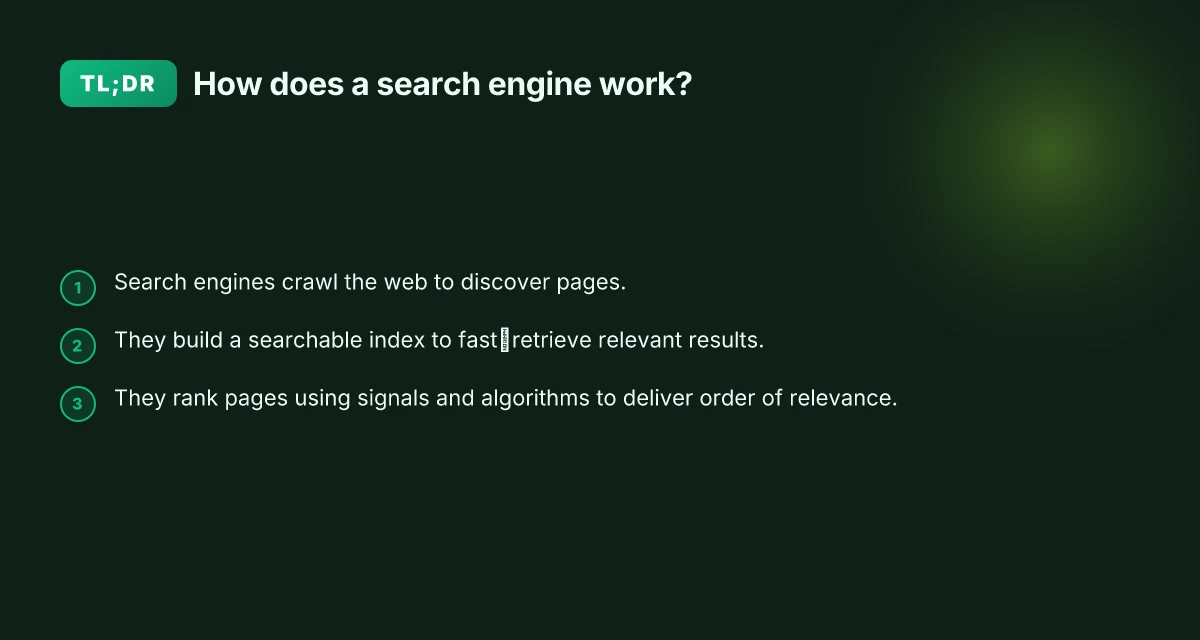
Search engines are the gateways to most of the information people seek on the internet. At a high level, they perform four big jobs: crawling the web to find pages, indexing what those pages say, ranking results to match a query, and delivering those results to you quickly. Below is a practical breakdown of what happens behind the scenes.
Comparison of crawling strategies
| Strategy | Coverage | Freshness | Resource use | Pros | Cons |
|---|---|---|---|---|---|
| Web-wide crawling | High | Moderate | High | Broad index | Bandwidth heavy |
| Targeted crawling | Moderate | High | Moderate | efficient for core sites | Misses some content |
| Incremental crawling | High | High | Moderate | up-to-date | needs scheduling |
| Focused crawling | Moderate | Moderate | Low | low cost | limited scope |
| Hybrid crawling | High | High | Moderate | balanced | complex setup |
Compiled November 2026; check the provider's site for current details.
1) Crawling: discovering content on the web
Crawling is the process of visiting web pages and following links to discover new or updated content. A search engine uses automated programs called crawlers or spiders to navigate the internet.
- How crawlers work
- They start with a list of known pages and follow the links on those pages to find new ones.
- They repeatedly revisit pages to detect changes or new content.
- They respect robots.txt files and meta noindex tags that tell crawlers not to access or index certain pages.
- Challenges in crawling
- The web is immense and constantly changing, so crawlers must be efficient and scalable.
- Some content is hard to reach (dynamic pages, API endpoints, or pages behind login).
- They must avoid overloading sites with requests.
- What crawlers typically collect
- Page content (text, headings, keywords)
- Metadata (title tags, meta descriptions)
- Links to other pages
- Media assets (images, videos) and structured data signals
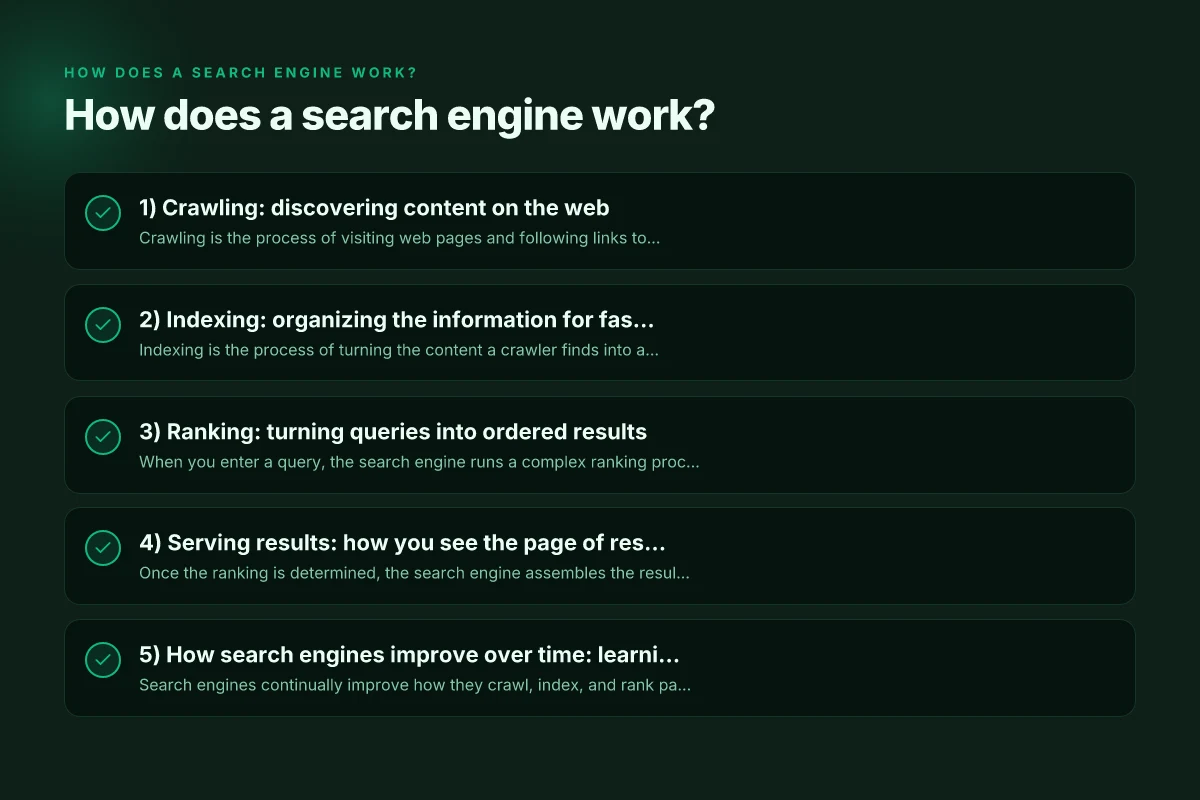
2) Indexing: organizing the information for fast search
Indexing is the process of turning the content a crawler finds into a structured, searchable dataset. Think of the index as a giant library catalog that helps the search engine locate relevant pages quickly.
- How indexing works
- The content of each page is analyzed and broken into tokens (words and phrases).
- Important signals are extracted: title, headings, anchor text, alt text on images, and structured data.
- The engine creates an inverted index, which maps terms to the pages that contain them.
- What the index stores
- The words on a page and their frequency
- The position of words (context matters for semantics)
- Signals like freshness (how recently content was updated)
- Page attributes (URL, canonical status, schema markup)
- Why indexing matters
- It enables rapid lookup when you type a query.
- It allows the engine to compare your query against many pages in a fraction of a second.
- It supports advanced features like rich results (snippets, knowledge panels) by tying information to structures.
Comparison of indexing approaches
| Approach | Granularity | Real-time support | Size handling | Pros | Cons |
|---|---|---|---|---|---|
| Full-text indexing | High | Yes / incremental | Large | fast keyword search | update cost high |
| Schemabased indexing | Medium | Yes / periodic | Medium | structured queries | misses unstructured data |
| Inverted index with n-grams | High | Yes | Large | flexible matching | memory heavy |
| Keyword-only indexing | Low | No | Small | simple | poor relevance |
| Semantic indexing | High | Yes | Large | better understanding | complexity / compute |
Compiled November 2026; check the provider's site for current details. PPT Slide: Mastering PowerPoint Slides for Effective Presentations
3) Ranking: turning queries into ordered results
When you enter a query, the search engine runs a complex ranking process to determine which pages are most relevant and trustworthy for that specific search.
- Core ideas behind ranking
- Relevance: how closely a page matches the intent and content of the query.
- Authority and trust: signals like backlinks, domain credibility, and site quality.
- Freshness and context: whether timely information or recent updates are important for the query.
- User signals: click-through rate, dwell time, and pattern of engagement (used to improve results over time).
- How signals are used
- Keywords and semantics: does the page cover the topic in depth? Do headings align with the query?
- Page quality: is the content well‑written, well‑structured, and free of harmful content?
- Page experience: loading speed, mobile friendliness, and safe browsing.
- Contextual relevancy: the engine considers your location, language, device, and prior search history to tailor results.
- The ranking process in stages
- Candidate generation: the index returns a broad set of potentially relevant pages.
- Candidate evaluation: each page is scored using numerous signals and a machine‑learned model.
- Result ranking: pages are ordered from most to least relevant and displayed to the user.
- Common ranking signals (high level)
- Content relevance: do pages answer the query directly and comprehensively?
- Authority: credible sources, quality backlinks, and domain trust.
- Page quality: accurate information, originality, and helpful structure.
- User experience: fast pages, readable content, and accessible design.
- Freshness: up‑to‑date information for time‑sensitive queries.
4) Serving results: how you see the page of results
Once the ranking is determined, the search engine assembles the results page. This includes organic results, sometimes paid ads, and sometimes features like snippets, image carousels, or knowledge panels.
- Organic results
- These are the pages deemed most relevant by the ranking system.
- Each result typically shows a title, URL, and a meta description.
- Rich results and features
- Snippets: concise answer snippets pulled from pages for quick insight.
- Knowledge panels: quick facts and context about people, places, or things.
- Image and video results: media exploration tied to the query.
- People also ask and related searches: suggestions to broaden or refine the search.
- Ads and alternatives
- Some search results include paid placements at the top or bottom.
- The engine attempts to keep a clear distinction between ads and organic results.
Ranking and result presentation factors
| Factor | Effect on ranking | User impact | Data needed | Notes |
|---|---|---|---|---|
| Relevance scoring | Improves order | Higher satisfaction | Query, document features | core metric |
| Freshness | Boosts recent results | Timely results | Content timestamps | time-sensitive queries |
| Popularity signals | Elevates trusted pages | Perceived authority | Click data, links | potential bias |
| Personalization | Tailors results | More relevant to user | History, context | privacy considerations |
| Latency / serving time | Slower pages hurt rank | Faster pages feel responsive | Server performance | mix of factors |
Compiled November 2026; check the provider's site for current details. What are some search engines
5) How search engines improve over time: learning and updating
Search engines continually improve how they crawl, index, and rank pages. This is driven by data, experiments, and updates to algorithms.
- Machine learning in ranking
- Modern engines use models trained on vast data to predict user satisfaction with results.
- Models are continually retrained as new data arrives.
- Updates and algorithms
- Core updates can shift how relevance is determined. These are broad changes affecting many results.
- Quality‑focused updates target low‑quality or spammy pages to protect user experience.
- Safety, privacy, and diversity
- Engines work to reduce harmful content and misinformation.
- They aim to provide diverse sources and avoid bias in ranking.
- Transparency and user control
- You can influence personalization through account settings (or disable it in some cases).
- Tools exist for understanding why a page ranked where it did, and for requesting removal or de-indexing of pages.
6) A simple table: what each stage does and what it affects
| Stage | What it does | What it affects for you |
|---|---|---|
| Crawling | Discovers pages and follows links | What content is available to be indexed |
| Indexing | Analyzes and records page content in a catalog | How quickly and accurately pages can be found by a query |
| Ranking | Scores pages using signals and models | The order of results you see for a query |
| Serving | Presents results with snippets, panels, ads | The readability and usefulness of the results you click on |
| Learning | Updates models and algorithms over time | Improvements in relevance and quality of future results |
7) Practical tips for users: how to get better results
- Use precise queries
- Include specific terms, phrases in quotes, or niche keywords to narrow results.
- Check different result types
- If you want definitive facts, try knowledge panels or defined snippets. For research, open multiple sources.
- Be mindful of context
- Location, language, and device can affect results. Try switching to a broader or different locale if needed.
- Look for quality signals
- Favor pages with clear authorship, recent updates for time‑sensitive topics, and well‑structured content.
- Use advanced search operators (where available)
- Quotation marks for exact phrases, minus signs to exclude terms, site: to search within a domain, and filetype: to find specific formats.
8) Final recommendation
If your goal is to understand how to get the most accurate answers quickly, start by framing your query with clear intent. For factual information, seek pages that provide explicit references, dates, and authors. If you’re researching a topic with many perspectives, open several high‑quality sources and compare their claims. Remember that search engines are powerful tools, but they’re designed to surface information, not decide truth for you. Use critical thinking, check dates and sources, and consider cross‑checking with primary sources when possible. For most users, refining your search terms and evaluating the quality of sources is the fastest path to reliable results.