Goals of BHA
A clear guide to the goals of beta-hydroxy acids (BHA) in skincare, how they work, and how to use them effectively.
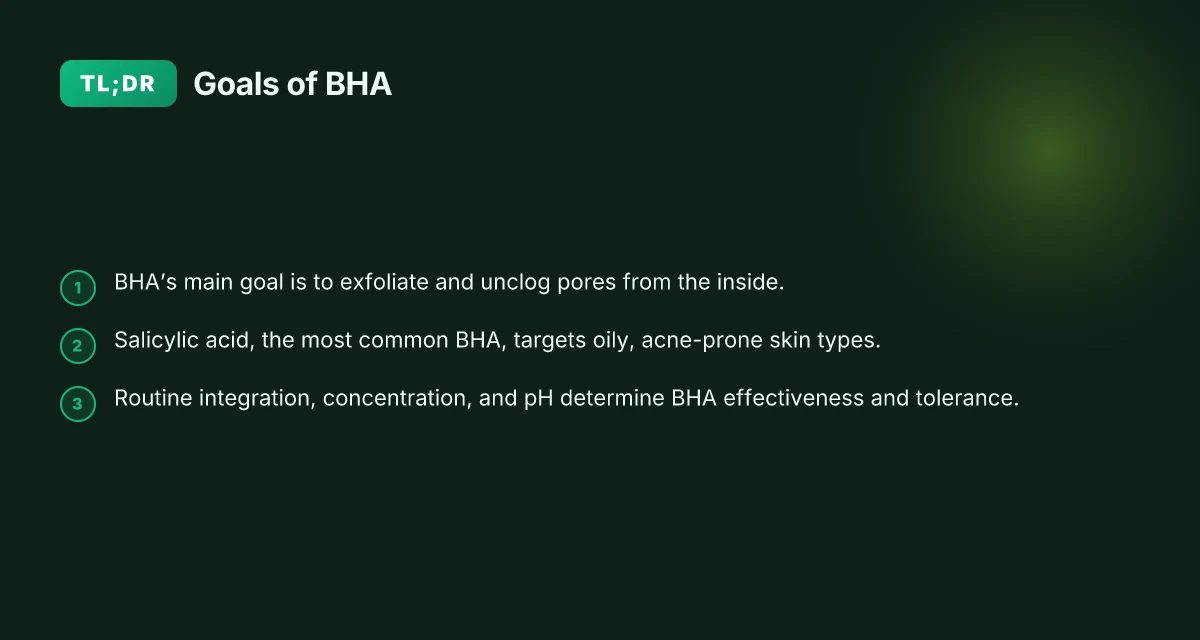
Introduction BHA, or beta-hydroxy acid, is a skincare ingredient best known for its pore-clearing, oil-dissolving properties. The primary goals of BHA are to exfoliate inside the pore, reduce excess sebum, and improve skin texture and tone. When used correctly, BHAs can help with acne-prone skin, blackheads, and dullness without overly drying the surface of the skin. The most widely used BHA is salicylic acid, though other beta-hydroxy acids exist.
Comparison of BHA products by active ingredient and strength
| Brand | Active Ingredient(s) | Typical Strength | pH Range | Texture | Notes |
|---|---|---|---|---|---|
| Product A | Salicylic acid (2%) | 2% | 3.5–4.0 | Gel | Suitable for Oily skin |
| Product B | Salicylic acid (1%) | 1% | 4.0–4.5 | Liquid | Gentle, for beginners |
| Product C | Salicylic acid (0.5–2%) | 0.5–2% | 3.0–3.5 | Foaming | May cause sensitivity at higher end |
| Product D | Salicylic acid + glycolic acid (2%/2%) | 2% SA + 2% GA | 3.5–4.0 | Serum | Dual exfoliation, careful use |
Compiled November 2026; check the provider's site for current details.
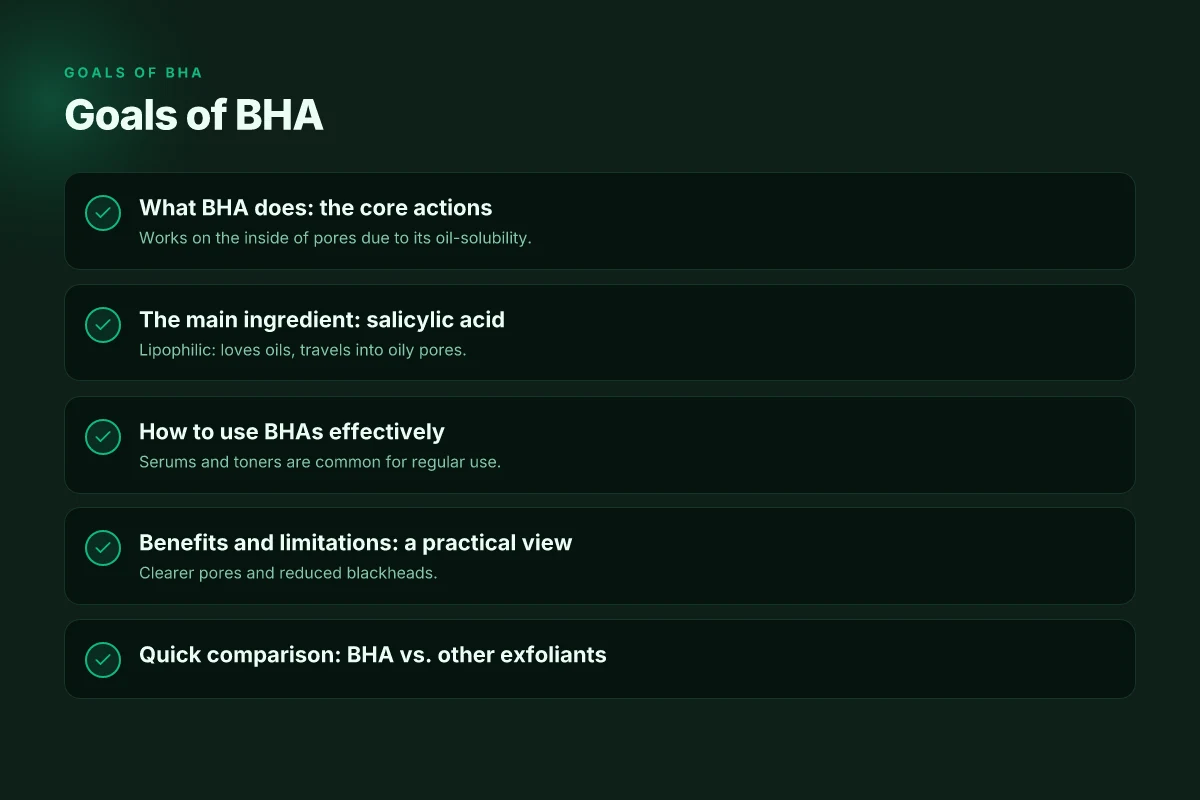
What BHA does: the core actions
How BHAs exfoliate
- Works on the inside of pores due to its oil-solubility.
- Helps remove dead skin cells that can clog hair follicles.
- Supports smoother skin texture and a more even surface.
How BHAs interact with oil
- Salicylic acid dissolves sebum that traps dead skin cells.
- Reduces the formation of comedones (whiteheads and blackheads).
- Improves your skin’s ability to shed debris, preventing buildup.
Anti-inflammatory effects
- Helps calm inflamed acne lesions.
- Can reduce redness associated with clogged pores.
- Particularly helpful for inflammatory acne-prone skin.
The main ingredient: salicylic acid
Why salicylic acid is the go-to BHA
- Lipophilic: loves oils, travels into oily pores.
- Effective at lower concentrations when formulated well.
- Widely studied with a strong safety profile for daily or regular use.
When to choose salicylic acid
- Oily, acne-prone skin.
- Visible blackheads or clogged pores.
- Preferences for a gentle, pore-targeted exfoliant.
How to use BHAs effectively
Choosing a product
- Serums and toners are common for regular use.
- Start with lower concentrations (0.5%–2%) to assess tolerance.
- Look for formulations with compatible pH (typically around 3–4) for optimal activity.
Frequency and layering
- Start 2–3 times per week and gradually increase if tolerated.
- Avoid layering too many actives at once. Rotate with other treatments.
- If using sunscreen, maintain daily sun protection; BHAs can increase sun sensitivity.
Application tips
- Apply to clean skin. Avoid immediately applying harsh physical exfoliants after BHA use.
- Don’t mix in the same routine with strong retinoids or vitamin C unless you know your skin tolerates it.
- If irritation occurs, reduce frequency or switch to a lower concentration.
Benefits and limitations: a practical view
Benefits
- Clearer pores and reduced blackheads.
- Smoother texture and more even skin tone.
- Less likelihood of clogged pores over time with consistent use.
Limitations
- May cause irritant contact dermatitis in sensitive individuals.
- Not a one-size-fits-all solution. Some skin types respond better to AHA (like glycolic) or PHA.
Who should consider BHAs
- People with oily or combination skin.
- Those dealing with recurring blackheads or whiteheads.
- Individuals looking for a chemical exfoliant with pore-clearing action.
Quick comparison: BHA vs. other exfoliants
| Exfoliant | Mechanism | Typical strength | pH | Pros | Cons |
|---|---|---|---|---|---|
| BHA (salicylic acid) | Oil-soluble, penetrates pores | 0.5–2% | ~3–4 | Pore clearing, anti-inflammatory | Can irritate if overused |
| AHA (glycolic) | Water-soluble, surface exfoliation | 5–10% | ~3–4 | Brightening, smooths surface | Less pore penetration; more irritation |
| Enzyme exfoliant | Proteolytic enzymes | gentle | variable | Mild, suitable for sensitive skin | Slower results |
Compiled November 2026; check the provider's site for current details.
Quick comparison: BHA vs. other exfoliants
| Attribute | BHA (Salicylic Acid) | AHA (Glycolic/Lactic) | PHA (Gluconolactone) |
|---|---|---|---|
| Primary action | Oil-soluble exfoliation inside pores | Surface exfoliation; improves texture | Gentle surface exfoliation for sensitive skin |
| Best for | Oily, acne-prone skin; clogged pores | Dry or sun-damaged skin; texture issues | Sensitive or reactive skin; compromise exfoliation |
| Typical concentration | 0.5%–2% | 5%–30% depending on product | 5%–10% commonly, gentler |
| Sun sensitivity | Moderate to high; use sunscreen | High; use sunscreen daily | Lower, but sunscreen still advised |
| Formulations | Serums, toners, gels | Serums, toners, peels | Gels, creams, lotions |
Safety, irritation, and tolerance
Signs of good tolerance
- Skin feels smoother and more even after a few weeks.
- Minimal redness or stinging during application.
- No ongoing peeling beyond initial adjustment period.
Signs of overuse or irritation
- Persistent redness, burning, or itching.
- Excessive dryness or flaking that lasts more than a few days.
- Breakouts or purging that worsens over time.
Special considerations
- Pregnancy or nursing: consult a clinician. Many products with BHA are not recommended during pregnancy.
- Interactions: avoid combining high-strength BA with other potent actives unless guided by a dermatologist.
- Prescription considerations: skin conditions like eczema or rosacea may require cautious use or alternate therapies.
Best-use scenarios by skin concern
| Concern | Best BHA option | Use-case notes | Alternative notes |
|---|---|---|---|
| Blackheads | 2% SA product | Daily or every-other-day use | Start 2 weeks, monitor |
| Acne-prone | 1–2% SA product | Targeted spot or whole-face | Combine with non-irritating routine |
| Oily T-zone | 2% SA gel/serum | Use after cleansing | Patch test first |
| Combination skin | 1–2% SA with buffer | Avoid over-drying | Hydrating moisturizer needed |
Compiled November 2026; check the provider's site for current details. Development of BHA
Building a BHA routine: a simple plan
- Start: 0.5%–1% salicylic acid 2–3 times per week after cleansing.
- Progression: if tolerated, move to nightly or 4–5 times weekly use.
- Monitoring: watch for signs of irritation. Adjust frequency or switch products as needed.
- Sun protection: use broad-spectrum SPF daily, as BHAs can increase sun sensitivity.
Final section and recommendation If your goal is to target clogged pores, blackheads, and oily skin, the goals of BHA are to exfoliate inside the pore, reduce sebum buildup, and improve texture. For many users, salicylic acid remains the most effective and accessible BHA due to its oil-loving chemistry and proven track record. The key to success is choosing a suitable concentration, using a compatible routine, and protecting your skin from sun exposure. Start with a conservative approach, then adjust based on how your skin responds.
Recommendation
- Begin with a low-dose salicylic acid product (0.5%–1%) 2–3 times a week.
- If well-tolerated after 4–6 weeks, consider increasing frequency or trying a slightly higher concentration (up to 2%), keeping an eye on irritation.
- Pair with a non-comedogenic moisturizer to support the skin barrier.
- Always finish with sunscreen in the daytime to prevent sun damage, especially when using exfoliants.
- If you have sensitive or reactive skin, consider a gentler option like a PHA or a lower-strength BHA and consult a dermatologist for personalized guidance.