Development of BHA

A concise overview of how BHA (butylated hydroxyanisole) was developed, its chemistry, uses, safety debates, and regulatory status.
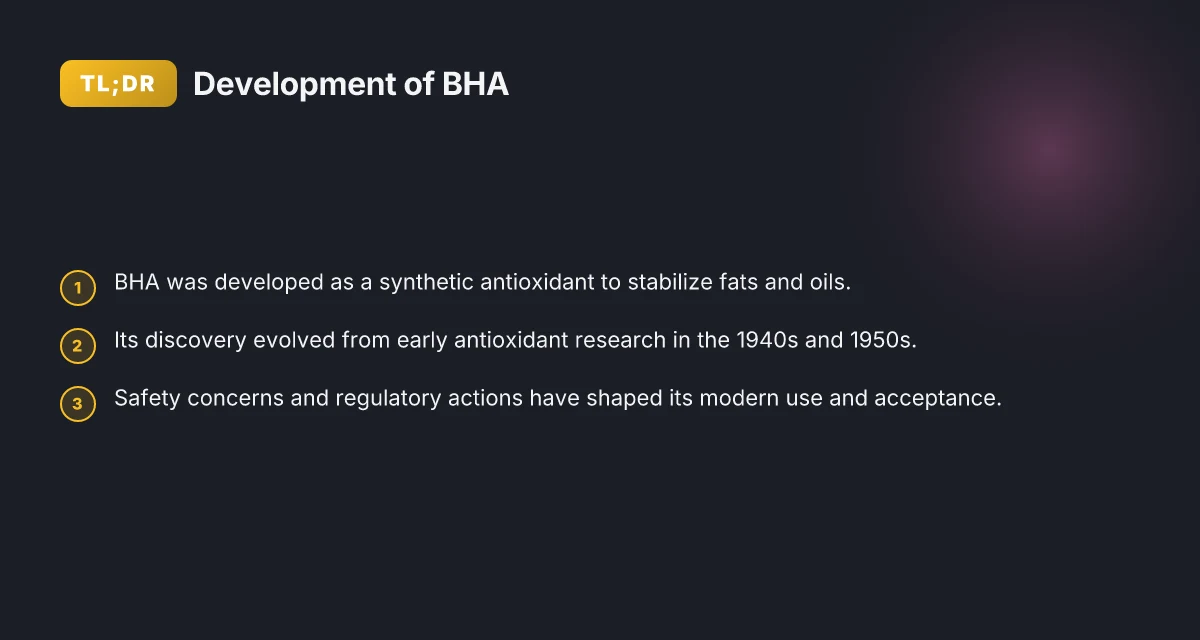
BHA, or butylated hydroxyanisole, is a synthetic antioxidant used to prevent fats and oils from becoming rancid. Its development stands at the intersection of mid-20th-century chemistry, food science, and industrial needs. Over the decades, BHA’s role expanded from a stabilizer for edible fats to an ingredient with broader applications in plastics, rubbers, cosmetics, and packaging. The story of its development reflects both the drive for longer shelf life in consumer products and the evolving conversations about food safety and chemical regulations.
Comparison of BHA vs related antioxidants in food applications
| Criterion | BHA | BHT | TBHQ | Propyl gallate | Vitamin E (tocopherols) |
|---|---|---|---|---|---|
| Primary use in foods | Stabilizer | Stabilizer | Stabilizer | Antioxidant additive | Fat-soluble antioxidant |
| Mechanism type | Free radical scavenging | Free radical scavenging | Free radical scavenging | Inhibits oxidation | Chain-breaking antioxidant |
| Regulatory status (food use) | Approved in many regions | Approved in many regions | Approved in many regions | Approved in many regions | Approved in many regions |
| Typical usage level | Low ppm range | Low ppm range | Low ppm range | Low ppm range | Variable, often higher |
| Sensory impact | Minimal color change | No color change | Minor color impact | Possible aftertaste | Generally neutral |
| Warning/controversy | Some safety debates | Some safety debates | Some safety debates | Controversy over interactions | Public discourse varies |
| Shelf-life impact | Improves stability | Improves stability | Improves stability | Improves stability | Improves stability |
| Regulatory scrutiny | Medium | Medium | Medium | Medium | Medium |
Compiled November 2026; check the provider's site for current details.
Origins and early antioxidant research
The concept of antioxidants for fats dates back to the early 20th century, but the specific lineage leading to BHA began in the 1940s and 1950s. Researchers were seeking compounds that could donate hydrogen atoms or scavenge free radicals to slow oxidative rancidity in fats. This era saw the identification and testing of a range of phenolic compounds and tert-butyl substituted phenols.
Key milestones in this period include:
- The recognition that phenolic antioxidants could interrupt lipid peroxidation chains.
- The challenge of balancing antioxidant activity with safety and sensory impact (taste and odor).
- Early screening of paraben-like and BHT-like structures, which informed later candidates.
BHA emerged as a refined phenolic antioxidant designed to be effective in a wide range of oil-rich foods and products. Its chemistry centers on a tert-butylated hydroxyanisole framework that can donate hydrogen atoms to stabilize reactive radical species.

Chemistry and mechanism of action
Understanding how BHA works helps explain why it found such broad use. BHA is a phenolic compound that acts primarily as a chain-breaking antioxidant in lipids. Its mechanism involves: Affordable Housing Project: A Practical Guide to Planning, Funding, and Delivering Your Initiative
- Donation of a hydrogen atom from the phenolic OH group to lipid radicals, forming a more stable radical that terminates the chain-propagating reactions of lipid peroxidation.
- Delocalization of the resulting radical across the aromatic ring, which stabilizes the molecule and reduces reactivity.
- The tert-butyl groups, positioned on the benzene ring, provide steric hindrance that helps preserve the antioxidant from premature reactions.
In practical terms, BHA slows rancidity, preserves flavor, and can extend shelf life under controlled conditions. Its effectiveness depends on concentration, the type of fat or oil, the presence of metals, light exposure, temperature, and interactions with other food additives or packaging materials.
Development timeline and industrial uptake
BHA’s path from concept to common use followed a steady industrial adoption pattern:
- 1940s–1950s: Conceptual development of synthetic antioxidants and early phenolic candidates.
- 1960s: Optimization of BHA structure for improved activity and stability.
- 1970s–1980s: Widespread adoption in the food industry, with labeling and regulatory reviews beginning to shape usage.
- 1990s–present: Expansion into non-food applications (cosmetics, plastics, rubber) and ongoing regulatory evaluations.
During these decades, BHA’s role evolved as food manufacturers sought reliable, cost-effective antioxidants that could work across fat-rich products like cereals, snack foods, baked goods, and processed oils. BHA provided a practical solution that complemented other antioxidants and helped maintain quality during storage and distribution.
Safety, regulation, and public discourse
Safety concerns have surrounded BHA since its early days. Critics point to animal studies suggesting possible carcinogenic effects at certain doses or in specific contexts, while supporters highlight the differences between animal data and typical dietary exposure in humans. The regulatory landscape reflects this tension: Bulgarian Housing Association - Contacts
- In the United States, BHA has been approved by the FDA for use in foods within specified limits, though it is not permitted in all products or all types of fat replacements in every circumstance.
- In the European Union, approvals and maximum usage levels have varied by product category, and some jurisdictions have imposed stricter limits or exemptions.
- International bodies, including the Joint FAO/WHO Expert Committee on Food Additives (JECFA), have conducted reviews and issued acceptable daily intake (ADI) guidelines, which influence regulatory decisions.
Public discourse around BHA has also focused on consumer transparency, labeling practices, and the broader question of synthetic additives in the modern diet. These conversations contribute to ongoing risk-benefit assessments that balance extended shelf life, cost, and safety concerns.
Development timeline and industry uptake: key milestones for BHA
| Milestone | Year/period | Industry adoption level | Geographic focus | Notable event | Current status |
|---|---|---|---|---|---|
| Discovery/fundamentals | 1940s | Emerging | Global | Antioxidant research begins | Foundational knowledge |
| Early food approvals | 1940s–1950s | Growing | U.S./Europe | Initial regulatory filings | Widespread allowed |
| Industrial scale production | 1950s–1960s | High | Global | Large-scale manufacturing | Standard practice |
| Regulatory debates | 1960s–1980s | Variable | Global | Safety reviews | Ongoing discussions |
| Diversification into packaging | 1970s–1990s | Moderate | Global | Use in materials | Expanded applications |
| Current regulatory posture | 2000s–present | Stable | Global | Reassessment in some regions | Widely used with limits |
Compiled November 2026; check the provider's site for current details.
Applications beyond food
Although BHA originated as a food antioxidant, its utility has extended into other industries: Home Page: Everything You Need to Know to Create a Strong Front Door for Your Website
- Packaging: BHA is used in some packaging films and materials to minimize oxidation and preserve product quality during transport and storage.
- Plastics and rubber: It acts as an antioxidant to protect polymers from oxidative degradation, improving durability and longevity in products ranging from consumer goods to industrial materials.
- Cosmetics: In some formulations, BHA helps stabilize oils and prevent rancidity, contributing to texture and shelf stability.
- Other additives: BHA can be part of complex formulations with synergists that enhance overall antioxidant performance or tailor activity to specific product environments.
The cross-industry use of BHA mirrors the broader trend of antioxidants serving multiple sectors with similar chemical challenges, namely, oxidative stress and aging of materials.
Comparisons with related antioxidants
To understand why BHA earned a lasting place, it helps to compare it with related antioxidants such as BHT (butylated hydroxytoluene), TBHQ (tert-butylhydroquinone), and natural alternatives like tocopherols (vitamin E). Here is a concise comparison:
| Antioxidant | Typical use context | Strengths | Common concerns |
|---|---|---|---|
| BHA | Fats and oils, some packaging | Broad activity, cost-effective | Regulatory scrutiny, sensory impact at higher doses |
| BHT | Similar to BHA, often paired | Synergistic effects, strong stability | Mixed safety signals in some studies |
| TBHQ | Oils and fats, baked goods | Very strong antioxidant, high efficacy | Stricter regulatory limits; potential odor changes |
| Tocopherols (Vitamin E) | Natural alternatives in foods | Food-grade, consumer-friendly | Sometimes less potent as a stand-alone antioxidant |
| Natural extracts (rosmarinic acid, rosemary extract) | Clean-label trends | Perceived naturalness, consumer demand | Often more expensive, variable potency |
These comparisons show why many manufacturers use BHA in combination with other antioxidants to optimize safety, efficacy, and cost while abiding by regulatory constraints.
Practical considerations for manufacturers and shoppers
For manufacturers: Board Members
- Evaluate product matrix: The fat content, presence of metals, light exposure, and storage conditions all influence BHA’s effectiveness.
- Determine synergy: Many formulations rely on BHA in combination with other antioxidants to achieve the desired shelf life without exceeding regulatory limits.
- Monitor regulatory changes: Stay updated on regional rules that affect permitted levels and product categories.
For shoppers and consumers:
- Read labels: Some products may contain BHA as part of fat-based formulations or packaging materials. When in doubt, check ingredient lists and regulatory disclosures.
- Consider alternatives: If there are dietary or safety preferences, look for products with natural antioxidants or “no added synthetic antioxidants” labeling.
- Understand the trade-off: Shelf life, flavor stability, and cost are influenced by the presence or absence of antioxidants like BHA.
Practical considerations for manufacturers and shoppers
| Topic | Manufacturer note | Shopper note | Typical constraints | Alternatives | Regulatory considerations |
|---|---|---|---|---|---|
| Cost | Low to moderate | Price impact small | Budget sensitivity | Other antioxidants | Approved status |
| Labeling | May be listed as BHA | Look for BHA on ingredients | Labeling rules vary | BHT, TBHQ, PG, tocopherols | Transparency requirements |
| Storage | Stable at room temp | Check expiry | Oxidation risk if misused | Balance of stability | Compliance with limits |
| Interactions | Works with other antioxidants | Not usually a concern for consumers | Food matrix effects | Synergists possible | Safety reviews |
| Sensory effects | Usually neutral | May notice slight flavor changes | Packaging compatibility | Alternative stabilizers | Regulation on claims |
| Safety communications | Ongoing reviews | Public discourse varies | Risk communication | Consumer education | Oversight bodies |
Compiled November 2026; check the provider's site for current details.
The future of BHA in a changing regulatory and consumer landscape
The development of BHA reflects a broader pattern in which industry must adapt to evolving science and public expectations. Moving forward, several factors will shape BHA’s trajectory: Understanding Links: What They Are, Why They Matter, and How to Use Them Effectively
- Safer alternatives: Ongoing research into natural antioxidants or innovative synthetic compounds may provide substitutes that meet safety concerns while delivering similar performance.
- Regulatory evolution: As more data accumulates, regulatory bodies may tighten or relax permitted levels, or require more explicit labeling. The pace of these changes varies by region.
- Clean-label trends: Consumer demand for minimally processed foods and recognizable ingredients could influence whether BHA remains a staple in some product categories, especially in markets with strong clean-label movements.
Recommendation
If you are a product developer or regulator, approach BHA with a structured risk-benefit lens. Use a well-documented formulation strategy that includes:
- Clear rationale for BHA usage levels within regulatory limits.
- Thorough testing across product matrices and storage conditions.
- Transparent communication about safety assessments and compliance with regional guidelines.
- Consideration of alternatives for products where consumer expectations favor natural ingredients or where regulatory pressure increases.
For consumers, stay informed about where BHA appears in the foods and products you use, and weigh your choices against personal preferences for synthetic versus natural antioxidants, based on the latest regulatory status and scientific findings. BHA has played a crucial role in extending shelf life and preserving quality. Its ongoing evolution in safety assessments and consumer expectations will continue to shape how and where it is used in the years ahead.