Affordable Housing Project: A Practical Guide to Planning, Funding, and Delivering Your Initiative
A comprehensive guide to initiating and managing an affordable housing project with practical steps, funding tips, and best practices.
The idea of an Affordable Housing Project is both urgent and achievable when you combine clear goals, solid financing, and inclusive design. This article walks you through the essential steps to plan, fund, and deliver a project that provides real housing relief while meeting local regulations and community needs. Whether you are a city planner, developer, non-profit, or community group, the framework below helps translate aspirational goals into a tangible, sustainable outcome.
Comparison of Affordable Housing Project Definitions
| Term | Definition | Key characteristics | Typical examples |
|---|---|---|---|
| Affordable housing project | Housing project with cost protections for tenants and/or targeted income groups | Subsidies or caps, long-term affordability, compliance metrics | Low-income housing, mixed-income developments |
| Rapid-build project | Accelerated construction approach | Streamlined permitting, modular or prefab, standardized designs | Modular apartments, prefab townhomes |
| Mixed-use project | Combines housing with other uses | Ground-floor commercial, density, parking strategy | Housing above shops, live-work units |
| Community land trust | Community-owned land model | Long-term stewardship, resident-ownership options | CLT multifamily, cooperative housing |
| Inclusionary housing | Requirement to include affordable units | In-lieu fees, density bonuses, zoning rules | Infill developments with affordable units |
| Social housing | Government-supported affordable housing | Public funding, governance by agency | Public housing, housing agencies |
Compiled November 2026; check the provider's site for current details.
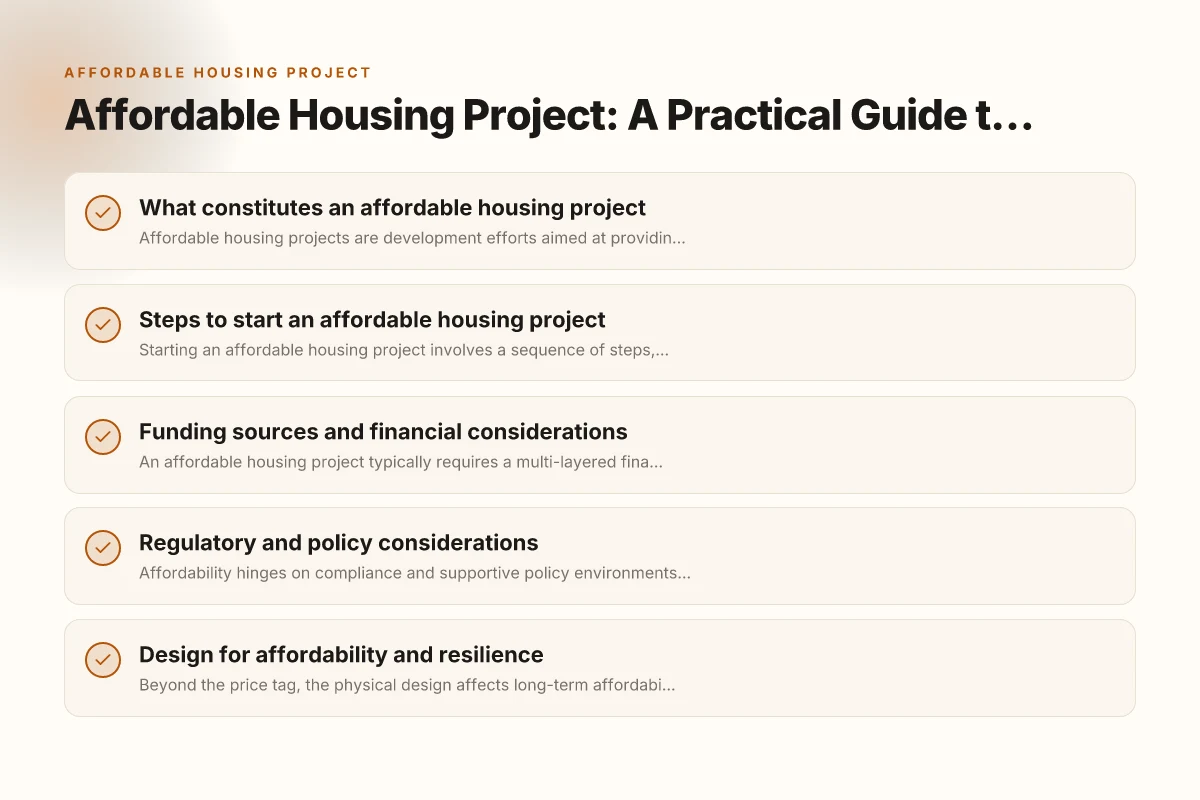
What constitutes an affordable housing project
Affordable housing projects are development efforts aimed at providing homes for households with lower or moderate incomes at a cost they can reasonably afford. They can range from rental housing to mixed-use buildings with affordable units, sometimes including supportive services. Key characteristics include:
- Income targeting: units priced for households earning at or below a defined percentile of area median income (AMI).
- Long-term affordability: covenants or regulatory agreements that ensure affordability for a specified period.
- Financial feasibility: a mix of subsidies, tax incentives, and private financing that makes the project economically viable.
- Quality and inclusion: livable design, accessible units, and integration with the neighborhood.
Steps to start an affordable housing project
Starting an affordable housing project involves a sequence of steps, each with decision points and risk considerations.
- Define scope and goals
- Determine target households (e.g., 60% AMI, families, seniors).
- Decide on unit mix, density, and affordability tenure.
- Set metrics for success (units delivered, cost per unit, occupancy rate, resident outcomes).
- Build a stakeholder map
- Identify city agencies, housing authorities, lenders, non-profit partners, community groups, and potential residents.
- Establish an advisory committee that includes residents or representatives from affected communities.
- Map permissions, regulatory requirements, and potential regulatory barriers.
- Assess site and zoning
- Conduct a site analysis: location, transit access, services, environmental constraints.
- Confirm zoning compatibility or identify the need for variances or waivers.
- Evaluate acquisition costs, due diligence timelines, and contingency plans.
- Develop the financial model
- Create a baseline budget: land costs, hard costs (construction), soft costs, financing fees.
- Model different funding scenarios: grants, low-interest loans, tax credits, public subsidies.
- Include sensitivity analysis for rent or sale price changes, occupancy risk, and construction overruns.
- Assemble the funding package
- Align sources with project needs: tax credits (LIHTC in the U.S., for example), public subsidies, philanthropy, and private equity.
- Plan for operating subsidies if necessary to cover ongoing affordability gaps.
- Prepare documentation: feasibility reports, operating pro formas, and regulatory compliance plans.
- Design and resident experience
- Prioritize affordable, durable, energy-efficient design with flexible unit layouts.
- Integrate universal design and adaptable features for aging in place.
- Incorporate communal spaces, in-building services, and outdoor areas that foster community.
- Navigate approvals and procurement
- Prepare a compelling development proposal for planning commissions or city councils.
- Use transparent procurement processes for construction and management partners.
- Plan for community process: public meetings, comment periods, and revisions based on feedback.
- Construction and occupancy
- Set a realistic construction timeline with milestones and risk buffers.
- Monitor cost management, change orders, and quality control.
- Establish onboarding, property management, and resident screening policies that respect fair housing laws.
Funding sources and financial considerations
An affordable housing project typically requires a multi-layered financing structure. The exact mix varies by country, region, and project type, but several core elements recur.
- Tax incentives and credits: programs like low-income housing tax credits (LIHTC) or equivalent incentives can significantly improve feasibility.
- Grants and subsidies: government or foundation grants may cover soft costs, predevelopment work, or capital subsidies.
- Debt financing: banks, credit unions, or specialized lenders offer construction and permanent loans with terms aligned to project cash flows.
- Equity and philanthropy: private investors or non-profit partners may provide equity or donations that reduce the need for expensive debt.
- Operating subsidies: to keep rents affordable over time, long-term operating subsidies or project-based vouchers may be necessary.
To help visualize a typical financing mix, consider the following simplified scenario (illustrative numbers only): Bulgarian Housing Association - Contacts
- 40% Tax credits and equity
- 30% Construction and permanent debt
- 15% Grants or subsidies
- 15% Operating reserves and contingency
When building the financial model, include:
- A stabilized occupancy rate assumption and an expense benchmark for utilities, maintenance, and management.
- A reserve plan for capital expenditures and emergency repairs.
- A sensitivity table showing how rent levels, vacancy, or interest rates affect debt service coverage.
Table: Example financing mix (illustrative only)
| Source | Share of total project cost | Key notes |
|---|---|---|
| LIHTC or equivalent tax credits | 25-40% | Requires compliance, programs vary by region |
| Equity from private or non-profit partners | 15-30% | Often paired with incentives or subsidies |
| Construction debt | 20-35% | Typically short-term, converts to permanent debt |
| Permanent debt | 15-25% | Longer term, may have favorable terms for affordable housing |
| Grants / subsidies | 5-15% | For predevelopment, soft costs, or operating support |
| Reserves / contingencies | 5-10% | To cover unforeseen costs |
Note: The exact percentages will vary. This table shows how a project might be structured. Consult local housing authorities and financial advisors for precise planning.
Stages to Start an Affordable Housing Project Home Page: Everything You Need to Know to Create a Strong Front Door for Your Website
| Stage | Key actions | Stakeholders | Typical duration | Metrics / outputs |
|---|---|---|---|---|
| Define goals | Set affordability targets, location, scale | Prospective residents, funders | 2–4 weeks | Goals document |
| Site assessment | Land availability, constraints, zoning | City, developer, engineers | 4–8 weeks | Site report |
| Financing plan | Identify sources, subsidies, debt/ equity | Funder, banker, gov’t programs | 6–12 weeks | Financial model |
| Design brief | Outline performance, resilience, finish standards | Architect, users | 4–6 weeks | Design brief |
| Approvals | Permits, environmental, community approvals | Planning, regulators | 3–6 months | Approved plans |
| Procurement | Nego contracts, build method | Contractor, suppliers | 6–12 weeks | Procurement package |
| Construction | Groundbreaking to weather-tight | Builder, subcontractors | 12–36 months | Built units |
| Occupancy | Tenant selection, leases, safety | Property manager, residents | 1–4 months | Leased units, occupancy rate |
Compiled November 2026; check the provider's site for current details.
Regulatory and policy considerations
Affordability hinges on compliance and supportive policy environments. Common considerations include:
- Affordability covenants: legal agreements that lock in rents or sale prices for a defined period.
- Inclusionary zoning: policies that require a portion of new developments to be affordable or contribute to a fund.
- Funding agreements: requirements tied to grants or tax credits often come with reporting, occupancy, and maintenance obligations.
- Fair housing compliance: ensuring design and operations do not discriminate and provide reasonable accommodations.
- Accessibility standards: meeting universal design or accessibility codes so units are usable by people with disabilities.
Engagement with local policymakers early in the process helps anticipate regulatory hurdles and align the project with community goals.
Design for affordability and resilience
Beyond the price tag, the physical design affects long-term affordability and quality of life. Consider: Board Members
- Efficient building systems: high-performance insulation, heat pumps, solar readiness, and energy-efficient appliances lower operating costs for residents.
- Durable materials and cost-effective maintenance: materials that withstand wear and tear reduce lifecycle costs.
- Flexible unit layouts: adjustable spaces that can adapt to families growing or shrinking.
- Community amenities: shared spaces like laundries, courtyards, and programming rooms support resident well-being.
- Resilience features: flood protection, fire safety, and climate-adaptive design minimize risk and disruption.
Funding Sources and Financial Considerations
| Source type | Typical programs | Eligibility / criteria | Pros | Cons | Example metrics |
|---|---|---|---|---|---|
| Grants | Federal, state, foundation | Nonprofit or entity, project fit | Free money, non-dilutive | Competitive, time-bound | Grant amount, app success rate |
| Low-interest loans | CDFIs, government loan programs | Debt service capacity | Lower cost of capital | Repayment obligation | Interest rate, DSCR |
| Tax incentives | LIHTC, tax-exempt bonds | Compliance with affordability rules | Leverage equity, long-term subsidies | Complex rules, monitoring | Credits allocated, carryforward |
| Mixed finance | Grants + loans + equity | Diverse funding plan | Risk sharing, larger capital | Coordination complexity | Total capital stack |
| In-kind / land contributions | Donation of land or facilities | Beneficiary alignment | Reduces upfront costs | Value attribution, timing | Land value, donation terms |
| Developer fees and reserves | Fee revenue, contingency | Sufficient project size | Flexibility in budgets | Can dilute margins | Fee percentage, reserve level |
Compiled November 2026; check the provider's site for current details.
Community engagement and equity
Involving residents and neighbors throughout the process improves acceptance and outcomes:
- Early outreach: host listening sessions, surveys, and open houses to gather input.
- Transparent communication: share timelines, budget bands, and decision criteria.
- Local hiring and procurement: commit to local labor, small business participation, and apprenticeship programs.
- Resident advisory boards: empower residents to influence operations and programming after occupancy.
Risks and mitigation strategies
No project is risk-free. Common risks and ways to mitigate them include: Understanding Links: What They Are, Why They Matter, and How to Use Them Effectively
- Budget overruns: implement strict cost controls, contingency planning, and staged construction.
- Financing gaps: diversify funding sources, secure lines of credit, and backstop with reserve funds.
- Enrollment shortfalls: conduct market testing and adjust unit mix or pricing early.
- Regulatory delays: maintain proactive relationships with authorities and prepare flexible design options.
Implementation timeline: a practical example
A hypothetical affordable housing project might unfold in phases over 24 to 48 months:
- Months 1-3: define scope, assemble team, initiate site due diligence.
- Months 4-6: secure pre-development funding, finalize feasibility studies, begin community outreach.
- Months 7-12: complete design development, initiate entitlement processes, lock financing terms.
- Months 13-18: obtain approvals, bid construction, finalize management arrangements.
- Months 19-36: construction phase with ongoing review and reporting.
- Months 37-48: lease-up, occupancy, and stabilizing operations. Begin ongoing monitoring of affordability covenants.
This timeline is illustrative. Real-world projects may accelerate or extend based on local conditions, financing approval speeds, and regulatory processes.
Regulatory and Policy Considerations
| Area | Policy instrument | Typical impact | Compliance burden | Enforcement risk | Helpful indicators |
|---|---|---|---|---|---|
| Zoning | Density allowances, inclusionary requirements | Affects unit count and affordability | Moderate to high | Medium | Zoning map, IHE/IBP |
| Permitting | Fast-track programs, pre-application | Shortens timelines | Moderate | Low to medium | Permit timeline, review comments |
| Subsidy rules | Annual affordability period, income limits | Long-term financial viability | High | Medium | Compliance checklists |
| Environmental | Energy codes, resilience standards | Operating costs, safety | Moderate | Low | Energy model, resilience rating |
| Tenant protections | Rent control, relocation rules | Stability for residents | Moderate | High if unenforced | Compliance occurrences |
| Public procurement | Local preferences, embeddings | Local economic benefits | Moderate | Low | Bid opportunities, local spend |
Compiled November 2026; check the provider's site for current details. Sponsors: How to Find, Vet, and Engage Partners that Accelerate Your Growth
Final recommendations
If you are considering launching an Affordable Housing Project, these actions help increase your odds of success:
- Start with a clear, measurable goal and a transparent governance structure. Align stakeholders around shared outcomes and accountable timelines.
- Build a robust financial model early that tests multiple funding scenarios and includes risk buffers. Diversify funding sources to reduce reliance on a single program.
- Prioritize design that minimizes operating costs for residents while delivering quality, accessible homes. Energy efficiency and durability pay off over the life of the project.
- Invest in community engagement from day one. Residents and local neighbors should influence design, services, and management plans.
- Prepare for regulatory and reporting requirements. Meet or exceed compliance expectations to preserve incentives and avoid delays.
Building affordable housing is a complex but rewarding endeavor. With clear goals, thoughtful financing, inclusive design, and strong community partnerships, you can deliver homes that improve lives and strengthen neighborhoods.
If you’d like, I can tailor this guide to your region or provide a customized project checklist, due diligence templates, or a sample investment memo based on your target city, budget, and program opportunities.