Sponsors: How to Find, Vet, and Engage Partners that Accelerate Your Growth
A practical guide to understanding sponsors, how to secure them, and how to build lasting, value-driven partnerships.
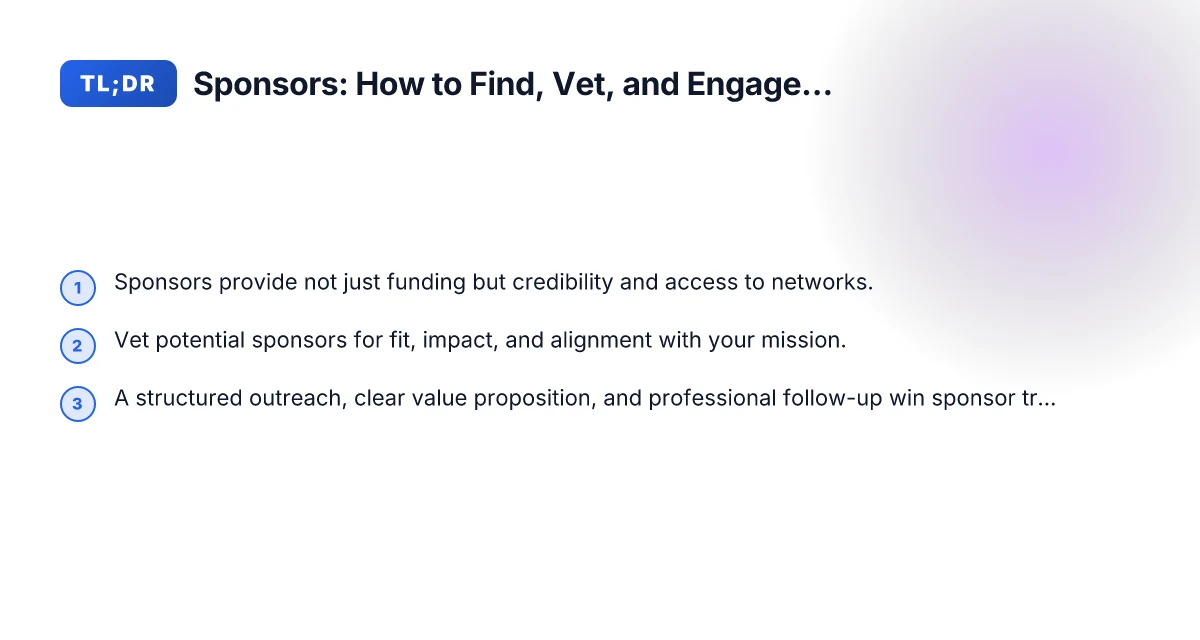
Sponsors are more than a source of money. They are partners who can amplify your reach, open doors, and help you scale. This guide breaks down what sponsorship really means, how to identify the right sponsors, how to approach them, and how to manage the relationship for long-term impact. Whether you’re seeking sponsorship for a nonprofit campaign, a community event, a startup launch, or a professional conference, the fundamentals stay the same: clarity, reciprocity, and professionalism.
Sponsor screening criteria by fit and sustainability
| Criterion | Description | Example indicators | How to measure | Weight (0-5) |
|---|---|---|---|---|
| Strategic alignment | Do sponsor goals align with project mission | Mission match, target audience overlap | Yes/No; qualitative notes | 5 |
| Value proposition clarity | Is benefit to sponsor clear and compelling | Specific ROI, visibility, exclusivity | Short phrase | 4 |
| Financial viability | Sponsor can sustain support | Budget size, funding frequency | Yes/No; amount if known | 4 |
| Reputational alignment | Values and ethics match | Public stance on issues | Yes/No; recent concerns | 3 |
| Long-term potential | Likelihood of ongoing partnership | Past renewals, pipeline | Yes/No; notes | 3 |
| Collaboration readiness | Ability to co-create and integrate | Joint activities planned | Yes/No; examples | 4 |
Compiled November 2026; check the provider's site for current details.
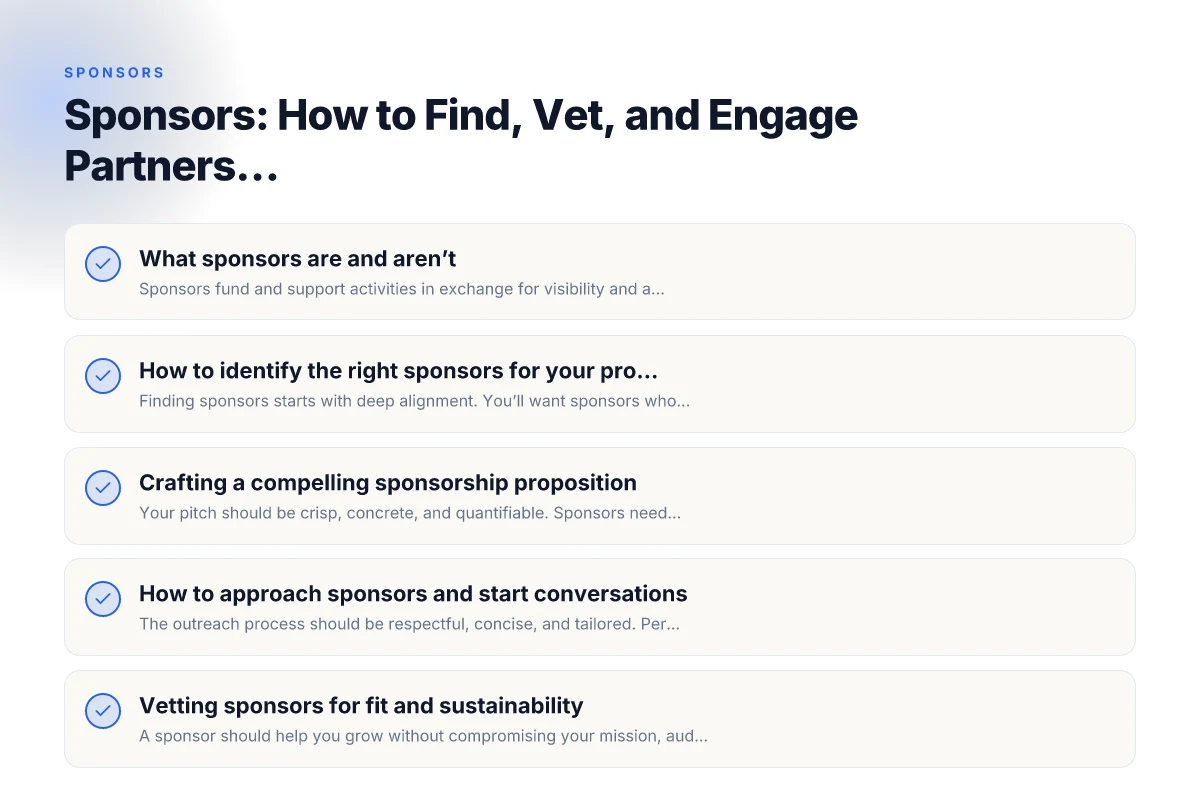
What sponsors are and aren’t
Sponsors fund and support activities in exchange for visibility and alignment with their brand, values, and business goals. They are not merely donors. They are strategic partners who expect a return on their investment in visibility, access, and reputation.
What sponsors can offer
- Financial support or in-kind goods and services
- Brand visibility: logos, product placements, event signage
- Access to audiences: attendee lists, email campaigns (where permitted), social media shout-outs
- Credibility: endorsement from a trusted sponsor can lift your project
- Networks and introductions: potential customers, partners, mentors, or investors
What sponsors typically expect in return
- Clear value proposition: why their brand should care
- Measurable impact: metrics, reach, and engagement
- Professional execution: reliable delivery on commitments
- Respect for brand guidelines and audience
- Mutually beneficial terms, with transparency about risks and opportunities
How to identify the right sponsors for your project
Finding sponsors starts with deep alignment. You’ll want sponsors whose products, services, or values intersect with your mission and audience. News: what it is, how it shapes our world, and how to stay informed
Steps to identify good matches
- Define your audience and impact: who is reached, how many people, what outcomes
- Create a sponsor fit profile: industries that align, brand values, budget ranges
- Map sponsor ecosystems: look for companies already supporting similar causes
- Prioritize mutual value: the sponsor should gain something meaningful beyond logo placement
Initial outreach has to be precise. A well-targeted approach is more effective than spamming a long list.
Crafting a compelling sponsorship proposition
Your pitch should be crisp, concrete, and quantifiable. Sponsors need to see the anticipated benefits and the risks of not partnering.
Key elements of a sponsor proposal Introduction to the Keyword: Understanding the Basics of the Topic
- Executive summary: 2–3 sentences on who you are, what you’re building, and why it matters
- Audience and reach: demographics, event size, channels, and expected impressions
- Sponsorship options: levels or customizable packages
- Deliverables and timing: what the sponsor gets and when
- Measurement plan: how impact will be tracked and reported
- Risk and contingency plan: what happens if plans shift
- Case studies or proof of concept: quick wins from past partnerships
Sponsor package ideas (levels)
- Title Sponsorship: exclusive branding, speaking slot, top placement in materials
- Gold/Silver/Bronze tiers: a mix of logo visibility, booth presence, and content contributions
- In-kind partnerships: product donations, services, or venue provision
- Named sessions or tracks: sponsor name attached to a specific part of the project
A simple one-page outline can be enough to start conversations. For larger partnerships, develop a formal written proposal and a slide deck.
How to approach sponsors and start conversations
The outreach process should be respectful, concise, and tailored. Personalization matters more than volume.
Outreach best practices Host Families: A Complete Guide to Welcoming Students, Travelers, and Exchange Guests
- Do your homework: know the sponsor’s recent campaigns, values, and goals
- Open with value: explain what they gain, not just what you need
- Be specific about sponsorship options: provide clear tiers and what’s included
- Offer a quick next step: a 15–20 minute call or a meeting to discuss
- Follow up promptly: recap the conversation and next actions
Email structure that works
- Subject line: “Opportunity to reach [audience] with [your project]”
- Opening line: show familiarity with their work
- Value proposition: two sentences on impact and audience match
- Sponsorship options: bullet points with tiers or customizable options
- Call to action: request a short call or meeting
- Contact information: your direct lines, and a calendar link if possible
During conversations, listen more than you speak. Sponsors will tell you what they care about in terms of metrics, branding, and partnerships.
Crafting a compelling sponsorship proposition checklist
| Element | What it accomplishes | Suggested content | Suggested metrics | Example phrasing | Priority (high/med/low) |
|---|---|---|---|---|---|
| Value to sponsor | Demonstrates ROI | Sponsorship benefits, metrics | Projected reach, engagement | "We expect X impressions" | high |
| Audience fit | Shows match with sponsor's targets | Demographics, segments | Audience overlap percentage | "Your target is Y" | high |
| Activation plan | Concrete collaboration ideas | Events, content, co-branding | Activation count | "Co-branded series" | high |
| Measurement plan | Accountability and reporting | KPIs, cadence | Monthly/quarterly reports | "We’ll report Q1 results" | med |
| Risk and mitigation | Builds trust | Potential risks, mitigations | Risk score | "Legal review completed" | med |
| Investment structure | Clarity on what sponsor funds | Tiers, benefits, deliverables | Pricing clarity | "Bronze/Silver/Gold" | high |
Compiled November 2026; check the provider's site for current details. History: Understanding Its Scope, Types, and How It Shapes Our World
Vetting sponsors for fit and sustainability
A sponsor should help you grow without compromising your mission, audience trust, or integrity. Vetting reduces risk and ensures a durable partnership.
Key questions to ask potential sponsors
- Do their values align with ours, and is there alignment with our audience?
- What does success look like for them, and can we measure it?
- Are there any brand constraints or guidelines we must follow?
- What is the expected time commitment and level of involvement?
- Are there conflicts of interest with existing sponsors or partners?
Due diligence checklist
- Reputation and media history: check for any controversies
- Track record with similar partnerships: case studies and references
- Legal and compliance: sponsorship contracts, usage rights, exclusivity
- Financial stability: ability to fund as promised
- Audience overlap: ensure the sponsor’s customers are relevant to your audience
Drafting a sponsorship agreement Donations: How to Give Effectively, Tax-Smartly, and Ethically
- Define the scope: deliverables, timelines, and approved usage of logos
- Outline rights and approvals: where branding appears, content rights, and edits
- Payment terms and deliverables: when and how funds are transferred
- Metrics and reporting: what you will measure and how often you will report
- Termination and exit: what happens if goals aren’t met
- Confidentiality and data handling: sensitive information safeguards
Measuring impact and reporting to sponsors
Transparency builds trust. Regular, readable reporting helps sponsors see value and renew or expand the partnership.
What to track and report
- Reach and impressions: audience size, event attendees, digital impressions
- Engagement: clicks, sign-ups, downloads, social interactions
- Brand lift: surveys or qualitative feedback on sponsor visibility
- ROI for the sponsor: lead generation, sales impact, trial or adoption rates
- Milestones and milestones achieved: progress against agreed deliverables
How to present results
- Executive summary: one page with top-line metrics
- Visual dashboards: charts and graphs that show progress
- Narrative insights: what worked, what didn’t, and why
- Next steps: opportunities for renewal or expansion
Table: sponsorship options and typical deliverables (illustrative) Contacts: A Practical Guide to Managing Your Network and Communication
| Level | Visibility at event | Digital badges | Speaking slot | Booth/activation | Data/reports | Estimated value (range) |
|---|---|---|---|---|---|---|
| Title | Logo + stage screen | Prominent | 1 slot | Premium booth | Quarterly report | $25k–$100k |
| Gold | Logo + signage | Featured | 1 session | Standard booth | Monthly updates | $10k–$25k |
| Silver | Logo on collateral | Logo | N/A | Smaller presence | Post-event recap | $3k–$10k |
| Bronze | Logo in program | Logo | N/A | N/A | Event recap only | $1k–$3k |
Building a lasting, values-aligned sponsorship program
A single sponsorship can catalyze a broader strategy. The goal is to build a sustainable program that benefits all parties.
Best practices for lasting partnerships
- Start with a plan, not a one-off deal: align on long-term goals
- Maintain professional communications: timely updates, clear expectations
- Deliver on every commitment: trust is built through reliability
- Seek feedback and adapt: sponsors’ needs may evolve over time
- Create joint value beyond money: co-branded content, exclusive experiences, or shared testimonials
Governance and process
- Create a sponsor management team or point person
- Maintain a living sponsor kit with updated packages
- Develop a renewal calendar to keep the relationship active
- Implement a post-event debrief to collect sponsor feedback
Common pitfalls to avoid Understanding Links: What They Are, Why They Matter, and How to Use Them Effectively
- Over-committing to a sponsor that doesn’t fit your audience
- Making promises you can’t keep or delivering late
- Lacking a clear measurement plan or case for attribution
- Treating sponsors as mere donors rather than partners
Conversation approach framework for initiating dialogue
| Stage | Goal | Sponsor cues | Suggested opening | Follow-up action | Success signal |
|---|---|---|---|---|---|
| Research | Identify mutual fit | Public statements, sponsorship history | "I noticed your support for X" | Send intro email with one-pager | Positive reply or meeting set |
| Outreach | Schedule intro call | Time availability | "Could we chat for 20 minutes next week?" | Share tailored one-pager | Meeting booked |
| Discovery | Uncover needs and fit | Pain points, goals | "What outcomes matter most to you?" | Propose tailored concept | Sponsor asks for proposal |
| Proposal | Present mutual plan | Budget, timeline | "Here is a 4-week concept aligned with your goals" | Send formal proposal | Interest and questions rise |
| Close | Finalize terms | Decision timeline | "Shall we move to a contract draft?" | Send agreement draft | Commitment or next steps |
Compiled November 2026; check the provider's site for current details.
Final recommendation: start with clarity, then build with reciprocity
If you’re new to sponsorship, begin with a focused, well-targeted outreach plan. Define your audience, articulate a clear value proposition, and offer a few thoughtful sponsorship options rather than a one-size-fits-all bundle. Prioritize sponsors who share your mission and show a willingness to collaborate on meaningful deliverables. As you establish trust, expand the partnership with co-created experiences, shared content, and measurable impact. The most successful sponsor relationships are those that feel unmistakably mutual: both sides gain visibility, credibility, and momentum to achieve their goals.