Housing Survey hosted by CINNI
An in-depth look at the CINNI-hosted Housing Survey, what it covers, who should participate, and how the results can inform policy and housing decisions.
The Housing Survey hosted by CINNI is a pivotal resource for understanding how people live, what they need in their homes, and where gaps exist in housing supply and affordability. This article breaks down what the survey is, who should participate, what kinds of data are collected, and how the results are used by policymakers, researchers, and community organizations. If you’re considering whether to engage with the CINNI Housing Survey, you’ll find practical guidance and expectations here.
Participant eligibility and engagement
| Criterion | CINNI survey participation | Typical eligibility for housing surveys | Incentives | Time commitment | Accessibility |
|---|---|---|---|---|---|
| Target participants | Homeowners, renters, landlords | Varies; often residents | Small token / none | Short to moderate | Multi-language options |
| Who should participate | Why it matters | Representativeness goals | Response rate importance | Expected completion time | Accommodations available |
| Consent & privacy | Explicit consent, data protection | May vary | Anonymized data often used | Estimated duration | Accessibility features |
Compiled November 2026; check the provider's site for current details.
What is CINNI and what is the Housing Survey?
CINNI stands for a research consortium focused on housing, neighborhood dynamics, and inclusive growth. The Housing Survey is an initiative designed to capture a comprehensive picture of:
- Housing tenure (ownership vs. rental)
- Affordability and housing costs relative to income
- Housing quality and conditions
- Availability of supports for special needs households
- Neighborhood amenities and access to services
- Stability and mobility patterns
The survey uses a combination of online questionnaires, phone interviews, and in-person outreach to maximize reach and inclusivity. It is conducted with strict privacy protections and follows established statistical standards to ensure reliable results.
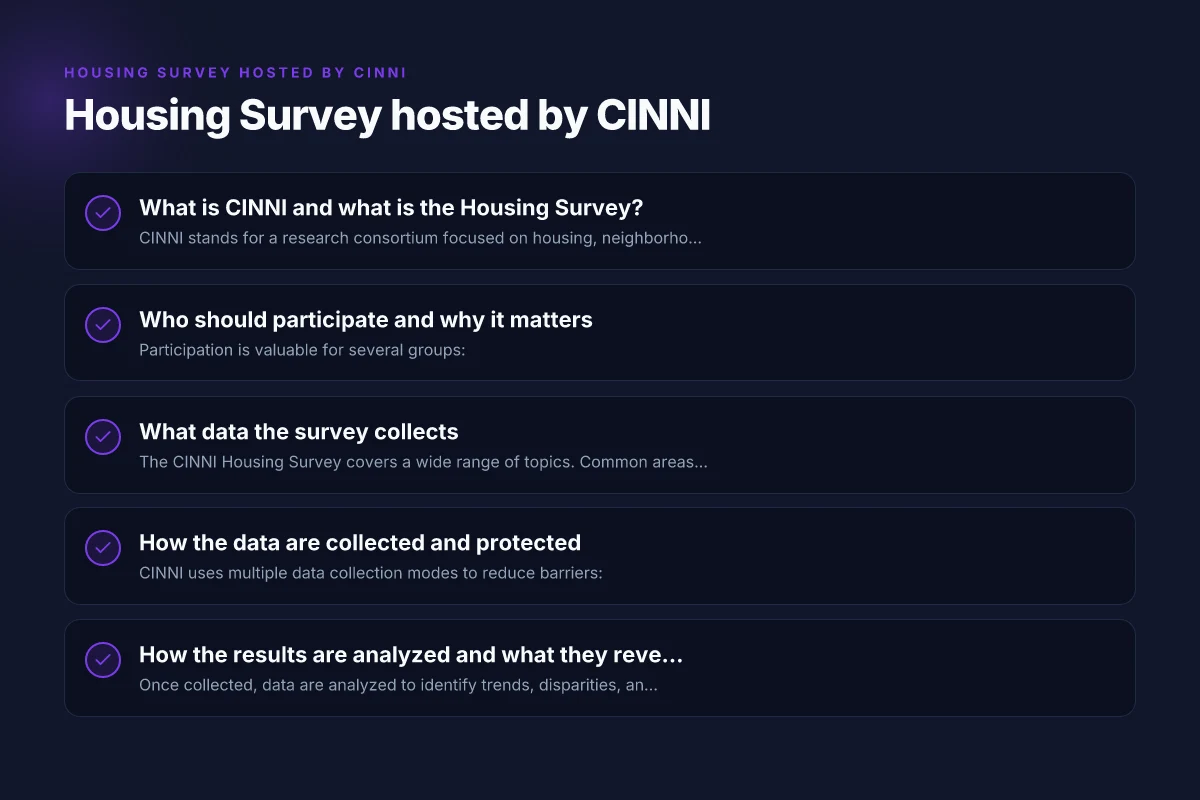
Who should participate and why it matters
Participation is valuable for several groups:
- Households: provides data on rent or mortgage burden, utility costs, and maintenance needs.
- Renters and landlords: sheds light on rental markets, vacancy rates, and negotiation dynamics.
- Homeowners with mortgage considerations: helps understand interest rates, refinancing behavior, and equity trends.
- Community organizations and advocates: can use the findings to push for targeted programs and funding.
Why participate? The data inform: NSPCC who helped who didn't
- Allocation of housing subsidies and grants
- Zoning and land-use policies that influence supply
- Programs to prevent displacement and support first-time buyers
- Infrastructure investments like transit, schools, and healthcare access
Your participation helps paint a realistic, inclusive picture of housing across neighborhoods, not just the loudest voices.
What data the survey collects
The CINNI Housing Survey covers a wide range of topics. Common areas include:
- Household demographics: age, household size, and composition
- Income and employment status: wages, benefits, and seasonal work
- Housing costs: rent or mortgage payments, property taxes, utilities
- Housing quality: age of the dwelling, maintenance issues, safety concerns
- Tenure and mobility: how long you’ve lived in your current home, past moves
- Access to services: proximity to schools, healthcare, grocery stores, childcare
- Neighborhood perceptions: safety, noise, green space, and community cohesion
- Special considerations: accessibility needs, multi-generational households, and language preferences
The survey is designed to be accessible, with multilingual options and accommodations for people with disabilities.
How the data are collected and protected
CINNI uses multiple data collection modes to reduce barriers: Singlebörsen - Wie sinnvoll sind sie? | CINNI
- Online questionnaires with mobile-friendly design
- Phone interviews for those without reliable internet
- Paper questionnaires available through community partners
- In-person outreach for underrepresented groups
Protection of privacy is a core priority. Data are anonymized, stored securely, and accessed only by authorized researchers under strict protocols. Participants are informed about how their data will be used, who will access it, and how long it will be kept.
Data collection, protection, and use
| Data types collected | Collection method | Privacy protections | Data protection standards | Data access for researchers | How results are shared |
|---|---|---|---|---|---|
| Demographics, housing details, opinions | Surveys, interviews, logs | Anonymization, consent | Encryption, access controls | Restricted to approved researchers | Public reports, dashboards |
| Data accuracy checks | Cross-checks, validation | Privacy-first approach | Regular audits | De-identified releases | Summary results only |
| Data retention | Retention period | Data deletion policies | Compliance standards | Third-party access rules | Updates and corrections |
Compiled November 2026; check the provider's site for current details.
How the results are analyzed and what they reveal
Once collected, data are analyzed to identify trends, disparities, and needs across different demographic groups and geographies. Analysts use statistical weighting to ensure results reflect the broader population. Key outputs include: NSPCC The Victims
- Baseline housing affordability metrics (e.g., share of income spent on housing)
- Market gaps (areas with insufficient affordable units)
- Quality indicators (maintained housing stock vs. deterioration)
- Vulnerable populations (elderly, low-income families, people with disabilities)
- Geographic maps of need (by neighborhood or district)
The findings help translate raw numbers into actionable insights for policy and practice.
The impact: how results influence policy and programs
Survey results often drive funding decisions, program design, and regulatory changes. Typical impacts include:
- Targeted affordability initiatives (rent subsidies, down payment assistance)
- Preservation programs for at-risk housing stock
- Zoning reforms to unlock new housing supply (density, accessory dwelling units)
- Enhanced services tied to housing stability (energy efficiency upgrades, tenant protections)
- Community planning conversations that incorporate resident needs
Local governments, housing authorities, nonprofits, and researchers routinely use CINNI’s data to justify proposals and measure progress over time.
How to participate: steps and practical tips
If you want to take part in the CINNI Housing Survey, here are practical steps: NSPCC: What It Is, What It Does, and How It Supports Children in the UK
- Find the official invitation: Check your mail, email, or community bulletin boards for the official invitation or link.
- Choose your mode of participation: Online, phone, or in-person options are typically available.
- Check eligibility: Some surveys have targeted samples, but many invite a broad cross-section of residents.
- Prepare for the questions: Expect items about income, housing costs, and dwelling conditions. It helps to have recent documents handy (lease, mortgage statement, utility bills).
- Be honest and thorough: The more accurate your responses, the more useful the data are for your area.
- Ask questions: If anything is unclear, contact the survey team through the provided channels. They can explain privacy protections and how your data will be used.
If you’re a community organization, you can often partner with CINNI to help reach underserved groups and provide language and accessibility support.
How to use the results: a practical framework
Policy makers and practitioners can apply CINNI’s Housing Survey results through a simple framework:
- Assessment: Identify prevailing affordability levels, vacancy rates, a stock of older housing, and areas of greatest need.
- Prioritization: Rank issues by severity, impact, and feasibility of solutions.
- Action: Design targeted programs (e.g., rental assistance, home rehabilitation, accessibility improvements).
- Evaluation: Establish metrics to track progress (e.g., changes in rent burden, housing quality scores).
- Communication: Share findings with the public to build support and accountability.
Here is a quick comparison to illustrate how results can differ by context, which helps tailor responses:
| Topic | Urban core outcomes (typical) | Suburban/rural outcomes (typical) | Implications for policy |
|---|---|---|---|
| Rent burden | Higher prevalence | Lower (but sometimes higher in isolated pockets) | Target subsidies where burden is greatest |
| Housing stock quality | Mixed, some aging units | Often newer stock but with maintenance gaps | Invest in rehabilitation and enforcement |
| Availability of affordable units | Scarce in core neighborhoods | More options but longer commutes | Coordinate with transit and job access |
| Service access | Proximity to jobs and amenities | Variable access, transport gaps | Improve mobility options and-service networks |
What CINNI’s Housing Survey means for you
For residents, the survey is more than a data collection exercise. It is a steering wheel for housing policy. The results help ensure that: NSPCC survey: what the latest findings reveal about child protection and public awareness
- Subsidies and programs go where they’re most needed
- Housing supply strategies consider both affordability and quality
- Communities preserve character while expanding options for diverse households
- Vulnerable groups receive targeted protections and supports
If you care about safer, more affordable, and better-quality housing in your area, engaging with CINNI’s Housing Survey is a direct way to influence outcomes.
Final section: recommendations for readers
- Participate if invited: Your input is essential for accurate, representative findings.
- Share the invitation: If you know others who might not hear about it, help spread the word through community groups, libraries, and local events.
- Advocate for accessibility: Encourage multilingual options, easy-to-use formats, and accommodations for people with disabilities.
- Follow the results: Look for public dashboards, reports, and briefings that translate data into concrete plans.
- Engage with local actors: Attend town halls or public meetings where CINNI data is discussed to voice neighborhood-specific concerns.
In summary, the Housing Survey hosted by CINNI is a foundational resource for understanding housing needs at a community level. By participating and using the learnings to inform policy, residents, advocates, and decision-makers can work together to create housing systems that are more affordable, more livable, and more equitable for everyone.