job type human resources officer(2026)
A comprehensive guide to the job type of a Human Resources Officer, including responsibilities, skills, career paths, and interview tips.
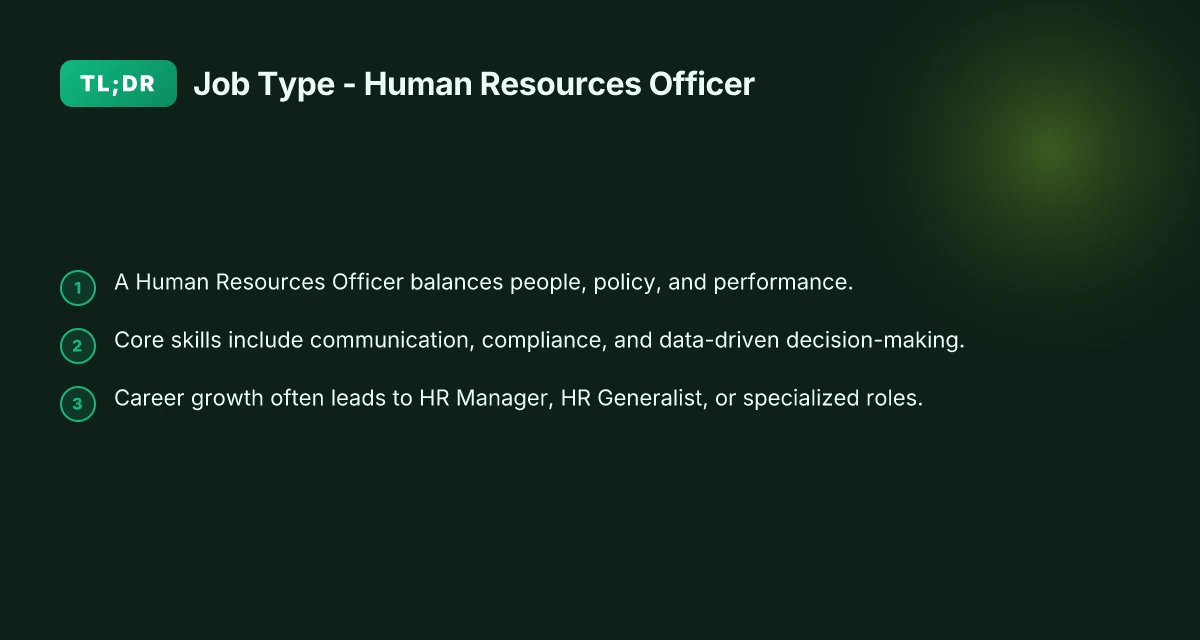
Human Resources Officers play a pivotal role in aligning people strategy with business goals. They are often the first line of contact for employees and a critical bridge between staff needs and organizational policy. This guide outlines what the Job Type - Human Resources Officer typically entails, the skills needed, how to pursue this career, and what to expect on the job.
Role overview and duties comparison
| Aspect | Human Resources Officer | HR Generalist | HR Coordinator | HR Advisor |
|---|---|---|---|---|
| Primary focus | Employee lifecycle, policy, compliance | Broad HR support | Administrative and logistics | Guidance and strategy support |
| Key duties | Recruitment, records, payroll support | Hiring, onboarding, offboarding, HRIS | Scheduling, documentation, reports | Advising managers, policy interpretation |
| Decision authority | Limited | Moderate | Low | Moderate to high (depends org) |
| Required experience | 1–3 years typical | 2–5 years | 0–2 years | 3–6 years |
| Core skills | Compliance, confidentiality | Communication, data entry | time management, coordination | Analytical thinking, advising |
| Typical tools | HRIS, MS Office | HRIS, ATS, MS Office | Calendar tools, spreadsheets | HR metrics, dashboards |
| Certification preference | Optional | Optional | Optional | Often preferred |
| Salary range (illustrative) | mid-range | mid-range | entry-to-mid range | mid-to-high range |
| Career path cue | Entry into HR | Path to HR Manager | Support role, transition to specialist | Move toward HR business partner |
Compiled November 2026; check the provider's site for current details.
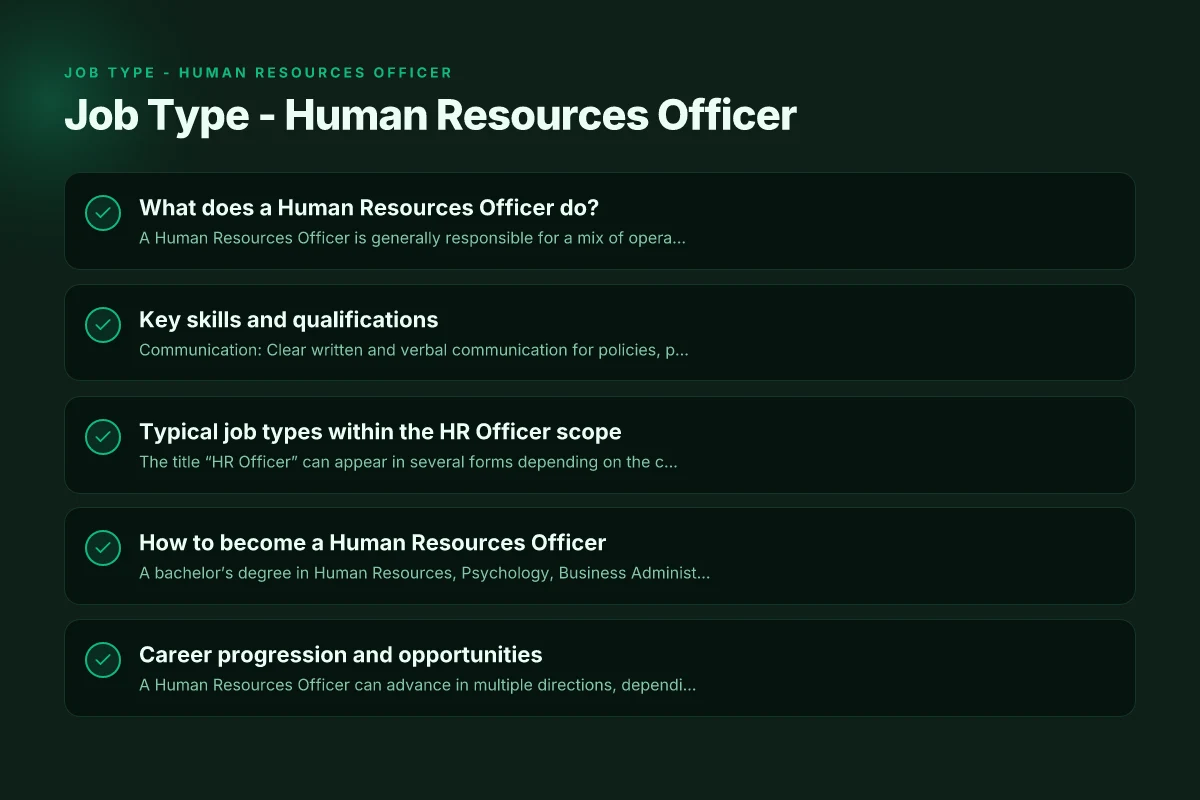
What does a Human Resources Officer do?
A Human Resources Officer is generally responsible for a mix of operational and advisory tasks that support the HR function. Typical responsibilities include:
- Assisting with recruitment and onboarding processes
- Administering HR policies and ensuring legal compliance
- Maintaining employee records and HR information systems
- Supporting performance management and employee development
- Handling employee relations and resolving routine workplace issues
- Coordinating payroll inputs and benefits administration in some organizations
- Collecting and analyzing HR metrics to inform decisions
- Assisting with health, safety, and well-being programs
The exact mix can vary by organization size and sector. In smaller companies, a single HR Officer might cover a wide range of duties. In larger organizations, they may focus on a specific area such as recruitment coordination, learning and development support, or HR operations.
Key skills and qualifications
Core competencies
- Communication: Clear written and verbal communication for policies, processes, and coaching.
- Attention to detail: Accurate record-keeping and compliance with employment laws.
- Discretion and ethics: Handling sensitive information with confidentiality.
- Organization and time management: Managing multiple tasks, dates, and documents.
Technical skills
- HR information systems (HRIS): Experience with systems like Workday, SAP SuccessFactors, BambooHR, or similar.
- Data analysis: Interpreting HR metrics (turnover, time-to-fill, absenteeism) to propose improvements.
- Microsoft Office or Google Workspace: Proficiency in spreadsheets, documents, and presentations.
Legal and policy knowledge
- Understanding of local labor laws, equal opportunity regulations, and worker safety standards.
- Basic contract familiarity and understanding of hiring practices, terminations, and disciplinary procedures.
Interpersonal abilities
- Conflict resolution and negotiation
- Empathy and customer service mindset for employee-facing tasks
- Collaborative spirit to work with managers, payroll, and compliance teams
Qualifications commonly seen
- Bachelor’s degree in Human Resources, Business Administration, or a related field
- Relevant HR certifications can help, such as SHRM-CP, PHR, or CIPD levels, though not always required
- Internship or prior HR/administrative experience is valuable
Typical job types within the HR Officer scope
The title “HR Officer” can appear in several forms depending on the country and company. Here are common variants and how they differ:
- HR Officer (Generalist): Broad duties across HR functions, recruitment, onboarding, policy, and administration.
- HR Officer (Recruitment): Primarily focused on staffing needs, candidate screening, interviewing coordination, and onboarding.
- HR Officer (Operations): Concentrates on HRIS maintenance, payroll liaison, reporting, and process improvement.
- HR Officer (Employee Relations): Emphasizes handling grievances, policy interpretation, and employee communications.
Here’s a quick comparison to illustrate how responsibilities can vary: organisation fold housing(2026)
| Focus Area | HR Officer (Generalist) | HR Officer (Recruitment) | HR Officer (Operations) | HR Officer (Employee Relations) |
|---|---|---|---|---|
| Primary tasks | Policies, onboarding, records | Sourcing, interviews, offers | HRIS, payroll liaison, reporting | Grievances, policy interpretation, communications |
| Interaction with staff | Broad, across departments | Hiring managers, candidates | Payroll, IT, HRIS users | Employees seeking resolution, managers |
| Key metrics | Turnover, onboarding time | Time-to-fill, offer accept rate | Data accuracy, process efficiency | Resolution time, policy adherence |
| Certifications favored | HR generalist knowledge | Recruitment-focused credentials | HRIS and admin skills | Employment relations knowledge |
| Typical career path | HR Generalist → HR Manager | Talent Acquisition Specialist → HR Manager | HR Operations Lead → HR Manager | Employee Relations Specialist → HR Manager |
Skills, qualifications and career paths
| Category | Entry requirements | Mid-level requirements | Senior-level requirements | Career pathways | Typical industries | Certifications (optional) |
|---|---|---|---|---|---|---|
| Education | High school or bachelor's | Bachelor’s in HR/Business | Master’s or professional degree | HR Officer → HR Manager → HR Director | Any industry with HR needs | SHRM-CP, PHR optional |
| Core skills | Communication, integrity | Data entry, organization | HR policy interpretation | Specialist vs. generalist routes | Corporate, government, NGO | CIPD, SHRM not mandatory |
| Experience | 0–2 years | 2–5 years | 5+ years | HR analyst, payroll lead, IR specialist | All sectors | Not required |
| Training needs | On-the-job learning | Software and processes | Strategic HR theory | Cross-functional roles | Field-specific needs | Certification refreshers |
| Progress markers | Confidence with tasks | Independent projects | Lead small teams | Lateral moves to payroll, IR, L&D | Lateral to operations | Certification status |
Compiled November 2026; check the provider's site for current details.
How to become a Human Resources Officer
Educational background
- A bachelor’s degree in Human Resources, Psychology, Business Administration, or a related field is common.
- Some roles accept equivalent experience or diplomas with strong HR exposure.
Gaining practical experience
- Seek internships or entry-level roles in HR, administration, or payroll.
- Volunteer on people-related projects (onboarding programs, workplace wellbeing initiatives) to demonstrate initiative.
Building relevant credentials
- Consider professional certifications such as SHRM-CP, PHR, or CIPD credits to bolster credibility.
- Short courses in HR analytics, employment law, or HRIS usage can be valuable.
Crafting a strong resume and cover letter
- Highlight HRIS experience, policy knowledge, and any successful project outcomes.
- Quantify impact (e.g., improved onboarding time, reduced turnover in a department).
- Demonstrate collaboration with managers and cross-functional teams.
Interview preparation
- Prepare examples that show problem-solving in HR scenarios: handling a policy disagreement, resolving a performance issue, or improving a process.
- Be ready to discuss compliance with labor laws and how you handle confidential information.
- Demonstrate your data-use mindset, how you track metrics and translate them into actions.
Career progression and opportunities
A Human Resources Officer can advance in multiple directions, depending on interests and company structure. Some typical paths include:
- HR Officer → HR Generalist → Senior HR Generalist
- HR Officer → HR Operations Manager → HR Manager
- HR Officer → Recruitment Specialist → Talent Acquisition Manager
- HR Officer → Learning and Development Support → L&D Coordinator or Specialist
- HR Officer with a focus on employee relations → Employee Relations Manager
Gaining cross-functional exposure is a strong booster. Working closely with payroll, compliance, IT, and department managers helps build a holistic HR profile. job type finance officer(2026)
Workplace realities and expectations
Work environment
- HR Officers often operate in an office or hybrid setting. In some sectors, they may travel for training, recruitment events, or union-related matters.
- The pace can vary. Startups may demand wearing multiple hats, while larger organizations may have more defined HR teams.
Typical hours and workload
- Most roles follow standard business hours, but examples exist where early mornings, evenings, or peak hiring seasons require flexibility.
- Peak periods include onboarding waves, annual benefits open enrollments, and performance review cycles.
Challenges you might face
- Balancing employee needs with policy and compliance requirements.
- Handling sensitive information with discretion.
- Staying current with evolving labor laws and HR best practices.
- Managing a backlog of administrative tasks in busy periods.
Rewards and impact
- Direct contribution to employee satisfaction and retention.
- Opportunity to influence culture, diversity and inclusion, and workplace safety.
- Clear pathway to higher HR leadership roles.
Interview and hiring tips for employers and candidates
For candidates:
- Show a track record of process improvement and people-centric outcomes.
- Be ready with examples of how you implemented or communicated HR policies.
- Demonstrate comfort with data: present a small HR metric you tracked and the action you took.
For employers:
- Look for a balance of soft skills and technical capability.
- Assess cultural fit and the ability to communicate policy clearly.
- Test HRIS literacy or a real-world scenario: employee inquiry handling, policy clarification, or data reporting.
Workplace realities, expectations and work-life
| Topic | Typical expectation for HR Officer | Potential challenges | Workload patterns | Work environment | Flexibility & remote work | Outlook notes |
|---|---|---|---|---|---|---|
| Work hours | Standard business hours | Peak periods for payroll/recruitment | Seasonal spikes | Office-based or hybrid | Some roles remote-capable | Demand for accuracy and discretion |
| Stress sources | Policy disputes, deadlines | Employee conflicts | Audits, data accuracy | High confidentiality | Varies by org | Regulatory changes may affect load |
| Interactions | Cross-functional, managers | Difficult conversations | Scheduling across teams | Collaborative setting | Remote meetings possible | Communication skills essential |
| Performance metrics | Timeliness, compliance | Error rates, data quality | Stakeholder feedback | Policy adherence | Customer/end-user impact | Regular audits and reports |
| Career risk | Replacing turnover | Budget cuts | Role redundancy | Changing HR tech | Automation risk | Adaptability matters |
Compiled November 2026; check the provider's site for current details. fold housing(2026)
Final recommendation
If you’re considering a career as a Human Resources Officer, start by grounding yourself in the fundamentals of HR policy, compliance, and employee support. Build practical experience through internships or entry-level HR roles, and seek certifications that align with your interests, whether generalist, recruitment, or HR operations. Develop a solid understanding of HRIS tools and data analysis, as these will differentiate you in competitive fields. Networking with HR professionals and joining local HR groups can provide insights and opportunities. With the right mix of people skills, organizational know-how, and a data-driven mindset, you’ll be well-positioned to grow into more strategic HR roles and shape positive work experiences across organizations.