media groups(2026)

A clear overview of media groups, their structure, strategies, and impact on content and audiences.
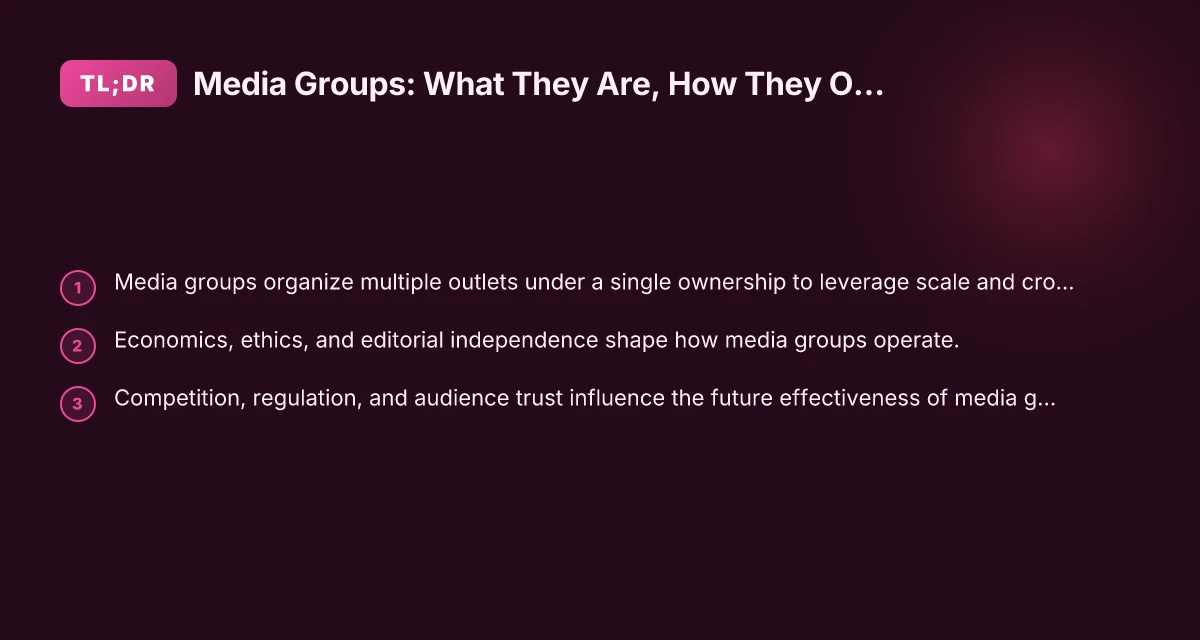
Media groups are a familiar feature of today’s media landscape, but what exactly are they, and why do they matter? At its core, a media group is a company or conglomerate that owns and operates multiple media brands, such as newspapers, magazines, radio, television, and digital platforms, often across different regions or countries. The goal is to achieve scale, diversify revenue, and extend reach through cross-promotion and shared resources. This article breaks down how media groups function, their business models, governance, and the potential implications for content quality, competition, and audiences.
Comparison of what counts as a media group
| Criterion | Definition | Examples | Notes |
|---|---|---|---|
| Core entities | Types included (networks, publishers, platforms) | Networks, publishers, platforms | Some sets include agencies; others exclude ad tech firms |
| Ownership scope | Public, private, or mixed | Public, private, family-owned | Mixed models common in media groups |
| Geographic reach | Local, national, or global | Local, national, multi-country | Global reach increases complexity |
| Portfolios | Single brand vs. multi-brand | Single-brand groups, multi-brand groups | Multi-brand often for diversification |
| Content focus | News, entertainment, or mixed | News, entertainment, lifestyle | Some specialize; some broad |
| Platform integration | Owned platforms vs. distribution | Own platforms, partner platforms | Ownership affects control and data |
| Scale indicators | Revenue, employees, audience | Revenue bands, staff counts | Fuzzy benchmarks by sector |
| Regulatory exposure | Light to heavy | Light, moderate, heavy | Varies by country and market |
| Financial structure | Debt-heavy vs. equity-driven | Debt levels, governance | Affects risk profile |
Compiled November 2026; check the provider's site for current details.
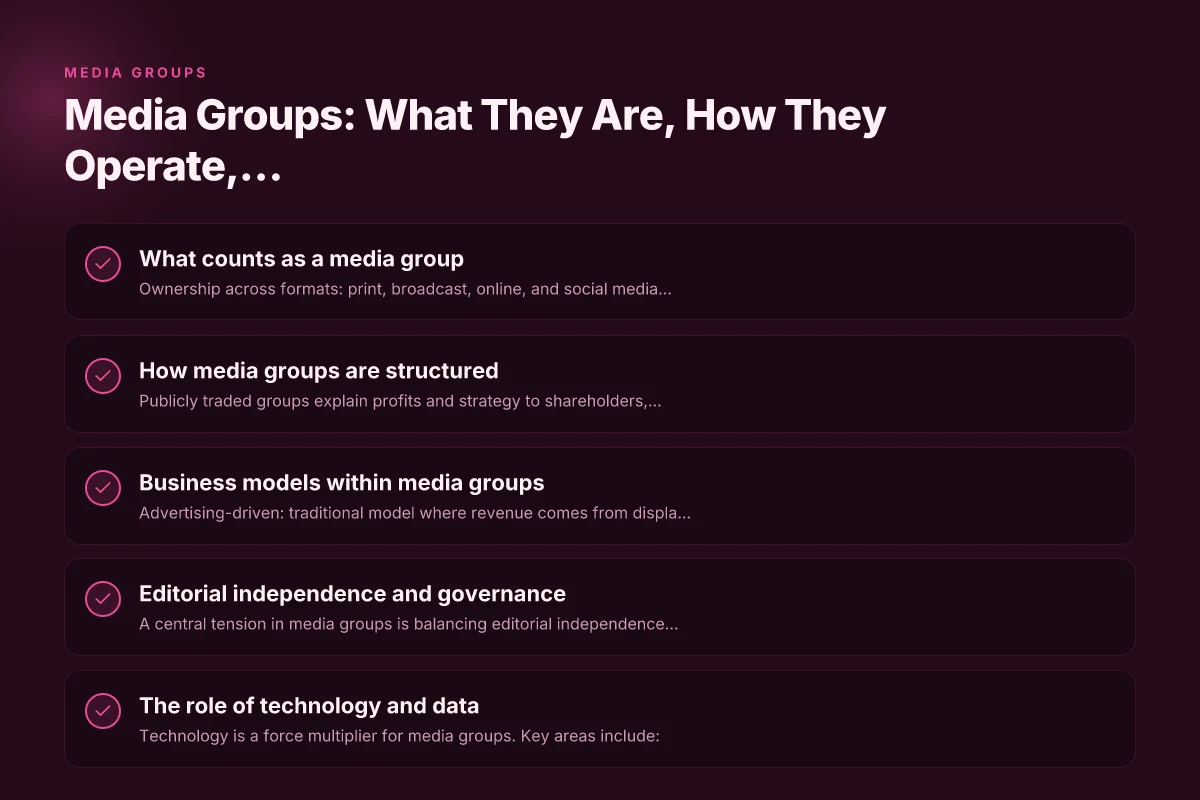
What counts as a media group
- Ownership across formats: print, broadcast, online, and social media properties.
- Shared corporate infrastructure: finance, legal, technology, sales, and strategy teams.
- Cross-brand synergies: bundled advertising packages, content syndication, and audience data.
- Geographic spread: national, regional, or international portfolios.
- Investment horizon: long-term brand building alongside short-term revenue goals.
Media groups can range from large multinational corporations to smaller regional firms. Some well-known global examples include large diversified groups that own newspapers, TV networks, and digital platforms. Others may be focused on one or two formats but still operate under a centralized holding company.
How media groups are structured
Corporate governance and ownership models
- Publicly traded groups explain profits and strategy to shareholders, subject to market pressures.
- Private or family-owned groups may emphasize long-term influence or editorial direction.
- Mixed ownership structures combine elements of both, with governance layers and committees.
Editorial and commercial divisions
- Editorial independence varies: some groups maintain strong walling between newsroom and commercial teams. Others lean into cross-pollination for revenue opportunities.
- Commercial functions include advertising sales, sponsorships, events, and branded content production.
Shared platforms and operations
- Technology: content management systems, analytics, audience development tools.
- Production: video studios, printing facilities, distribution networks.
- Data and audience insights: centralized data teams that track engagement, subscriptions, and monetization.
Regional and brand autonomy
- Local outlets may retain strong editorial voices and local reporting emphasis.
- Central leadership often sets overarching standards, brand guidelines, and strategic priorities.
Structural dimensions in media groups
| Layer | Description | Typical components | Governance cues | Pros | Cons |
|---|---|---|---|---|---|
| Ownership layer | Who owns the group | Parent company, shareholders | Board composition | Clear accountability | Conflicts of interest |
| Operating layer | How units are run | Brands, divisions, studios | Autonomy vs. central control | Efficiency, focus | Alignment risk |
| Platform layer | Where content lives | Websites, apps, distribution | Data access rules | Reach, analytics | Silos, data fragmentation |
| Revenue layer | How money is earned | Ads, subscriptions, licensing | Profit centers | Diversification | Revenue cannibalization |
| Content layer | What is produced | Newsrooms, studios, agencies | Editorial governance | Brand strength | Bias risk, quality variance |
Compiled November 2026; check the provider's site for current details.
Business models within media groups
- Advertising-driven: traditional model where revenue comes from display, video, and programmatic ads across multiple brands.
- Subscription and memberships: direct-to-consumer models where readers pay for premium content, newsletters, or ad-free experiences.
- Hybrid models: combinations of ads and subscriptions, plus events, merchandising, and sponsored content.
- Syndication and licensing: licensing content to other outlets or platforms, pooling of investigative reports, or shared video libraries.
- Acquisition-driven growth: expanding portfolio by buying competitors or complementary outlets to gain scale.
Below is a simple snapshot comparing revenue levers across common media group scenarios: community voluntary groups(2026)
| Revenue Source | Typical Role in a Media Group | Potential Pros | Potential Cons |
|---|---|---|---|
| Advertising | Core early-stage revenue | Scales with audience size | Margin pressure from incumbents, ad-blocking, and fragmentation |
| Subscriptions | Growing emphasis in recent years | Predictable, recurring income | Retention risk, churn, content needs to justify value |
| Sponsorships/Branded Content | Complementary revenue | High-margin campaigns, partner alignment | Editorial risk if not clearly separated |
| Events and memberships | Diversified revenue stream | Direct engagement with audiences, community building | Operational costs, market saturation |
| Licensing and syndication | Passive income from content assets | Extends reach and monetization of top reporting | Dependency on partner networks, rights management |
Editorial independence and governance
A central tension in media groups is balancing editorial independence with corporate strategy. Factors that influence this balance include:
- Firewalls between editorial and commercial teams to prevent conflicts of interest.
- Clear codes of conduct and ethical guidelines for reporting, sourcing, and transparency.
- Board oversight and independent directors to monitor editorial integrity.
- Transparent corrections, retractions, and accountability mechanisms.
In practice, some groups succeed at maintaining strong newsroom autonomy while exploiting group-wide efficiencies. Others struggle when commercial pressures intrude on newsroom decisions, which can erode trust with audiences and raise regulatory concerns.
Business models within media groups
| Model | Primary revenue | Key lever | Typical risk | Examples (generic) | Notes |
|---|---|---|---|---|---|
| Advertising-funded | Ad sales, data-enabled targeting | Scale, audience data | Regulation, ad-blocking | Large publishers, networks | Dependent on ad market health |
| Subscription-led | Subscriptions, DLCs | Value, exclusivity | Churn, price sensitivity | Premium outlets | Revenue predictability varies |
| Freemium/platform monetization | Ads + microtransactions | Engagement, funnels | Content dilution | Platforms with free tiers | Balance between free and paid |
| Licensing & syndication | Licensing fees | Content packs, rights | Rights expiration | News agencies, formats | Stable but capex heavy |
| Affiliate/commerce | Affiliate revenue | Product integration | Alignment risk | Tech/media retailers | Needs clear disclosures |
Compiled November 2026; check the provider's site for current details. belfast s cathedral quarter(2026)
The role of technology and data
Technology is a force multiplier for media groups. Key areas include:
- Content management and distribution: ensuring fast publishing, multi-platform delivery, and responsive design.
- Personalization and recommendation engines: tailoring content to reader interests to improve engagement and retention.
- Data-driven decision making: using analytics to guide newsroom priorities, product development, and monetization strategies.
- Digital security and trust: protecting against hacks, misinformation, and data breaches.
- Automation and AI: support for research, fact-checking, editing, and production workflows, while preserving human editorial judgment.
Data can unlock powerful audience insights, but it also raises privacy concerns. Responsible data practices, consent management, and clear user controls help maintain trust.
Regulation, competition, and market dynamics
Media groups operate in an evolving regulatory landscape. Issues that commonly arise include:
- Ownership limits and concentration: regulators may scrutinize how many outlets a single group can control in a market.
- Content standards and misinformation: authorities and industry bodies push for accuracy, transparency, and safety.
- Privacy and data protection: rules govern how audience data is collected, stored, and used.
- Net neutrality and platform dynamics: the power of platforms over distribution affects reach and revenue.
- Public-interest broadcasting: some regions require or incentivize groups to maintain public-service components.
Competition among groups can drive innovation, but it can also reduce plurality if ownership becomes highly consolidated. A healthy media ecosystem tends to feature a mix of large groups, regional independents, and non-profit or public-interest outlets. arts groupsgalleries(2026)
How audiences experience media groups
- Brand portfolios: audiences encounter a family of brands, sometimes with cross-promotion and bundled access.
- Subscription ecosystems: multi-brand subscriptions or shared digital passes can simplify access and loyalty.
- Local versus global content: readers may get both local reporting and global perspectives from the same group.
- Trust and transparency: editorial integrity, clear corrections, and disclosure of sponsored content influence credibility.
Audiences increasingly expect clarity about who owns content, how revenue is earned, and how their data is used. Transparent governance and consistent quality across brands help build lasting relationships.
Pros and cons of media groups
Pros
- Scale and efficiency: shared services reduce costs and enable bigger projects.
- Diversified revenue: multiple streams can stabilize income against ads or subscriptions alone.
- Cross-brand discovery: audiences find related content across a wider portfolio.
- Investment in investigative and high-quality journalism: larger resources can support ambitious reporting.
Cons
- Editorial pressure: commercial goals can influence newsroom priorities.
- Market concentration: fewer independent outlets can limit diversity of viewpoints.
- Internal politics: governance complexity may slow decision-making.
- Risk of homogenization: brand templates and shared templates can suppress unique voices.
Practical guide for readers, advertisers, and industry watchers
- Readers: Look for clear ownership disclosures, transparent corrections, and a visible separation between editorial and commercial content.
- Advertisers: Consider the brand safety and alignment across the group’s portfolio, plus the value of cross-brand storytelling versus single-brand placements.
- Industry watchers: Track regulatory changes, ownership transactions, and shifts in subscription strategies to gauge how the landscape is evolving.
If you’re evaluating a specific media group, ask: page title(2026)
- Who owns the group and what are their stated goals?
- How is editorial independence protected within the structure?
- What are the main revenue streams, and how diversified are they?
- How does the group handle data privacy, sponsorships, and transparency?
- What investments are being made in investigative reporting and quality journalism?
Final section: the recommendation
For readers seeking reliable information and a strong standard of journalism, prioritize media groups that demonstrate clear editorial independence, transparent ownership, and accountable governance. When possible, diversify your news diet across multiple outlets, including independent and nonprofit sources, to counterbalance any single group's biases or commercial pressures. Advertisers and partners should favor groups with robust content ethics policies, clear disclosure practices for sponsored content, and proactive investments in credible, fact-checked reporting. In a dynamic media environment, thoughtful engagement with a well-governed media group can yield high-quality content while supporting a healthy, competitive information ecosystem.