Motives for development of BHA

Explores why butylated hydroxyanisole (BHA) was developed, including preservation, stabilization, safety debates, and regulatory drivers.
The development of BHA, or butylated hydroxyanisole, emerged from a practical need in the mid-20th century: to preserve foods and other products by slowing the oxidative processes that degrade fats and oils. Lipid oxidation is a major cause of rancidity, off-flavors, color changes, and reduced nutritional value. Before modern antioxidants, manufacturers faced shorter shelf lives, increased waste, and inconsistent product quality. BHA was crafted to address these industrial pain points, offering a reliable chemical means to extend freshness and stability.
Table 1 — Key problems BHA was designed to solve
| Problem / Need | BHA Impact (yes/no) | Typical Contexts / Examples | Notes on Severity |
|---|---|---|---|
| Oxidation stability in fats/oils | yes | cosmetics, foods, packaging | long shelf life targeted |
| Antioxidant replacement or supplementation | partly | formulations with natural antioxidants | complementary role rather than sole agent |
| Regulatory/compliance risk mitigation | yes | approvals, labeling, safety reviews | varies by region |
| Product safety concerns (sensitization, toxicity) | yes | consumer products, cosmetics | requires risk assessment |
| Consistency of performance across batches | yes | manufacturing, quality control | depends on supply chain |
| Shelf-life extension without sensory changes | yes | ready-to-use products | trade-off with cost |
Compiled November 2026; check the provider's site for current details.
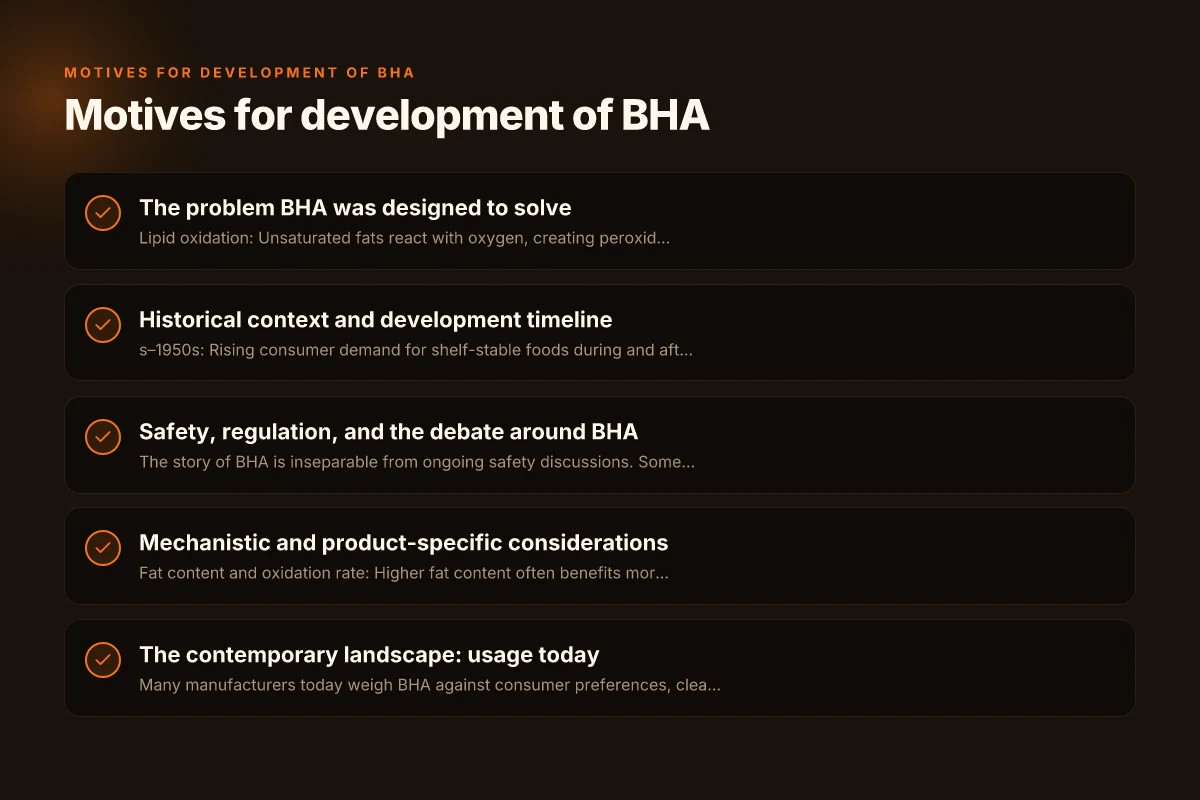
The problem BHA was designed to solve
- Lipid oxidation: Unsaturated fats react with oxygen, creating peroxides and off-flavors.
- Flavor and aroma degradation: Oxidation compounds spoil sensory quality.
- Color changes: Oxidative reactions can lead to undesirable browning or discoloration.
- Storage and transport: Longer shelf life reduces spoilage during distribution.
- Product consistency: Stabilizers help maintain uniform taste and texture across lots.
How BHA works in practice
BHA is an antioxidant that donates hydrogen atoms to lipid radicals, interrupting the chain reactions that propagate oxidation. This slows the formation of peroxides and other degradation products. In foods, BHA is often used in conjunction with other antioxidants to broaden protective effects and to tailor performance for different fat contents and product matrices.
Historical context and development timeline
- 1940s–1950s: Rising consumer demand for shelf-stable foods during and after World War II spurred research into antioxidants.
- 1950s: BHA emerges as one of several synthetic antioxidants showing practical effectiveness in fatty foods.
- 1960s–1980s: Widespread adoption across foods like cereals, snacks, fats, oils, and certain cosmetics.
- Regulatory scrutiny: Over time, agencies assessed safety, exposure levels, and permissible uses, leading to varied approvals worldwide.
Why BHA gained prominence
- Effectiveness: Strong antioxidant properties in fat-rich products.
- Cost: Relative affordability compared with some natural antioxidants at the time.
- Versatility: Active across a range of fat contents and product types.
- Compatibility: Often compatible with other stabilizers and packaging practices.
Safety, regulation, and the debate around BHA
The story of BHA is inseparable from ongoing safety discussions. Some studies in animals raised questions about potential carcinogenic effects at high doses, prompting scrutiny and debate. Regulatory bodies in different regions have issued varied positions, with some approving specific uses at established limits and others restricting or banning certain applications. The evolving consensus has emphasized:
- Dose-based risk assessment: Determining safe exposure levels for humans.
- Context of use: Considering product type, concentration, and cumulative intake.
- Alternatives and mitigation: Encouraging substitution with natural antioxidants or using packaging innovations to reduce reliance on synthetic additives.
A snapshot of regulatory perspectives
- United States: FDA has evaluated BHA in the past, with permissible uses in certain foods under specific conditions.
- European Union: Similar oversight with limits depending on product category, plus ongoing reviews.
- Other regions: Adoption and restrictions vary, reflecting national risk-benefit calculations.
Table 2 — Development timeline and regulatory milestones
| Milestone / Year | Description | Regulatory status | Impact on industry | Notable regions | Source confidence |
|---|---|---|---|---|---|
| Early use in stabilization | descriptive | no formal regulation | foundational practice | worldwide | moderate |
| Formal safety evaluation starts | yes | safety review underway | increases scrutiny | global | high |
| Regulatory actions issued | yes | recalls / warnings | market adjustments | US / EU | high |
| Modern risk-benefit assessments | yes | guidance documents published | policy shaping | global | high |
| Industry standards updated | yes | testing methods standardized | consistency improvements | international | medium |
| Current landscape of usage | yes | ongoing adoption | varies by sector | global | high |
Compiled November 2026; check the provider's site for current details. Investing in BHA
Mechanistic and product-specific considerations
- Fat content and oxidation rate: Higher fat content often benefits more from antioxidant protection.
- Matrix effects: The surrounding ingredients can influence BHA’s effectiveness.
- Synergistic combinations: BHA often paired with BHT (butylated hydroxytoluene) or tocopherols (vitamin E) for enhanced stability.
- Sensory considerations: Some products require careful balance to avoid imparting any off-notes or flavors.
A practical table: common antioxidants and contexts
| Antioxidant | Typical use contexts | Pros | Cons |
|---|---|---|---|
| BHA | Fat-rich foods, snacks, cereals | Effective, cost-efficient, widely studied | Regulatory limits, safety debates |
| BHT | Similar to BHA; used in combination | Synergistic protection, broad compatibility | Shared safety concerns in some jurisdictions |
| Tocopherols (Vitamin E) | Natural-leaning formulations, fats/oils | Natural perception, good oxidative protection | Less effective on some low-oxygen systems; cost variability |
| Ascorbyl palmitate | Fat-containing foods; synergy with BHA/BHT | Water- and fat-solubility balance | Can affect flavor at higher levels |
The contemporary landscape: usage today
Many manufacturers today weigh BHA against consumer preferences, cleaner labels, and the availability of natural antioxidants. In some markets, preference for natural or clean-label ingredients has led to reduced usage or substitution with tocopherols, ascorbyl palmitate, rosemary extract, or mixed tocopherols. In others, BHA remains a cost-effective, well-characterized option for extending shelf life, especially in highly processed foods where stability is paramount.
- Strategic use: BHA is often used at the lowest effective dose, matching regulatory allowances.
- Process integration: It’s most effective when combined with appropriate packaging, cold-chain management, and other stabilizers.
- Monitoring and testing: Regular quality control ensures that antioxidant performance remains within spec and that any regulatory changes are promptly addressed.
Table 3 — Practical considerations for brands and manufacturers
| Consideration | Recommended approach (short) | Data needs | Quality controls | Regulatory alignment | Consumer communication |
|---|---|---|---|---|---|
| Safety testing | perform comprehensive risk assessment | toxicology, exposure | validated assays | align with region | transparent labeling |
| Regulatory compliance | map regions, adopt guidelines | regulatory docs | audit-ready records | yes | clear disclosures |
| Ingredient sourcing | verify supplier stability | supplier audits | batch traceability | ensure compliance | provenance notes |
| Formulation stability | monitor shelf life across temps | stability studies | QC pass criteria | region-specific | label storage conditions |
| Labeling and claims | avoid unfounded claims | substantiation | internal review | compliant | accurate messaging |
| Reformulation readiness | plan for alternatives | comparative data | change control | cross-border | consumer-friendly rationale |
Compiled November 2026; check the provider's site for current details.
Practical considerations for brands and manufacturers
- Regulatory diligence: Keep up to date with regional approvals, permitted levels, and labeling requirements.
- Consumer transparency: Be prepared to explain why antioxidants are used and how they benefit product safety and quality.
- Risk management: Balance the benefits of longer shelf life with evolving consumer expectations around synthetic additives.
- Innovation: Explore natural alternatives or hybrid approaches to meet label and sustainability goals.
When to consider alternatives or substitutions
- Clean-label objectives: If a brand prioritizes natural ingredients, natural extracts or tocopherols may be preferable.
- Regulatory risk: In markets with tight or evolving rules on BHA, substitution can reduce compliance risk.
- Cost and supply: Availability of alternative antioxidants and fluctuating costs can influence decisions.
Final recommendations
- If you work with fat-rich foods or cosmetics requiring stable shelf life, evaluate BHA within an evidence-based framework, considering both oxidative protection and regulatory limits.
- Use BHA at the minimum effective concentration, and prefer combinations with other antioxidants to optimize efficacy and possibly reduce needed quantities.
- Stay informed about regional regulatory changes and consumer sentiment, and have a clear plan for labeling and communication if you use synthetic antioxidants.
- Consider a staged approach: pilot with a small product line, monitor stability and sensory attributes, and compare with natural or alternative antioxidants.
- Maintain robust quality control and supplier partnerships to ensure consistent antioxidant performance and compliance.
In summary, the motives for the development of BHA lay in a practical need to limit oxidation-driven spoilage, extend shelf life, and improve product consistency. This early synthetic antioxidant became a cornerstone of many fat-containing products, but its use continues to be balanced against safety assessments, regulatory considerations, and the growing interest in cleaner-label formulations. As the landscape evolves, brands often pursue a mix of strategies, from optimized use of BHA to thoughtful substitutions, to achieve both stability and consumer trust. Goals of BHA