Research Projects: A Practical Guide to Planning, Managing, and Sharing
A comprehensive guide to understanding, planning, and managing research projects effectively.
The word "research projects" covers the entire lifecycle from ideation to dissemination. Whether you are a student, a faculty member, or a professional researcher, a well-planned project can make the difference between noisy, underfunded work and a coherent, impactful contribution to your field. This article lays out practical steps, best practices, and concrete tools to manage research projects more effectively, with a focus on clarity, collaboration, and impact.
Planning approaches and tooling options
| Approach / Tool | Planning depth | Schedule method | Collaboration support | Documentation needed | Best used for |
|---|---|---|---|---|---|
| Waterfall | High | Linear timeline | Limited | Formal plan | Fixed requirements, clear deliverables |
| Agile / Scrum | Moderate to high | Iterative sprints | Strong | Lightweight artifacts | Unclear requirements, frequent iterations |
| Hybrid | Moderate | Combined | Moderate | Essential | Mixed certainty environments |
Compiled November 2026; check the provider's site for current details.
What defines a research project
- A research project is a time-bound effort with a defined goal, a plan, and a team.
- It has inputs (funding, data, tools), activities (experiments, analysis, writing), and outputs (papers, datasets, software).
- Success is judged by whether the goals are met, the work is reproducible, and the outputs are shared with the community.
Core components
- Objective: The central research question or hypothesis.
- Scope: Boundaries that prevent scope creep.
- Timeline: Milestones and deadlines.
- Resources: People, budget, data, and infrastructure.
- Governance: Roles, responsibilities, and decision rights.
- Outputs: Publications, datasets, code, and reports.
Common pitfalls to avoid
- Ambiguous goals that drift over time.
- Over-ambitious scope without adequate resources.
- Inadequate data governance and documentation.
- Poor communication among team members and stakeholders.
- Incomplete or opaque sharing of results.
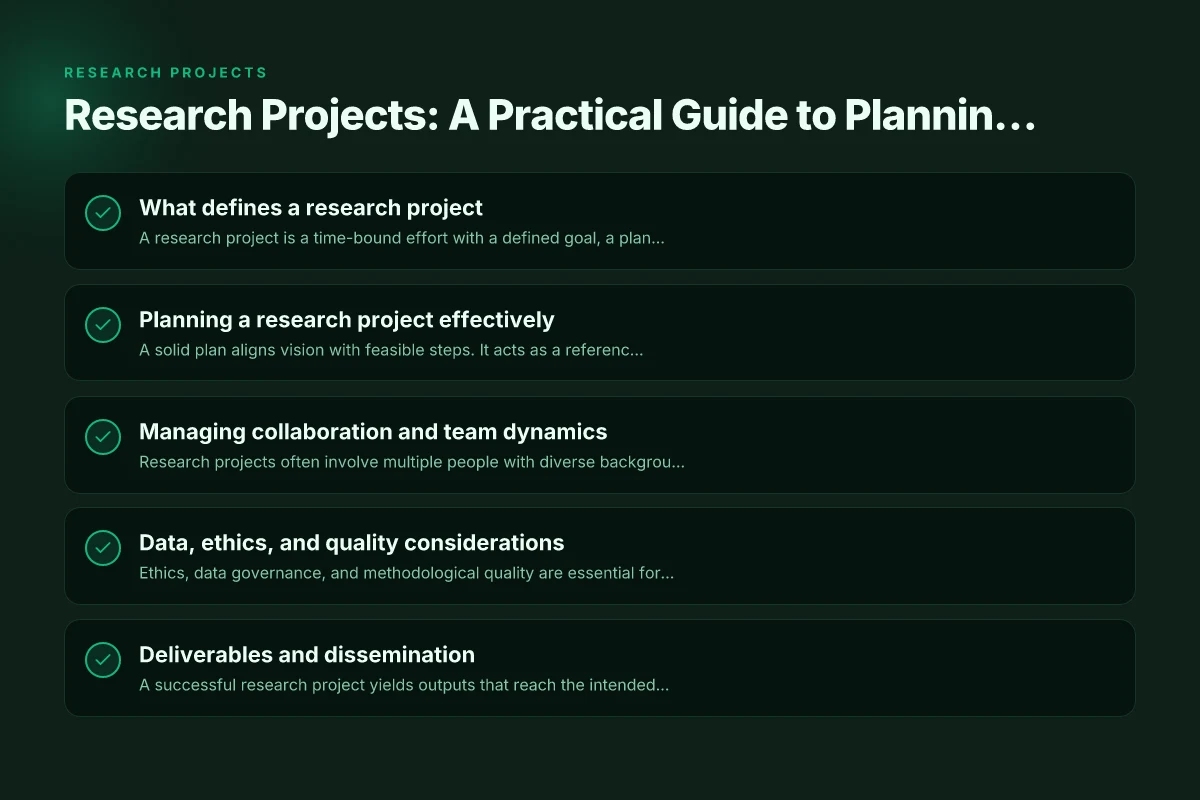
Planning a research project effectively
A solid plan aligns vision with feasible steps. It acts as a reference point when decisions are needed and when things go off track.
Define the goal and success criteria
- Write a concise research question or objective.
- List measurable success criteria (e.g., number of experiments, datasets to produce, a publishable manuscript, code release).
Scope and boundaries
- State what is in scope and what is not.
- Include explicit out-of-scope items to prevent creeping scope.
Work breakdown structure (WBS)
- Break the project into phases: literature review, data collection, analysis, writing, dissemination.
- Create tasks with owners, estimates, and prerequisites.
Timeline and milestones
- Develop a Gantt-style timeline or a milestone calendar.
- Include critical path tasks and buffers for uncertainty.
Resource planning
- Human resources: roles, expertise, and availability.
- Data and tools: datasets, software licenses, computing resources.
- Budget: allocate for personnel, data access, travel, publication fees.
Risk management
- Identify top risks (data access, equipment failure, personnel turnover).
- For each risk, define mitigation strategies and contingency plans.
Governance and decision rights
- Establish a project lead or PI, and define decision-making authority.
- Set up communication protocols (regular meetings, escalation paths).
Managing collaboration and team dynamics
Research projects often involve multiple people with diverse backgrounds. Clear processes reduce friction and accelerate progress.
Roles commonly found
- Principal Investigator (PI) or project lead.
- Co-researchers or collaborators with specialized expertise.
- Data managers and software engineers.
- Research assistants or students.
- Advisors or external partners.
Communication practices
- Regular status updates (weekly or biweekly).
- Shared documentation: a central repository for plans, meeting notes, and results.
- Transparent authorship and contribution records early on.
Documentation and reproducibility
- Maintain a data management plan (DMP) describing data collection, storage, sharing, and privacy.
- Version control for code and notebooks.
- Documentation for methods and experiments to enable replication.
Tools to support collaboration
- Project management: Trello, Asana, or Jira for task tracking.
- Documentation: Notion, Google Docs, or SharePoint.
- Code and data: GitHub or GitLab. Data repositories with DOIs.
- Communication: Slack, Teams, or Mattermost.
Data, ethics, and quality considerations
Ethics, data governance, and methodological quality are essential for credible research.
Data governance and privacy
- Assess whether data contain sensitive information.
- Apply anonymization, access controls, and data use agreements as needed.
- Ensure compliance with institutional review boards (IRB) or ethics committees when required.
Reproducibility and transparency
- Pre-register hypotheses or analysis plans when appropriate (e.g., clinical trials, simulations).
- Share code and processed data where possible, with licenses and documentation.
- Provide a clear methods section and supplementary materials.
Quality assurance
- Use standard operating procedures (SOPs) for data collection and analysis.
- Conduct pilot studies to validate instruments and procedures.
- Implement versioning and audit trails for data and analyses.
Deliverables and dissemination
A successful research project yields outputs that reach the intended audiences and can be reused. Cancer Registration Scheme
Typical deliverables
- Publications: journal articles, conference papers, technical reports.
- Datasets and code: well-documented and accessible, with licenses.
- Software tools: user guides, tutorials, and release notes.
- Policy briefs or white papers: for applied research or stakeholder engagement.
- Presentations and outreach materials: posters, slides, and demonstrations.
Dissemination channels
- Academic channels: journals, conferences, preprint servers.
- Open science channels: open data repositories, code hosting with permissive licenses.
- Practitioner and public channels: blogs, policy briefs, webinars, community events.
Licensing, copyright, and attribution
- Choose appropriate licenses for data and code (e.g., CC-BY, MIT, Apache 2.0).
- Acknowledge contributors fairly and maintain a data and code citation plan.
A simple comparison: project management approaches
Here is a brief table to compare two common approaches to research project management: Waterfall-like planning vs. Agile-inspired iterative planning.
| Dimension | Waterfall-like planning | Agile-inspired iterative planning |
|---|---|---|
| Planning focus | Upfront, comprehensive plan | Lightweight plan, frequent adjustment |
| Flexibility | Low; changes costly | High; welcomes changes |
| Milestones | Large, phase-gated milestones | Short sprints, frequent reviews |
| Risk handling | Early risk assessment, late adjustments | Continuous risk monitoring and mitigation |
| Collaboration style | Structured, hierarchical | Cross-functional, collaborative |
| Documentation emphasis | Heavy emphasis upfront | Documentation evolves with work |
| Suitable for | Large, long-term projects with stable goals | Projects with evolving requirements and uncertainty |
This contrast helps teams decide which approach fits their discipline, data accessibility, and stakeholder needs. Some projects benefit from a hybrid approach that starts with a solid foundation and evolves with feedback.
Measuring progress and evaluating outcomes
Tracking progress ensures the project stays aligned with goals and enables timely course corrections.
Metrics and indicators
- Milestone completion rate and adherence to schedule.
- Quality indicators: reproducibility of results, number of successful experiments.
- Resource utilization: budget burn rate, personnel workload.
- Dissemination impact: number of citations, data/code reuse, and user adoption.
Review cycles
- Regular internal reviews (monthly or quarterly) to assess progress.
- Mid-project checkpoints to revalidate goals and scope.
- End-of-project evaluation to synthesize findings and lessons learned.
Lessons learned
- Document what worked well and what didn’t.
- Capture process improvements for future projects.
- Share learnings with the wider team to prevent repetition of mistakes.
Data, ethics, and quality controls options Publications: A Practical Guide to Understanding and Using Them
| Aspect | Data management approach | Ethics and compliance | Quality assurance | Documentation | Suitability notes |
|---|---|---|---|---|---|
| Data handling | Versioned datasets, metadata | Consent, approvals | Validation, audits | Data management plan | Data integrity priority |
| Ethics controls | IRB/ethics board when needed | Approval status | Risk assessment | Ethics documentation | Sensitive topics flagged |
| Quality checks | Pre-registration, prereg | Compliance checks | Reproducibility tests | SOPs | High-stakes results |
Compiled November 2026; check the provider's site for current details.
Final section: a practical recommendation
If you’re starting a research project, begin with a one-page project brief that captures the goal, scope, key activities, milestones, and required resources. Use this brief as a living document that you revisit and revise as you learn more. Establish a lightweight governance structure: a clear project lead, a small core team, and a simple decision log. Invest early in data management and reproducibility, without solid data and code practices, the impact of your findings will be harder to realize. Finally, plan for dissemination from the start: identify target journals or conferences, shape your outputs for reuse (data and code licenses), and consider stakeholder needs to maximize relevance and uptake.
In summary, a well-managed research project blends clarity with adaptability. A clear objective, disciplined planning, collaborative governance, rigorous data practices, and thoughtful dissemination together create a strong foundation for producing credible, impactful, and reusable knowledge.