Subsidised places for CINNI members
A practical guide to how CINNI members can access subsidised places across courses and programs, with eligibility and tips.
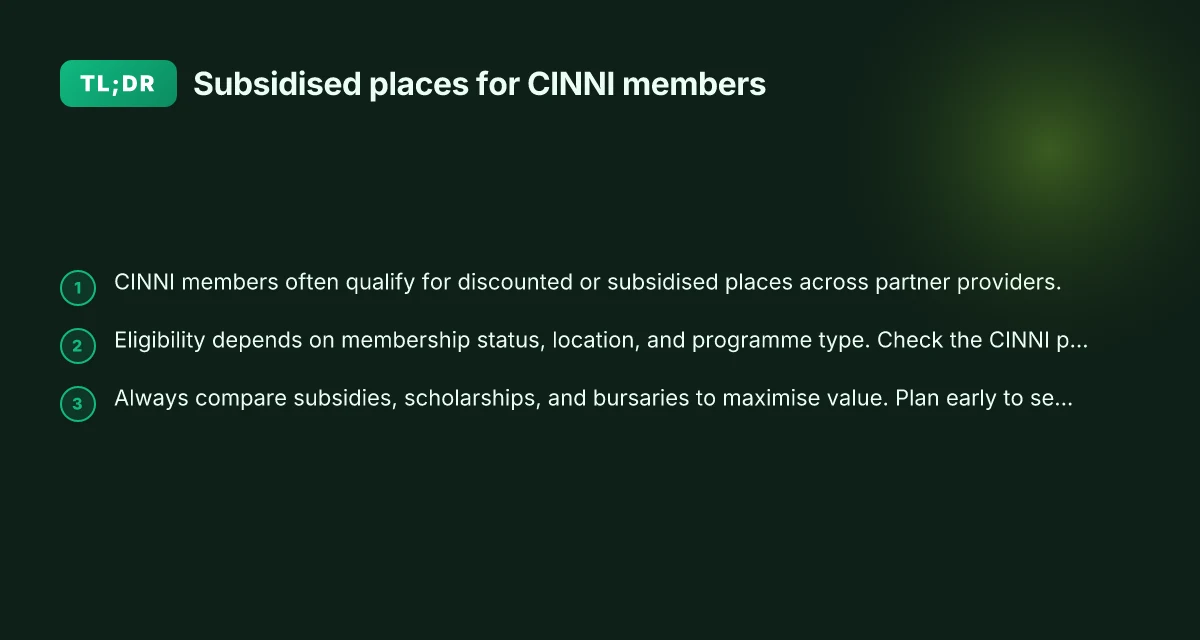
CINNI, or the CINNI members’ network, provides access to a range of subsidised places designed to help members upskill without breaking the bank. This article explains where those subsidies come from, who can access them, how to apply, and practical tips to maximise your chances of securing a discounted or subsidised place.
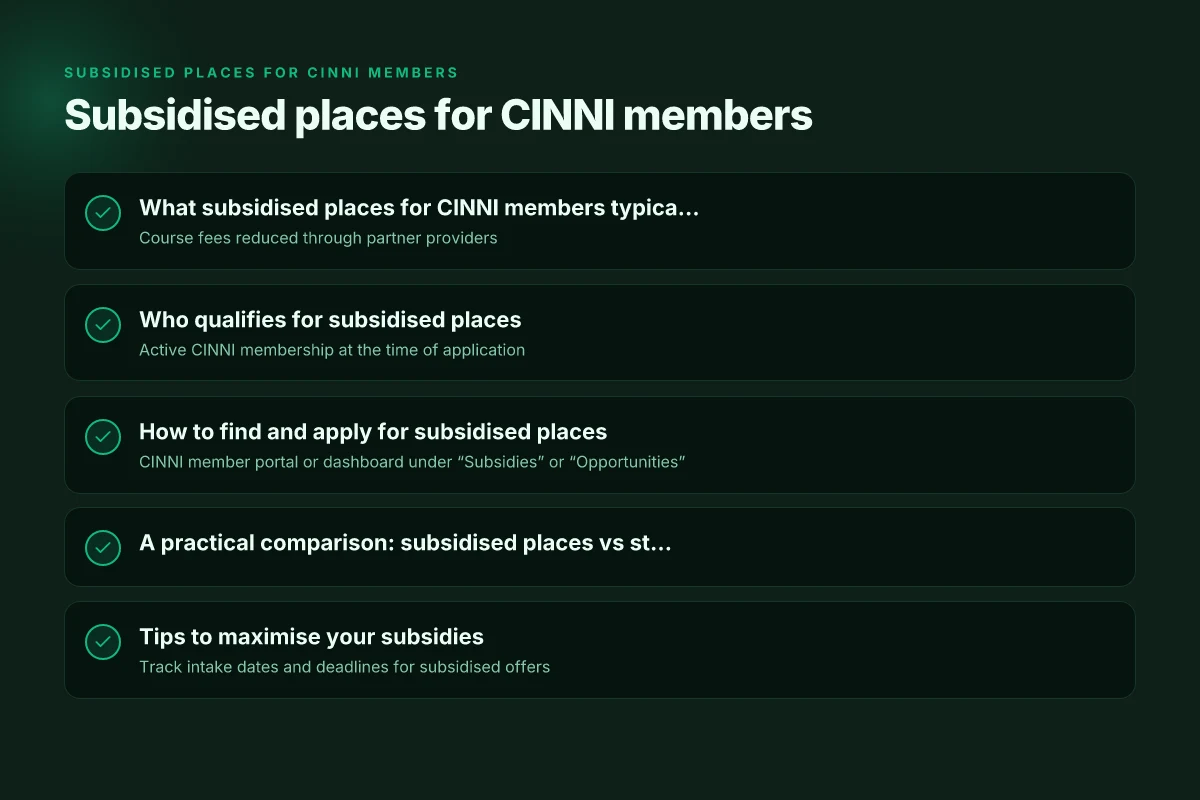
What subsidised places for CINNI members typically cover
| Category | Coverage details | Examples | Notes |
|---|---|---|---|
| Tuition or fees | Discounted or waived fees | Course fees 20-80% off | Varies by program |
| Materials | Subsidised books/tools | Textbooks, kits discounted | Some items not covered |
| Access | Extended or priority access | Extra sessions, premium slots | Limited quotas |
| Support services | Mentoring, counseling, admin help | Mentors, admin waivers | Availability differs |
| Travel/subsistence | Travel grants or stipends | Transport reimbursement | May require receipts |
| Certification | Exam or test prep support | Exam fee waivers | May be program-specific |
Compiled November 2026; check the provider's site for current details.
What subsidised places for CINNI members typically cover
Types of subsidies
- Course fees reduced through partner providers
- Scholarships or bursaries tied to CINNI membership
- Training credits or voucher schemes
- Travel and accommodation subsidies for in-person programmes
- Hybrid or online course discounts with added benefits (e.g., extended access)
Common formats
- Short courses and micro-credentials
- Professional development certificates
- Workshops and masterclasses
- Degree or progression programmes via CINNI partners
How subsidies are structured
- Percentage-based fee reductions (e.g., 20-50% off)
- Fixed-price bundles for members
- Tiered subsidies based on membership level or tenure
- Time-bound offers aligned to intake cycles
Who qualifies for subsidised places
Eligibility basics
- Active CINNI membership at the time of application
- Residence in a country or region where CINNI subsidy programs operate
- Meets programme-specific criteria (e.g., prerequisites, experience)
Membership tiers and impact
- Standard members: access to baseline subsidies
- Premium or higher-tier members: enhanced subsidies or early access
- Affiliate partners or local chapters: regional subsidies or special rates
Special circumstances
- Students, early-career professionals, or underrepresented groups may have additional support
- Organisations sponsoring CINNI members may offer joint subsidies for their staff
Who qualifies for subsidised places
| Criterion | Description | Typical groups | Eligibility notes |
|---|---|---|---|
| Membership status | CINNI member in good standing | All active members | Renewal up-to-date |
| Income level | Low to mid income | Low-income families, students | May require proof |
| Program type | Specific CINNI programs | Training tracks, certifications | Not all programs eligible |
| Prior participation | Previous use of subsidies | First-time or repeat users | Limits per year |
| Regional eligibility | Local subsidies apply | Region-based rules | Check regional pages |
| Time window | Application deadlines | Annual cycles | Late apps denied |
Compiled November 2026; check the provider's site for current details.
How to find and apply for subsidised places
Where to look
- CINNI member portal or dashboard under “Subsidies” or “Opportunities”
- Partner provider pages listing CINNI-backed discounts
- Email newsletters and regional chapter notices
- CINNI events and webinars announcing limited-time subsidies
The application steps
- Verify eligibility in your CINNI dashboard
- Choose a programme with a subsidised option
- Prepare required documents (proof of membership, identity, CV, statements of interest)
- Submit the application before the deadline
- Await notification and complete enrolment per provider instructions
Common documentation
- Proof of CINNI membership (membership number or card)
- Identification documents (where required)
- Personal statement or motivation for choosing the programme
- Employer or sponsor letter if an organisational subsidy is involved
A practical comparison: subsidised places vs standard pricing
| Criterion | Subsidised place | Standard price |
|---|---|---|
| Cost to member | Reduced; varies by programme | Full price |
| Eligibility checks | Often required; proof of CINNI membership | Basic enrolment details |
| Enrollment speed | Can be slower due to verification | Usually faster |
| Availability | Limited by intake cycles and provider capacity | Generally readily available |
| Perceived value | High if subsidy aligns with goals | High if budget allows |
A practical comparison: subsidised places vs standard pricing
| Item | Subsidised price | Standard price | Savings | Notes |
|---|---|---|---|---|
| Tuition | discounted | full | amount saved | % varies |
| Materials | partial subsidy | full price | discount amount | Limited stock |
| Access | priority slots | regular slots | time/availability benefit | Subject to quotas |
| Support | included services | paid add-ons | value of services | Some regions vary |
| Travel | stipends available | out-of-pocket | potential savings | Requires receipts |
| Certification | exam fee support | full fee | savings on exams | Only certain programs |
Compiled November 2026; check the provider's site for current details. Housing Survey hosted by CINNI
Tips to maximise your subsidies
Plan early and gather intel
- Track intake dates and deadlines for subsidised offers
- Create a shortlist of programmes that align with your career goals
- Subscribe to CINNI alerts for subsidy launches
Leverage your CINNI network
- Reach out to regional chapters or mentors who’ve secured subsidies
- Request guidance on the best programmes for your field
- Share your interest in subsidies with your supervisor or sponsor if they’re funding you
Strengthen your application
- Tie your goals to how the programme will benefit your work or community
- Highlight relevant experience, projects, or outcomes
- Obtain a recommendation or endorsement if required
Consider a multi-programme strategy
- Combine a subsidised short course with a more extensive programme
- Look for bundles or tiered offers that stack savings
- Check transfer policies if you need to switch programmes
Be mindful of logistics
- Some subsidies require attendance in person. Others support online formats
- Verify whether travel or accommodation subsidies are available and eligible
- Confirm post-completion requirements to maintain subsidy eligibility (e.g., completion within a timeframe)
Case study: a CINNI member navigating subsidies
A mid-career professional in the UK used CINNI’s subsidised place for an online professional certificate in data analytics. Through the member portal, they found a 40% off offer with a partner provider, meeting the eligibility criteria as an active CINNI member. They prepared a concise motivation statement, highlighted relevant projects, and submitted the application before the deadline. The discount reduced the course fee from £1,200 to £720, with a completion guarantee from the provider. After finishing, they used the certificate to advance within their organisation, and CINNI followed up with an alumni network event that connected them to mentors for further opportunities.
Regional and sector-specific subsidies
- Europe: Several CINNI chapters publish quarterly rounds of subsidies tied to local training needs, often with travel grants for in-person attendance.
- North America: Partner providers offer subsidised certificates with emphasis on emerging tech and leadership development.
- Asia-Pacific: Substantial support for upskilling in sectors like manufacturing, logistics, and digital transformation.
- Public sector and non-profit: Special rates for employees of government or non-profit organisations to encourage public service innovation.
- SMEs and startups: Subsidy aggregators within CINNI sometimes negotiate tiered pricing for small teams.
How CINNI structures the subsidy ecosystem
- Central governance: A coordinator team manages subsidy guidelines, provider relationships, and eligibility criteria.
- Provider network: A curated list of partner institutions and platforms offering CINNI-backed discounts.
- Member engagement: Regular webinars, Q&A sessions, and office hours to help members understand options.
- Feedback loop: Members share outcomes, enabling refinements to subsidy awards and application processes.
Frequently asked questions
- Do subsidised places require repayment if I don’t complete the course? Typically not, but verify the provider’s policy. Some may require a minimal completion rate for continued eligibility.
- Can I hold more than one subsidy at the same time? This depends on provider guidelines and CINNI rules. Often stacking is not allowed, but you may apply sequentially.
- Are there eligibility tests or prerequisites? Yes, many subsidies require proof of CINNI membership and alignment with the programme’s goals.
- How long does the approval process take? It ranges from a few days to a couple of weeks depending on the programme and regional chapter volume.
Recommendation: Start with your CINNI dashboard If you’re a CINNI member, your first stop should be the member portal. Look for “Subsidies,” “Discounts,” or “Opportunities” sections. Take note of current offers, deadlines, and eligibility requirements. Prepare your application materials in advance, including a clear motivation statement that links the programme to your career path. Reach out to regional chapters or mentors if you’re unsure which options best fit your goals. By planning early and engaging with the CINNI network, you’ll improve your odds of securing a subsidised place that aligns with your professional development needs.