Patient to patient: how peer experiences shape care, hope, and decision-making
Exploring how patient-to-patient support improves engagement, outcomes, and well-being across health journeys.
Patient to patient experiences are not just anecdotes. They are a powerful form of practical knowledge that can complement medical expertise. When patients connect with others who have walked a similar path, they gain insights, reassurance, and strategies they can apply to their own care. This article explores what patient-to-patient interactions look like, why they matter, and how to engage with them safely and effectively.
Comparing peer-to-peer connection methods in health care
| Method | What it is | Typical setting | Pros | Cons | Safety notes |
|---|---|---|---|---|---|
| In-person support group | Local meetings with peers | Community centers, hospitals | Personal contact, shared experiences | Scheduling, travel | Moderated when possible |
| Online patient forums | Web-based discussions | Websites, apps | 24/7 access, diverse voices | Variable quality | Look for moderation, trusted hosts |
| Peer navigation / coaching | Guided peer support from trained peers | Clinic or telehealth | Structured support, goal focus | May cost, availability | Verify training and credentials |
| Social media patient communities | Groups on social platforms | Facebook, Reddit, etc. | Large reach, rapid updates | Echo chambers, privacy risk | Use privacy settings; vet users |
| Mentor-mentee programs | Long-term pairing with a peer mentor | Health system programs | Individualized guidance | Time commitment | Confirm mentor training |
| Telephone support line | Synchronous voice help | Helplines | Immediate help, accessible | Limited depth | Check line reliability |
Compiled November 2026; check the provider's site for current details.
What patient-to-patient means in health care
Patient-to-patient care describes the relationships and exchanges that occur between individuals who share a health condition, treatment journey, or caregiving role. These connections can take many forms:
- Online communities and forums where people ask questions, share experiences, and offer support
- In-person support groups with facilitated meetings
- Mentoring programs pairing veterans of a condition with newcomers
- Peer-led education sessions that translate medical information into practical steps
- Care partner networks where family members exchange tips and coping strategies
Healthy patient-to-patient interactions are grounded in respect, consent, and clear boundaries. They complement professional care by offering lived experience, practical know-how, and a sense of belonging that can be hard to obtain from clinicians alone.
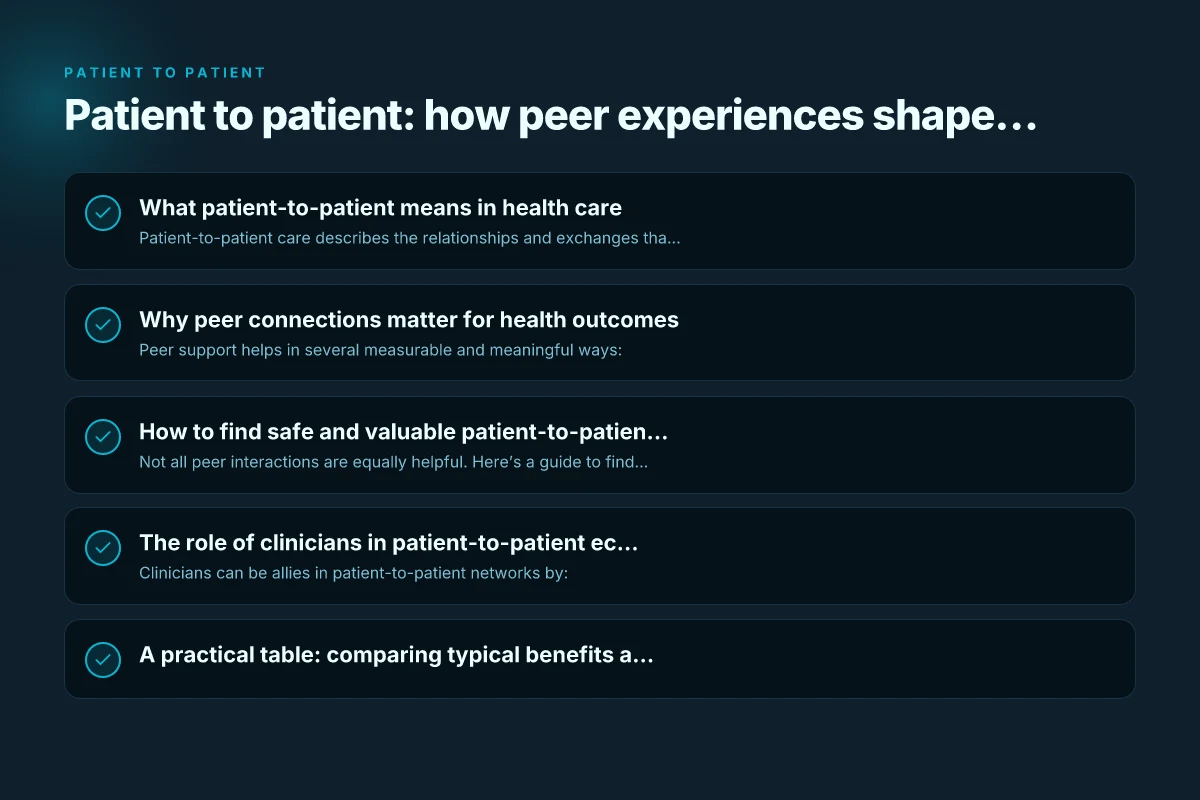
Why peer connections matter for health outcomes
Peer support helps in several measurable and meaningful ways:
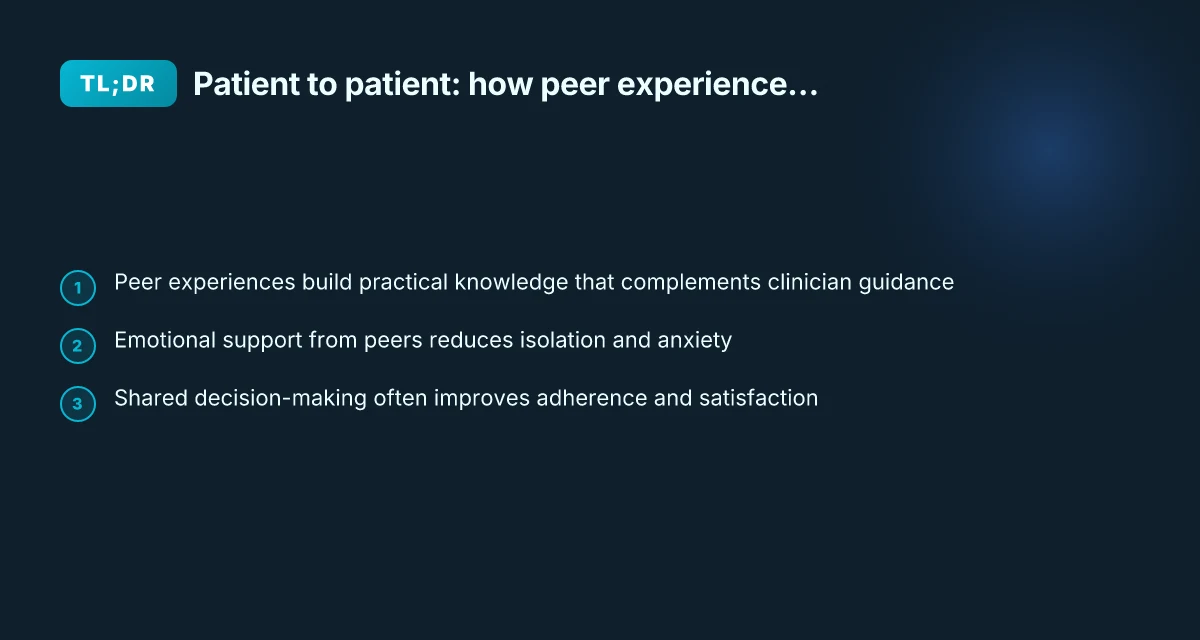
- Knowledge diffusion: Peers share tips on daily management, side effects, symptom tracking, and navigating health systems.
- Emotional resilience: Sharing fears and successes reduces isolation and normalizes the patient experience.
- Behavioral impact: Observing others’ routines can inspire better adherence to medications, diets, or exercise plans.
- Empowered decision-making: Access to diverse real-world experiences helps patients ask better questions and weigh options.
- Reduced burden on caregivers: Care partners can learn practical strategies, leading to smoother routines and less burnout.
Clinical research increasingly acknowledges the value of peer support as a complementary intervention. It does not replace professional medical advice. It often enhances engagement and satisfaction with care, which can translate into better health trajectories. Councelling: Understanding the Path to Better Mental Health and Support
How to find safe and valuable patient-to-patient connections
Not all peer interactions are equally helpful. Here’s a guide to finding high-quality, supportive connections:
- Start with reputable sources: Hospitals, patient advocacy groups, and accredited health organizations often host moderated forums and support groups.
- Look for facilitation and boundaries: Facilitated groups have trained moderators who guide discussions, maintain respect, and protect privacy.
- Check for confidentiality and consent: Ensure you understand how personal stories are shared and whether you can remain anonymous.
- Seek diversity of experience: A mix of ages, stages of disease, and treatment plans broadens perspectives and reduces bias.
- Be mindful of medical accuracy: Use peer insights as supplements, not substitutions, for professional advice. Cross-check medical facts with your clinician.
Ideas to engage:
- Join condition-specific patient communities to access targeted experiences.
- Attend caregiver support groups for practical tips on daily life and caregiving logistics.
- Volunteer as a peer mentor if you feel ready to help others.
The role of clinicians in patient-to-patient ecosystems
Clinicians can be allies in patient-to-patient networks by:
- Recommending credible groups and online communities that align with your condition and stage
- Encouraging patients to share goals and concerns encountered in peer settings during visits
- Addressing myths or misleading information encountered in peer discussions
- Coordinating with peer-support programs to integrate experiential knowledge with medical plans
- Providing education on how to assess the reliability of online sources
A collaborative approach ensures that patient-to-patient interactions support, rather than undermine, medical care. Clinicians can help translate peer insights into concrete, personalized steps. Patient support: empowering care through resources, empathy, and access
A practical table: comparing typical benefits and considerations of peer support methods
| Method | Typical Benefits | Considerations |
|---|---|---|
| Online forums | 24/7 access, diverse experiences | Varying quality of information; verify facts with professionals |
| In-person support groups | Structured discussions, real-time empathy | Scheduling, transportation, group dynamics |
| Peer mentoring | One-on-one guidance, personalized tips | Matching process; boundary setting |
| Caregiver networks | Shared strategies for daily life, respite options | Emotional load on caregivers; privacy concerns |
| Patient education events | Clear, actionable tips; expert-moderated Q&A | May be time-limited; ensure accuracy of content |
Evaluating benefits and considerations of peer support methods
| Benefit | In-person groups | Online forums | Peer navigation | Social media groups | Mentor programs | Telephone line |
|---|---|---|---|---|---|---|
| Emotional support | high | high | moderate | variable | high | moderate |
| Practical advice | high | high | high | variable | high | moderate |
| Information accuracy | variable | mixed | high | mixed | high | moderate |
| Accessibility (time/place) | moderate | high | moderate | high | moderate | high |
| Privacy risk | moderate | variable | low | high | low | low |
| Moderation/quality control | variable | variable | high | low | high | moderate |
Compiled November 2026; check the provider's site for current details.
How to determine if a peer story is helpful for you
When you hear someone’s experience, ask yourself:
- Is the situation similar to mine in key aspects (condition, treatment stage, life context)?
- What can I realistically apply from this story to my own plan?
- Does the person acknowledge uncertainties or limitations?
- Are there red flags, such as marketing bias, that I should be wary of?
- Have I consulted with my clinician about any ideas or changes I’m considering?
Guidelines for evaluating information: Cancer Research: Advancements, Methods, and Impacts
- Cross-check facts that affect safety, such as medication interactions or warning signs.
- Prioritize peer stories that emphasize practical strategies rather than unverified claims.
- Use peer experiences to inform questions you bring to your next medical appointment.
A short guide to safe participation in patient-to-patient spaces
- Protect your privacy: Use pseudonyms if you’re not comfortable sharing personal details.
- Set boundaries: Decide in advance what you’re willing to discuss and what you want to keep private.
- Practice critical thinking: Treat anecdotes as perspectives, not prescriptions.
- Report harmful content: If you encounter misinformation or harmful advice, flag it to moderators or seek professional input.
- Balance time and energy: Don’t overcommit to groups at the expense of self-care or medical appointments.
Criteria to decide which peer approach fits you
| Criterion | Description | High match examples | Low match examples | Indication you should choose differently |
|---|---|---|---|---|
| Time availability | How often you can participate | Flexible schedule | Very limited time | Choose asynchronous options |
| Privacy comfort | How private you need space to be | Anonymous forums | Public groups | Prefer one-on-one |
| Need for structure | Desire for guided goals | Peer navigation, mentor programs | Open forums | Seek formal program |
| Information reliability | Trust in information | Moderated groups, trained peers | Unmoderated forums | Social posts |
| Access barriers | Travel, cost, tech | Online, phone lines | In-person | In-person only |
Compiled November 2026; check the provider's site for current details.
Real-world stories: mixed experiences, common themes
People often come away with similar takeaways, even across different conditions:
- Feeling less alone: Knowing someone else has walked a similar path reduces fear.
- Practical tips: Small routines, like a daily pill reminder or a symptom diary, make a tangible difference.
- Hope and realism: Peers share both setbacks and breakthroughs, helping manage expectations.
- Empowered questions: Patients learn to ask clinicians about options they hadn’t considered.
- Boundary awareness: Healthy peer communities recognize when medical escalation is needed and encourage professional advice.
However, not all stories have perfect outcomes. Some people encounter information that conflicts with their treatment plan or creates anxiety. The key is to filter, verify, and always coordinate with healthcare providers. Support for patients
How to start a personal plan that integrates patient-to-patient input
- Define your goals: What do you want to learn or improve, symptom management, emotional support, decision-making?
- Choose your channels: Online communities for broad insights, in-person groups for closer connections, or a mix.
- Identify a reliable source: Look for groups with clear moderation, privacy policies, and factual content.
- Create a one-page plan: Include your current treatment, questions for your clinician, and a list of practical strategies you want to try.
- Schedule regular check-ins: With your clinician, your peer mentor, or within a group to share progress and recalibrate.
- Track outcomes: Note what works, what doesn’t, and any changes you make to your plan.
Final recommendation
Patient-to-patient support can be a powerful complement to professional care, offering practical know-how, emotional grounding, and a sense of community. To maximize benefits, curate your connections thoughtfully: prioritize credible, moderated, and supportive spaces. Integrate peer insights with medical guidance. And always consult your clinician before making major changes to treatment. If you’re unsure where to start, ask your healthcare team for recommendations on reputable groups and forums aligned with your condition and care goals. Engaging thoughtfully in patient-to-patient communities can enhance understanding, reduce isolation, and empower you to participate more actively in your health journey.