Cancer Research: Advancements, Methods, and Impacts
An in-depth look at cancer research: goals, methods, breakthroughs, and how findings translate to care.
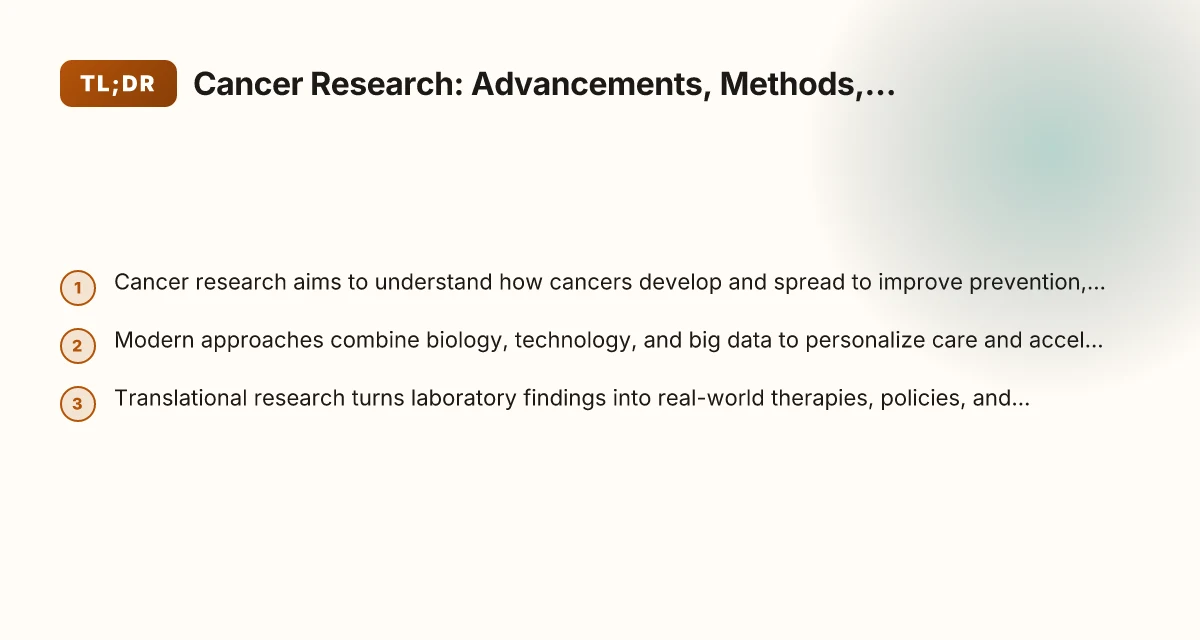
Cancer research is a dynamic field that blends biology, technology, and clinical insight to reduce suffering from one of humanity’s leading health challenges. From understanding genetic mutations to testing new therapies in patients, researchers aim to uncover how cancers start, grow, and evade treatment, then translate those insights into tangible improvements in prevention, diagnosis, and care. This article explores the landscape of cancer research, the methods scientists use, notable breakthroughs, and how findings reach patients.
Comparison of cancer research aims and outcomes
| Aim / Outcome | What it measures | Typical time frame | Key stakeholders | Example metrics | Notes |
|---|---|---|---|---|---|
| Understanding cancer initiation | Mechanisms of onset | Years | Researchers, funders | Genes/pathways identified | theoretical basis |
| Mechanisms of progression | Tumor growth and spread | Years to decades | Clinicians, patients | Growth rate, metastasis rate | requires models |
| Treatment efficacy | Response rates | Months to years | Clinicians, patients | ORR, PFS, OS | depends on trial design |
| Translational impact | Evidence from bench to bedside | Moderate | Clinicians, policy | FDA approvals, guidelines | long pipeline |
| Prevention insights | Risk reduction impact | Years | Public health, communities | Risk reduction %, incidence change | population-level |
Compiled November 2026; check the provider's site for current details.
What cancer research seeks to uncover
Cancer is a disease of abnormal cell growth driven by genetic and epigenetic changes, environmental exposures, and interactions with the body's immune system. Key questions researchers pursue include:
- What triggers the initial transformation of normal cells into cancer cells?
- How do cancer cells acquire the ability to invade tissues and spread (metastasize)?
- Why do some tumors respond to treatments while others resist?
- How can early detection improve survival rates?
- What are the most effective ways to tailor therapies to individual patients?
Addressing these questions requires a holistic view that spans the lab, the clinic, and population health. Researchers examine molecular pathways, tumor microenvironments, immune responses, and patient experiences to build a complete picture of cancer biology and care pathways.
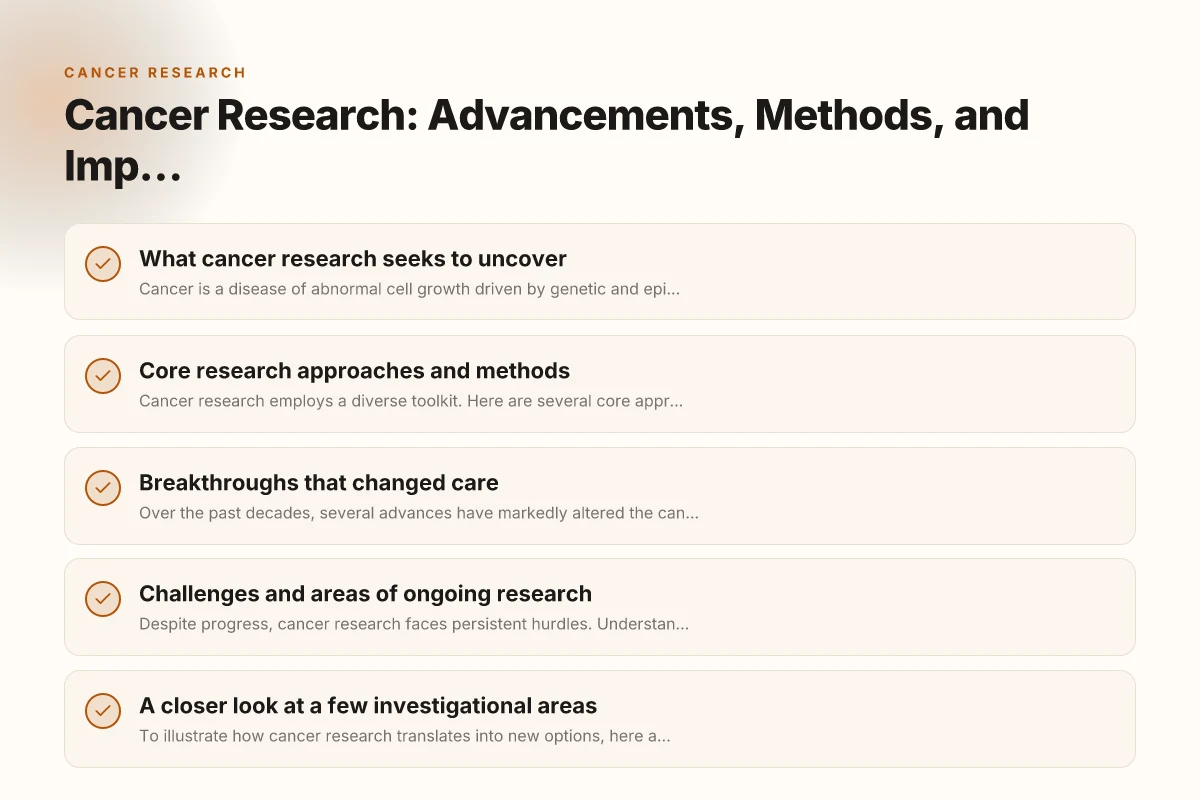
Core research approaches and methods
Cancer research employs a diverse toolkit. Here are several core approaches, with notes on what each contributes:
Molecular and cellular biology
- Gene sequencing and analysis reveal mutations driving cancer.
- Functional studies test how specific genes affect cell growth, death, and differentiation.
- Epigenetics explores how gene expression is regulated beyond DNA sequence.
- Model systems, including cell lines and organoids, simulate tumor behavior in controlled settings.
Genomics and precision medicine
- Next-generation sequencing identifies driver mutations and guides targeted therapy choices.
- Liquid biopsies monitor circulating tumor DNA to detect cancer and track treatment response.
- Multiplex assays profile tumors to capture heterogeneity and evolution over time.
Immunology and immunotherapy
- Research on how tumors evade immune detection informs therapies that unleash the immune system.
- Checkpoint inhibitors, CAR-T cells, and cancer vaccines represent major evolutions in treatment design.
- Studies on the tumor microenvironment examine how immune cells, stroma, and vasculature influence outcomes.
Preclinical models and translational science
- Animal models test safety and efficacy before human trials.
- Patient-derived xenografts preserve tumor characteristics for testing.
- Organoids recreate tumor architecture, enabling drug screening in a human-relevant context.
Epidemiology and public health
- Population studies identify risk factors, screening strategies, and disparities in outcomes.
- Big data and biobanks enable associations between lifestyle factors and cancer risk.
- Health policy research translates findings into screening guidelines and access improvements.
Technology and data science
- High-throughput screening accelerates the evaluation of thousands of compounds.
- Artificial intelligence aids image analysis, pattern recognition, and discovery of new targets.
- Digital pathology and standardized data sharing promote reproducibility and collaboration.
Core research approaches and methods comparison Support for patients
| Method / Approach | Purpose | Typical data type | Strengths | Limitations | Examples |
|---|---|---|---|---|---|
| Genomic sequencing | Identify mutations | DNA data | High specificity | Cost, interpretation | TCGA-like studies |
| Molecular profiling | Characterize tumors | omics data | Personalized signals | Complex data | IHC, RNA-seq |
| Preclinical models | Study mechanisms | Cells, animals | Controlled tests | Translation gaps | Xenografts, organoids |
| Clinical trials | Test therapies | Patient data | Causal insight | Enrollment limits | RCTs, basket trials |
| Epidemiologic studies | Population risk | Population data | Public health impact | Confounding | Cohort, case-control |
Compiled November 2026; check the provider's site for current details.
Breakthroughs that changed care
Over the past decades, several advances have markedly altered the cancer landscape. This section highlights a few that illustrate the trajectory from discovery to patient benefit.
- Targeted therapies: Drugs designed to inhibit specific molecular drivers, such as EGFR or ALK mutations, have transformed certain cancers from chronic to manageable conditions for many patients.
- Immunotherapy: Treatments that harness the immune system, like checkpoint inhibitors, have produced durable responses in melanoma, lung cancer, and other diseases, changing the prognosis for some advanced cancers.
- Precision medicine: Sequencing tumors to guide choices in chemotherapy, targeted therapy, or immunotherapy personalizes care and reduces unnecessary toxicity.
- Early detection and screening: Improved imaging, biomarker tests, and population screening programs catch cancers earlier when treatment is more successful.
- Liquid biopsy: Detecting tumor-derived DNA in blood provides a less invasive option for monitoring disease, tracking mutations, and spotting recurrence.
- Combination strategies: Integrating therapies that attack cancer on multiple fronts (e.g., targeted therapy + immunotherapy) helps overcome resistance mechanisms.
Challenges and areas of ongoing research
Despite progress, cancer research faces persistent hurdles. Understanding and addressing these challenges helps prioritize future efforts:
- Heterogeneity: Tumors vary within a patient and over time, complicating diagnosis and treatment.
- Resistance: Cancers adapt to therapies, necessitating new targets or combination regimens.
- Toxicity and quality of life: Balancing effectiveness with side effects remains essential, especially for long-term survivors.
- Accessibility and equity: Disparities in screening, diagnosis, and treatment access affect outcomes globally.
- Data integration: Combining genomic, clinical, and imaging data requires standards, interoperability, and robust privacy protections.
Researchers tackle these issues through collaborative networks, standardized protocols, and patient-centered study designs that emphasize real-world impact. Research Projects: A Practical Guide to Planning, Managing, and Sharing
A closer look at a few investigational areas
To illustrate how cancer research translates into new options, here are short examples of active fields:
- Tumor microenvironment modulation: Studying how non-cancer cells within tumors influence growth and response to therapy opens avenues to make treatments more effective.
- Minimal residual disease (MRD): Sensitive tests aim to detect tiny amounts of cancer after treatment, guiding decisions about additional therapy or surveillance.
- Epigenetic therapies: Drugs that modify epigenetic marks can reprogram cancer cells to a less aggressive state or restore sensitivity to other treatments.
- Synthetic lethality: Exploiting specific genetic dependencies in cancer cells to selectively kill them while sparing normal cells.
- Cancer prevention: Research into vaccines (e.g., HPV) and lifestyle interventions aims to reduce cancer incidence in populations.
Breakthroughs that changed care vs. ongoing challenges
| Breakthrough / Change | Impact on care | Evidence level | Current challenges | Next steps | Example area |
|---|---|---|---|---|---|
| Targeted therapy success | Better tumor control | High | Resistance | Combination strategies | HER2, EGFR inhibitors |
| Immunotherapy revolution | Durable responses | High | Autoimmune risks | Biomarkers | Checkpoint inhibitors |
| Liquid biopsy concept | Less invasive monitoring | Moderate | Sensitivity limits | Standardization | ctDNA detection |
| Precision medicine adoption | Tailored treatments | Moderate | Access disparities | Reimbursement | Genomic-guided therapy |
| Early detection advances | Earlier stage diagnosis | Moderate | Screening uptake | Cost-effective tests | Low-dose CT, biomarkers |
Compiled November 2026; check the provider's site for current details.
A comparison: how research translates to patient care
| Stage | Purpose | Examples |
|---|---|---|
| Basic science | Understand mechanisms of cancer initiation and progression | Gene function studies, signaling pathway mapping, tumor biology |
| Translational research | Bridge lab findings to clinical applications | Preclinical models, biomarker development, early-phase trials |
| Clinical trials | Test safety and efficacy in people | Phase I/II/III trials, randomized designs, adaptive trials |
| Implementation | Integrate discoveries into standard care | Guidelines, clinician education, health policy, access programs |
This table shows the flow from curiosity-driven science to real-world care. Each stage builds on the previous, with feedback loops that refine hypotheses based on patient outcomes and practical constraints. Cancer Registration Scheme
How research informs practice and policy
Cancer research informs care in several essential ways:
- Treatment personalization: Sequencing tumors and using biomarkers tailor therapies, aiming for higher response rates with fewer side effects.
- Surveillance and follow-up: Data on recurrence patterns guide monitoring schedules and long-term survivorship plans.
- Screening and early detection: Population studies determine who should be screened and how often, balancing benefits with potential harms.
- Access and equity: Research highlights where gaps exist in care, guiding programs to reduce disparities.
- Cost and value considerations: Health economics research helps determine which therapies provide meaningful benefit relative to their cost.
Patients, clinicians, researchers, funders, and policymakers all play roles in moving discoveries from bench to bedside. Collaboration accelerates progress, while transparent reporting and patient engagement ensure that research serves those most affected.
A closer look at investigational areas vs. patient impact
| Investigational area | Stage of research | Potential patient impact | Accessibility once approved | Evidence strength | Time to clinic |
|---|---|---|---|---|---|
| CAR-T and cell therapies | Early to mid-stage | High potential for some cancers | Limited by cost | Varies by cancer | Years |
| CRISPR-based interventions | Exploratory | Long-term potential | Uncertain | Preclinical | Many years |
| Tumor microenvironment targets | Investigational | Improved response rates | Moderate | Early-phase | Several years |
| Prophylactic vaccines | Early | Prevention potential | Broad if approved | Conceptual | Long horizon |
| Nanomedicine delivery | Experimental | Enhanced targeting | Limited | Early | Several years |
Compiled November 2026; check the provider's site for current details. Publications: A Practical Guide to Understanding and Using Them
The practical side: joining the fight against cancer
If you’re curious about how to engage with cancer research beyond reading, here are practical paths:
- Support and donate: Contribute to reputable cancer research organizations that fund scientists and clinical trials.
- Participate in trials: Talk to your clinician about whether any trials may be suitable for you or a loved one.
- Volunteer for biobanks or studies: Some programs collect data and samples to advance understanding of cancer risk and treatment.
- Stay informed: Follow credible sources for updates on breakthroughs, clinical guidelines, and patient resources.
- Advocate for access: Support policies that expand screening, reduce costs, and improve equitable care.
A short final section: the recommendation
Cancer research is a comprehensive, evolving enterprise that seeks to reduce incidence, improve early detection, and expand effective treatments. For anyone touched by cancer, patients, caregivers, clinicians, or researchers, the recommendation is clear: stay curious, stay engaged, and seek trustworthy information. If you’re a patient, discuss personalized options with your care team, including participation in appropriate clinical trials. If you’re a supporter or policymaker, advocate for data sharing, equitable access, and investment in high-impact areas like early detection and immunotherapy. The collective effort of scientists, clinicians, and communities continues to push the boundaries of what’s possible, turning discovery into improved survival and quality of life for more people every day.