Request: How to Make Clear and Effective Requests That Get Results

Learn practical strategies to make requests clearly, respectfully, and with better success rates.
Making a request well is a skill that can unlock faster cooperation, better outcomes, and stronger relationships. Whether you’re asking a colleague for help, a service provider for a change, or a customer for a decision, the way you frame and deliver your request matters as much as the content of what you’re asking for. This guide walks you through practical steps to craft requests that are clear, respectful, and persuasive, so you can move things forward with less back-and-forth and fewer misunderstandings.
Comparison of Request Clarity Levels (vague to explicit)
| Aspect | Vague | Somewhat Clear | Clear | Very Clear | Ultra Clear | Notes |
|---|---|---|---|---|---|---|
| Audience awareness | Low | Moderate | High | Very high | Explicit | |
| Objective stated | Unclear | Partially stated | Clear | Specific | Quantified | |
| Context provided | Minimal | Some | Enough | Thorough | Comprehensive | |
| Action requested | Ambiguous | Implied | Explicit | Direct | Precise | |
| Expected outcome | Unstated | Hoped | Desired | Measurable | Committed | |
| Tone framing | Neutral | Polite | Respectful | Firm | Assertive |
Compiled November 2026; check the provider's site for current details.
What makes a good request
A good request is specific, actionable, and respectful of the other person’s time and constraints. It should answer five core questions:
- What do you want? State the exact outcome you’re seeking.
- By when? Set a clear deadline or timeframe.
- Why now? Provide a brief rationale to motivate action.
- What do you need from them? Identify responsibilities, information, or resources.
- What happens next? Explain the next steps or consequences of success or delay.
When you can answer these questions upfront, you reduce ambiguity and set both parties up for success.
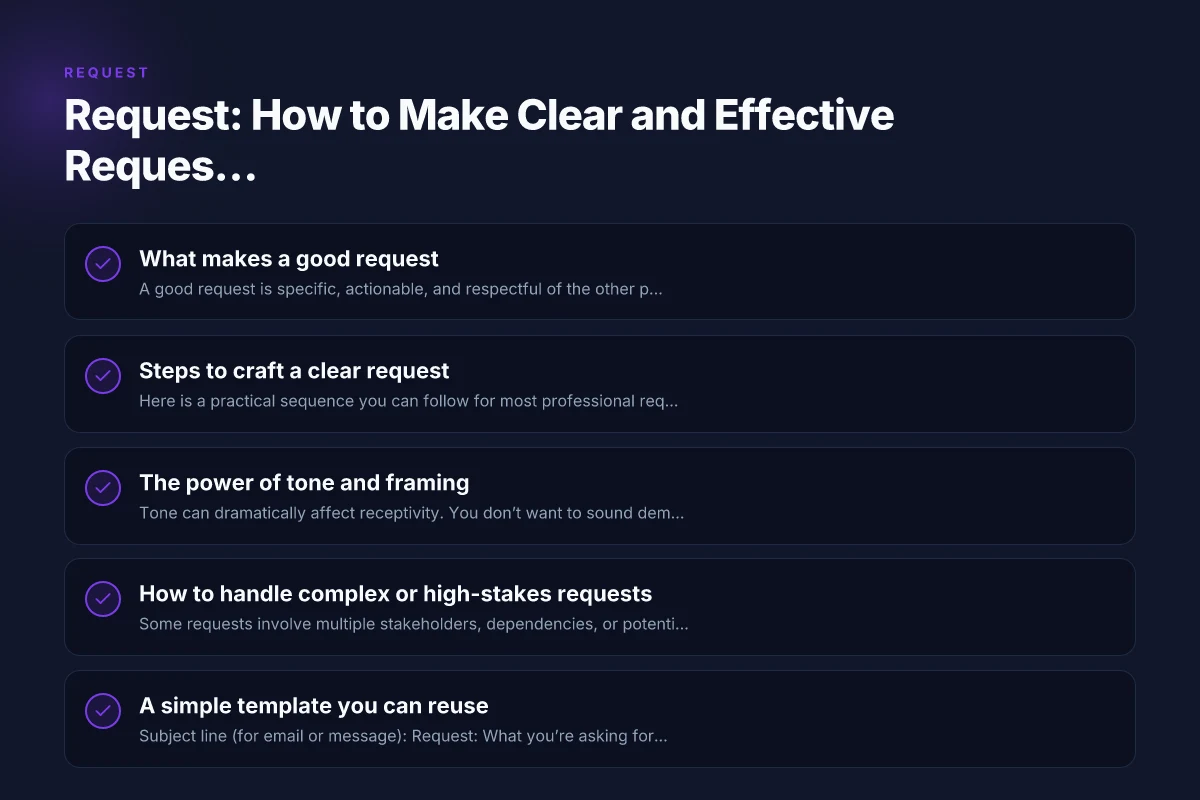
Steps to craft a clear request
Here is a practical sequence you can follow for most professional requests:
- Start with the outcome
- Use explicit language: “I’d like you to …” rather than “If you have time, could you…”
- Name the desired end state: “I need the report by Friday noon that summarizes Q3 results and includes the updated forecast.”
- Add a concrete deadline
- Give a specific date and time when possible: “by Friday, May 3 at 12:00 PM.”
- If a hard deadline isn’t possible, provide a target window and explain why: “by end of day Friday. If not, please give me a heads-up by Thursday.”
- Explain the rationale
- Briefly connect the request to a goal, project, or constraint: “This helps the team finalize the budget before the leadership meeting.”
- Define the required contributions
- List what you need from them in bullet form: documents, approvals, or actions.
- Be explicit about what you will do and what you expect them to do: “I’ll send you the template. You’ll fill in the numbers and return them to me.”
- Outline next steps
- Describe what happens after the request is fulfilled: “I’ll circulate the draft for review by the group, and we’ll discuss in Friday’s stand-up.”
- Mention contingencies: “If you anticipate a delay, please let me know as soon as possible.”
The power of tone and framing
Tone can dramatically affect receptivity. You don’t want to sound demanding or entitled, but you also don’t want to be vague. Aim for a respectful, collaborative tone that emphasizes shared goals and mutual benefit. A few practical tone tips: Education and Training: A Practical Guide to Lifelong Learning and Skill Development
- Use “we” language to signal partnership: “We’re aiming to complete this by Friday so the team can proceed.”
- Frame requests as options rather than ultimatums: “Would you be able to provide the figures by Thursday? If not, what’s a workable alternative?”
- Show appreciation for their time: “I know you’re juggling a lot, so I appreciate your help with this.”
How to handle complex or high-stakes requests
Some requests involve multiple stakeholders, dependencies, or potential risks. In these cases, structure helps and empathy matters even more:
- Break the request into chunks: “Here are three parts: 1) data, 2) narrative, 3) visuals. Please confirm if you can deliver each by the dates below.”
- Identify stakeholders early: “If you’re not the right person, could you point me to who handles this?”
- Offer mutual benefits: “If you can complete this by Friday, it allows us to publish on schedule and keeps our customers informed.”
Steps to Craft a Clear Request (compare approach options)
| Step | Option A: Quick draft | Option B: Full context | Option C: Stakeholder alignment | Option D: Final polish | Practical tip |
|---|---|---|---|---|---|
| 1. Define objective | Brief | Clear | Aligned | Confirmed | Write one sentence |
| 2. Identify audience | Assumed | Know who | Include roles | Confirmed | List names |
| 3. State outcome | Hoped | Specific | Measurable | Committed | Use numbers |
| 4. Provide context | Minimal | Relevant | Necessary | Thorough | Ask: what matters? |
| 5. Specify action | Implicit | Explicit | Direct | Precise | Use verbs |
| 6. Set timeline | As needed | Clear deadlines | Firm deadlines | Finalized | Add buffer |
Compiled November 2026; check the provider's site for current details.
A simple template you can reuse
- Subject line (for email or message): Request: [What you’re asking for] by [Deadline]
- Greeting: Hello [Name],
- Opening line: I’m writing to request [clear outcome].
- Details (bullets):
- What you need: [specific task or information]
- By when: [deadline]
- Why it’s needed: [brief rationale]
- Any constraints: [budget, format, etc.]
- Next steps: Once you’ve completed this, I will [what happens next].
- Closing: Thank you for your time and help.
- Sign-off: Best regards, [Your Name]
This template helps you maintain consistency while adapting to different contexts. Fundraising: A Practical Guide to Planning, Launching, and Growing Your Campaign
Common pitfalls to avoid
- Vague asks: “Could you do this soon?” leaves people guessing about what “soon” means.
- Overloading with information: Too many details can overwhelm. Pare down to the essentials.
- Apologizing excessively: It can undermine authority and clarity. Be concise and respectful instead.
- Failing to define success: Without a clear outcome, you won’t know if the request was fulfilled.
- Not acknowledging constraints: If you ignore the other person’s workload, you’ll breed resentment or delays.
A quick comparison: sending a vague request vs. a clear request
| Aspect | Vague request | Clear request |
|---|---|---|
| Outcome stated | “Could you help with something when you can?” | “Please draft the Q3 sales summary by Friday 12 PM.” |
| Deadline | Implied or undefined | Specific date/time |
| Rationale | Not provided | “So we can finalize the budget” |
| Required actions | Open-ended | Bullet points with exact steps |
| Next steps | Not specified | Clear follow-up plan and owner |
This table highlights how clarity reduces back-and-forth and speeds up decision-making.
Tone and Framing Options for High-Impact Requests
| Scenario | Passive framing | Neutral framing | Respectful framing | Firm framing | Assertive framing | Best practice |
|---|---|---|---|---|---|---|
| Internal team ask | If possible | Please | Could you | I need | You must | Start with respect, end with accountability |
| Client request | Hopeful | Kindly | Please, thank you | We require | This must be | Balance politeness with clear needs |
| Stakeholder escalation | Potential | It would help | We request | We demand | This has to | Align with outcomes, avoid blame |
| Urgent change | Possibly | At your convenience | Could you prioritize | Expedite now | This is critical | Tie to impact and deadlines |
Compiled November 2026; check the provider's site for current details.
How to follow up effectively
Even with a well-crafted initial request, follow-up matters. Do it with courtesy and purpose: Ulster Cancer Foundation: Support, Research, and Hope for Northern Ireland
- Send a brief reminder if the deadline passes: “Just a quick check-in on the Q3 report. Is there anything you need from me to complete it?”
- Confirm receipt and feasibility: “Can you confirm you have everything you need and whether the deadline is still workable?”
- Record the outcome: Once the request is fulfilled, acknowledge completion and thank the person. This reinforces positive behavior and helps future interactions.
When to escalate or reframe
If a request is repeatedly ignored or delayed, you may need to:
- Reframe the ask: Clarify the impact and adjust expectations or deadlines.
- Involve a stakeholder: Bring in a supervisor or manager if the decision-maker is unavailable.
- Offer solutions: Propose alternatives that might be more feasible or efficient.
Practical examples across contexts
- coworker asking for input on a project: “Could you review the project plan and provide feedback on the scope and timeline by Wednesday 3 PM? I’ll incorporate your notes and share a revised version Thursday morning.”
- vendor requesting a change to a service contract: “We’d like to amend the SLA to reflect 24/7 support for critical incidents. Please confirm if this can be activated by June 15, and share any pricing implications.”
- manager requesting time for a one-on-one: “I’d like to schedule a 30-minute check-in this Friday to discuss your workload and any blockers. Does 2:00 PM work for you?”
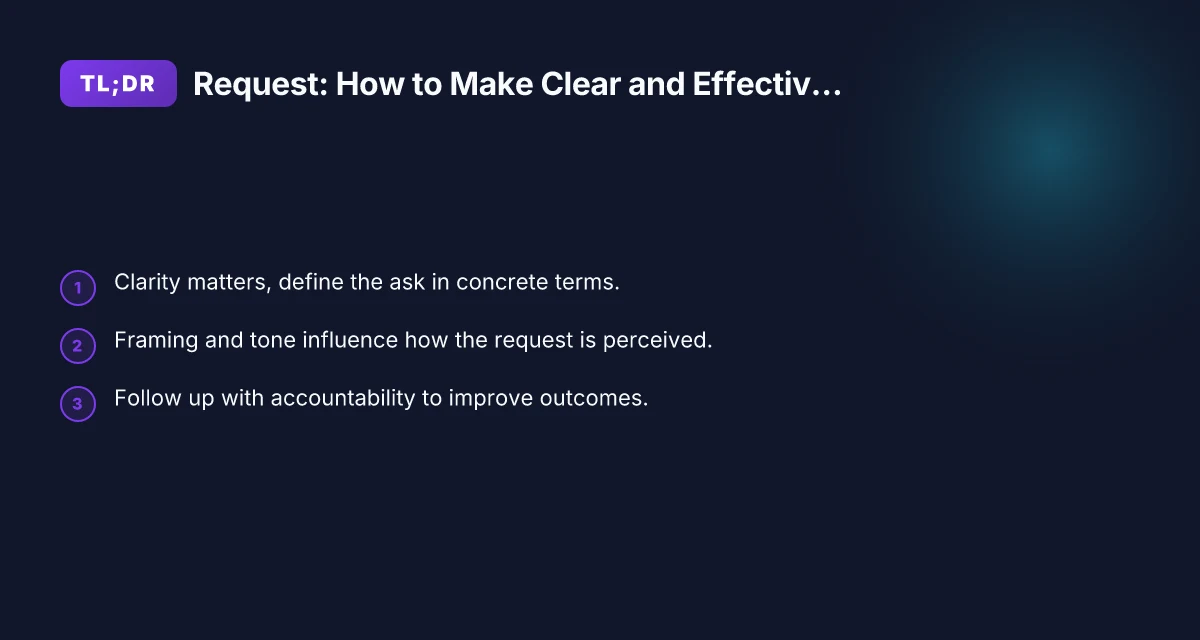
The bottom line: start with clarity, lead with respect, and seal with accountability
Requests that are clear, specific, and timely have a higher probability of getting answered, acted upon, and integrated smoothly into workflows. By starting with a precise outcome, setting a concrete deadline, explaining the rationale, outlining the required contributions, and describing the next steps, you reduce friction and increase your chances of a positive result. Pair that with a respectful tone and a simple follow-up routine, and you’ll build stronger collaboration habits that pay off across projects, teams, and relationships.
Recommendation Make a habit of drafting requests using a simple 4-step micro-template:
- State the exact outcome.
- Set a concrete deadline.
- Briefly explain the rationale.
- List required actions and confirm next steps. Practice this with everyday requests and you’ll see faster responses and clearer commitments.